Showing posts with label autism. Show all posts

Saturday, September 15, 2018

ARE ENVIRONMENTAL TOXINS DAMAGING BABIES' BRAINS?

According to the Centers for Disease Control, the incidence of neurodevelopmental disorders--any of a number of brain-related problems such as attention deficit, hyperactivity or autism--increased by 17 percent between 1997 and 2008. Attention deficit hyperactivity disorder (ADHD) rose by 33 percent, while autism exploded by an astonishing 289 percent during that period.

Most strikingly, autism has continued to rise. In 2008, about one US child out of 125 was diagnosed on the autistic spectrum, while by 2018, it was one out of 59, including one out of every 42 boys.

There's still debate about whether these dramatic increases are real, or are caused by increased awareness, more access to care or changing diagnostic criteria. Those may all be factors, but it seems unlikely that they can explain a tripling in the documented incidence of autism in such as short time.

A small but growing body of research suggests that the risk of autism or other neuro-developmental disorders is increased by exposure to pesticides or other persistent organic pollutants (POPs), which may disrupt crucial steps in brain development. We all carry numerous POPS in our bodies, and they have been shown to cause a wide range of metabolic abnormalities. Given the complexity and delicacy of fetal development, and especially the development of the brain, it would not be surprising to find that these ubiquitous pollutants are at least part of the story.

Some recent research with tadpoles may shed light on this question. Although humans and frogs may seem very distantly related, both are vertebrates (animals with backbones) and share many developmental steps and basic brain features. 

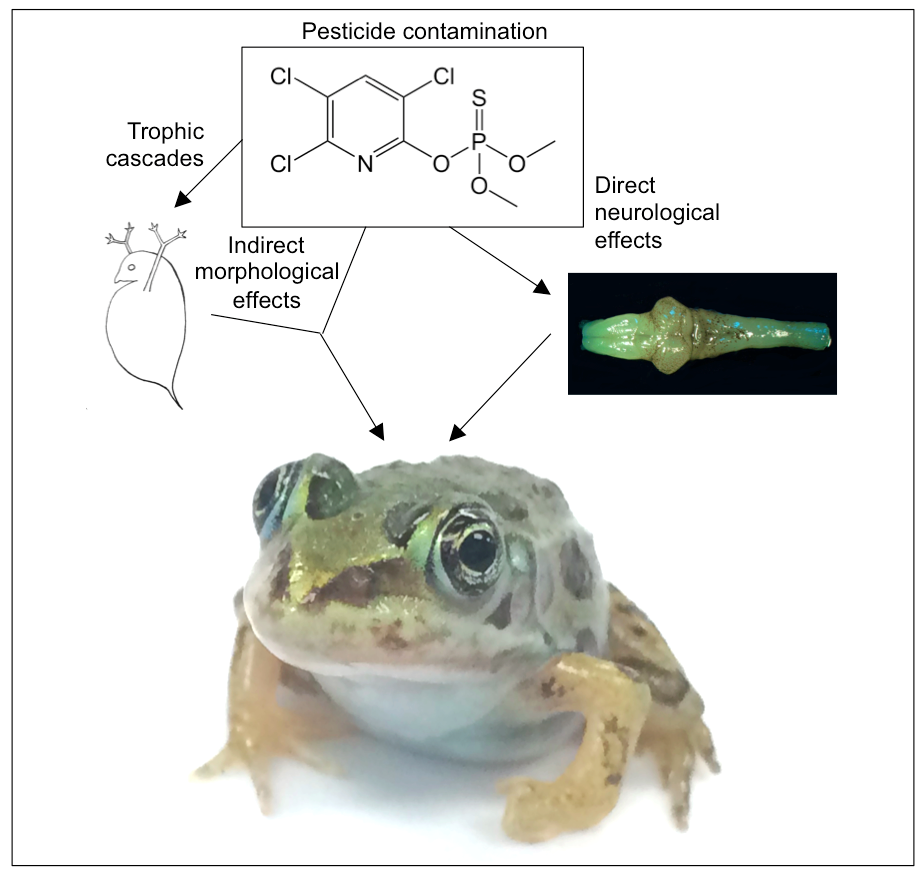
Sara McClelland, a biologist at Duquesne University in Pittsburgh, Pennsylvania, and her colleagues studied the impact of very low doses--1 millionth of a gram per liter of water--of the commonly-used pesticide chlorpyrifos on the brains and bodies of the tadpoles of northern leopard frogs. 

As they reported in the journal Environmental Toxicology and Chemistry, exposure to chlorpyrifos caused significant changes to the tadpoles' brains. Three brain areas were impacted, areas important to vision, hearing, breathing and motor control. Those changes turned out to be independent of the pesticide's effect on the tiny animals the tadpole's feed on.

 "Innocuous" pesticide dose directly impacts vertebrate brain development
Credit: McClelland et al., Environmental Toxicology and Chemistry

"This study demonstrates that exposure to very low, presumably innocuous levels of organophosphorous pesticides can alter neurodevelopment in amphibians," says McClellnd. "Due to developmental similarities in vertebrates, this work may have implications for how exposure to low doses of organophosphorous pesticides could affect human neurodevelopment."

Given that chlorpyrifos is just one of dozens or hundreds of toxins that we are exposed to, more research on their human impacts is urgently needed. As epidemiologist Miguel Porta points out, "Whatever we know, whatever we think we know about the adverse health effects of a given chemical compound, and about the adverse health effects of several different compounds, simply think that it will not be uncommon for them to be--each and all--present at high concentrations in a significant minority of your patients, constituency, citizens, family or friends. And then think about the plausible negative health effects of the combination or 'cocktail' at high and low concentrations."

-----

You can find a link to the Environmental Toxicology and Chemistry study here.

And a recent study linking a "cocktail" of pollutants to impaired fetal growth at this URL.

And click here for another recent study on the impact of toxic cocktails on brain development.

-----

If you enjoyed this post, please subscribe to follow or receive email alerts from zerospinzone.blogspot.com.


Friday, August 17, 2018

LINK BETWEEN AUTISM AND LONG-BANNED INSECTICIDE DDT

Remember DDT? It's an insecticide that was banned worldwide for most uses more than 30 years ago, but which lingers in the environment and in our bodies to this day. In its heyday, DDT was sprayed massively over farms, forests and cities to control mosquitoes and other insects. I remember as a child swimming in an outdoor pool as a plane flew overhead spraying DDT over the entire city. People accepted it as normal.

We're just now finding out that there's a possible link between DDT and autism, a severe, often disabling developmental disorder estimated to impact more than 25 million people worldwide, and 15 children out of ever thousand in the US (one out of every 42 boys!). Autistic children have difficulties with communication and relating to people, and often repeat certain movements or behaviors such as rocking over and over again.

 Autistic child and his mother
Credit: istock

A long-term study involving over one million mothers and children in Finland found that high levels of DDE--a breakdown product of DDT that ends up in the fatty tissues of animals and humans--in the blood of pregnant women doubled the risk of a child developing autism with intellectual disability. This link remained strong even after controlling for factors such as the mother's age and psychiatric history.

DDT is one of many Persistent Organic Pollutants (POPs), potentially toxic man-made chemical compounds that accumulate in soil, water and air, in the foodchain and in our bodies. Other research has shown that 10 percent of us have high concentrations of 10 or more POPs in our blood, and that high concentrations of POPs in the body are associated with a variety of metabolic abnormalities, including those leading to metabolic syndrome, diabetes and heart disease.

The current research is the first to reveal a link to autism. The authors suspect that DDT and its metabolite DDE may trigger autism because they lead to lower birthweight infants, and by interfering with the proper functioning of androgens, hormones necessary for the development of male characteristics.

"Unfortunately," says Alan Brown, an epidemiologist at Columbia University Medical Center,  "[these chemicals] are still present in the environment and are in our blood and tissues. In pregnant women, they are passed along to the developing fetus. Along with genetic and other environmental factors, our findings suggest that prenatal exposure to the DDT toxin may be a trigger for autism."

Clearly, homing in on the environmental causes of autism can help us find ways to reduce the high and still increasing incidence of this extremely disruptive condition.

-----
If you liked this post, please sign up to follow or receive email notifications from zerospinzone.


Thursday, January 11, 2018

AN INFECTIOUS IDEA -- A VIRUS-LIKE PROTEIN MAY BE CRUCIAL TO LEARNING AND MEMORY

We've all heard the phrase, "an infectious idea." It turns out that this may not just be a metaphor--new research has revealed that a virus-like protein in all of our brains may be vital for learning and memory.

"If it looks like a duck and quacks like a duck," the saying goes, "it probably is a duck." So, no matter how surprising it is, finding a crucial protein in the brain that looks like a virus and acts like a virus raises the intriguing possibility that our ability to learn and remember may stem from a chance infection of some ancestral four-legged creature by a retrovirus 350 to 400 million years ago.

The protein in question is called Arc. It's found in animals as different as flies, mice and humans. It's been known for some time that Arc is important for learning and memory. Mice lacking Arc forget what they've learned within 24 hours, and lack the kind of brain plasticity that lets young animals, most notably human children, soak up new information quickly and easily. Arc continues to be important for learning and memory throughout life, and impaired Arc functioning is associated with autism, amnesia and Alzheimer's disease.

Arc (long purple proteins inside the perimeter of the vesicle) can encapsulate and deliver its own genetic material to brain cells (light green branching blobs) in a manner similar to the way in which viruses infect host cells.  
Credit: Jacobo Lopez, Yi-Chu Su, Hugo Vaca

Jason Shepherd, a neuroscientist at the University of Utah, and his colleagues first suspected that something was different about Arc when they found that the protein self-assembles into structures called capsids that look like a lunar lander or the HIV retrovirus. Intrigued, they found that not only can the Arc capsid jump from cell to cell like a virus, it also transfers its own genetic material in the form of messenger RNA into the new cell.

Learning takes place when interconnected brain cells are activated at the same time. Intriguingly, the researchers found that when neurons "infected" by Arc are activated, they release newly minted Arc capsids. This suggests that the transfer of this virus-lilke protein from cell to cell may be a previously unknown and unsuspected mechanism for learning and memory.

Neuron expressing Arc and transferring it to other neurons
Credit: Elissa Pastuzyn 

“We went into this line of research knowing that Arc was special in many ways," says the study’s lead author, postdoctoral fellow Elissa Pastuzyn. "But when we discovered that Arc was able to mediate cell-to-cell transport of RNA, we were floored. No other non-viral protein that we know of acts in this way.”

Geneticists have been able to trace back the history of the Arc proteins found in all mammals. Sometime between 350 and 400 million years ago, a primitive four-limbed creature, or tetrapod, was infected by a retrovirus that left some of its genetic material in the animal's DNA. That chance addition to the mammalian genetic code has apparently proven extremely useful, perhaps laying the groundwork for the success of our mammalian ancestors, and even for our remarkable capacity for learning and remembering.

REA
-----

You can read more about this research at this URL.

The scientific article describing this research can be found in Cell, January 11, 2018.

-----

If you enjoyed this post, please sign up to follow or receive email alerts from zerospinzone.blogspot.com.


Wednesday, June 07, 2017

MRI SCANS REVEAL AUTISTIC BRAIN DIFFERENCES AT SIX MONTHS OF AGE

Although symptoms of autism don't usually appear until a child's second year, and most autistic children aren't diagnosed until they are three or older, recent research shows that the brains of 6-month-old infants who will go on to develop autism already differ from those of normal infants.

These findings may lead to earlier diagnosis and more effective treatment for children who are at risk of developing autism.

They also provide more evidence, if that's still needed, that autism is not caused by childhood vaccinations. As Robert Emerson, the study's lead author points out, "If these differences are already present at six months of age, they would represent a biological foundation for autism that is in place before several vaccines on the CDC schedule that are administered after six months of age, including the Measles, Mumps, Rubella (MMR) inoculation, which is typically given at one year."

A child showing autistic symptoms

Emerson and colleagues at the University of North Carolina at Chapel Hill used functional magnetic resonance imaging (fMRI) while children slept to track brain size, growth and connectivity in 59 infants who were at high risk for autism because they had autistic older siblings. Twenty percent of them could be expected to develop autism, compared to 1.5 percent of children without autistic siblings.

They found a variety of differences between the brains of infants who went on to develop autism and those who didn't.

In keeping with earlier research, those infants who eventually showed autistic symptoms had a faster rate of growth in brain volume and brain surface area between six months and two years of age

The researchers then used advanced artificial intelligence techniques to differentiate between the brains of those infants who did or did not develop autism. Machine-learning programs trained themselves on the brain scans, and were eventually able to identify correctly 82 percent of the children--9 of 11--who would become autistic and 100 percent of those who developed normally.

This very high rate of discrimination was based on nearly 1000 "functional correlations"--how separate regions of the brain connect and work together--that differed between infants who were on autistic versus normal developmental paths.

Schematics representing brain scan signatures at six months that predicted later autism diagnosis in infants. Red bars indicate weaker connections in autistic infant brains, blue bars stronger connections.
[Credit: R.W. Emerson et al., Science Translational Medicine (2017)]

The authors caution that these are preliminary results using state-of-the-art technology, so further research and the development of simpler and less expensive brain-scanning techniques are needed before they can be applied clinically. 

"If future studies confirm these results, detecting brain differences may enable physicians to diagnose and treat autism earlier than they do today," says Diana Bianchi, M.D., Director or the National Institute of Child Health and Development (NICHD).

According to the Centers for Disease Control (CDC), one child out of every 68 in the US will be diagnosed with autism. The earlier that those children can be correctly diagnosed and start to receive treatment--while the brain is most malleable--the better their outcomes.

You can find a summary of an earlier Nature article about this research here, and a link to the abstract of the current study, in Science Translational Medicine, at this URL.

---------

If you enjoyed this post, please subscribe or sign up for email alerts (above right) and let your friends know about zerospinzone.blogspot.com.


Tuesday, October 18, 2016

IN U.S. EXPOSURE TO HORMONE DISRUPTING CHEMICALS COSTS HUNDREDS OF BILLIONS PER YEAR

Following up on my recent post "Ten Percent of US have high concentrations of ten or more toxins in our blood,", here's a new study that calculates the costs to the U.S. economy from the burden of disease that some of those chemicals cause.


Plastic bottles--one of many sources 
of endocrine-disrupting chemicals
Credit: Velka/Shutterstock (public domain)

Writing in The Lancet Diabetes and Endocrinology, October 17, researchers at the New York University Medical Center say that even a conservative estimate of the diseases and conditions--including birth defects, autism, attention-deficit disorder, intellectual disability, infertility, obesity, diabetes, heart disease and stroke--caused by exposure to these toxins puts their cost to the economy at $340 billion. That's 2.3 percent of the U.S. Gross Domestic Product (GDP).

Flame retardants alone (found in building insulation, fabrics, furniture and electronics) account for more than $200 billion of those health-related costs.

The researchers say this is the first assessment of the overall costs to the U.S. economy from the buildup of endocrine-disrupting substances in the population.

The major sources of these chemicals include plastic bottles, the lining of metal food cans, detergents, flame retardants, toys, pesticides and cosmetics. These pervasive chemicals build up in our bodies over time. They can impair fetal development in the womb, especially the brain and nervous system, and lead to a variety of diseases in adults.

These chemicals are pervasive and extremely difficult to avoid. To address the problem at the policy level, the authors call for more proactive testing and tighter regulation, starting with the Environmental Protection Agency (EPA). They point out that people living in Europe, where these substances are more strongly regulated, have less exposure, lower levels in the bodies and blood, and reduced risk of disability and disease.

At the personal level, they recommend steps such as not microwaving food in plastic containers or covered by plastic wrap, avoiding containers with the number 3, 6 or 7 on the bottom, which contain phthalates and using fragrance free or "all natural" cosmetics.

You can find more ways to minimize your and your family's exposure to endocrine disrupting chemicals here.

This may seem a daunting or even impossible task, given how ubiquitous these chemicals have become. However, new research shows that avoiding common sources of endocrine disrupting chemicals can quickly reduce levels in the body