
 Posts


New research in mice has shown for the first time that it's possible to stop the formation of amyloid plaques--one of the key pathological features of Alzheimer's disease--and for the brain to clear them away entirely. This line of research has the potential to lead to medications that can slow, stop, or perhaps even reverse the ravages of this dread, mind-destroying disease.

As many people know through personal experience with friends or family members, Alzheimer's is an implacably progressive neurodegenerative disease that robs individuals of their memory, cognitive functions, ability to care for themselves, personalities and, eventually, their lives. It's currently the sixth leading cause of death in the U.S. and, strikingly, ". . . is the only disease in the 10 leading causes of deaths in the United States that cannot be cured, prevented or slowed."
A new study, however, opens up the possibility that Alzheimer's may in fact one day be slowed or prevented, if not cured. Working with mice genetically modified to develop Alzheimer's disease, neuroscientist Riqiang Yan* and his colleagues at the Cleveland Clinic-Lerner Research Institute in Cleveland, Ohio, found that gradually reducing an enzyme called BACE1 blocked the development of amyloid plaques, which are a central part of Alzheimer's pathology.
Although their study was complex and highly technical, the logic behind it is clear. BACE1 is one of two enzymes that snip amyloid precursor protein, or APP, into the shorter pieces that glom together into the plaques that are thought to disrupt and eventually kill neurons. Since BACE1 has important biological functions, removing it early in life or completely creates serious neuro-developmental problems. Still, the researchers reasoned, reducing it gradually in adult mice might slow or stop Alzheimer's without causing unacceptable side effects. That's exactly what they found.
TK
TK
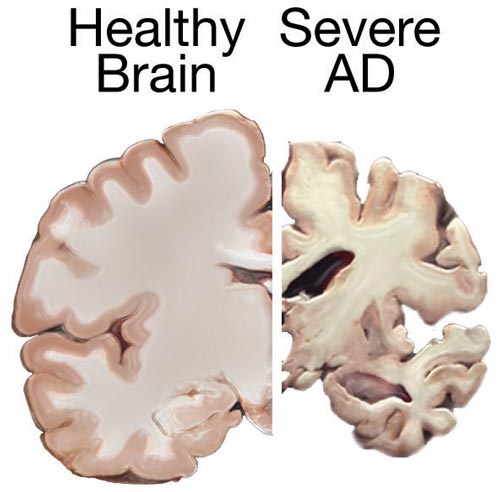
Comparison of a healthy brain and a brain with severe Alzheimer's disease
Credit: Wikimedia
As many people know through personal experience with friends or family members, Alzheimer's is an implacably progressive neurodegenerative disease that robs individuals of their memory, cognitive functions, ability to care for themselves, personalities and, eventually, their lives. It's currently the sixth leading cause of death in the U.S. and, strikingly, ". . . is the only disease in the 10 leading causes of deaths in the United States that cannot be cured, prevented or slowed."
A new study, however, opens up the possibility that Alzheimer's may in fact one day be slowed or prevented, if not cured. Working with mice genetically modified to develop Alzheimer's disease, neuroscientist Riqiang Yan* and his colleagues at the Cleveland Clinic-Lerner Research Institute in Cleveland, Ohio, found that gradually reducing an enzyme called BACE1 blocked the development of amyloid plaques, which are a central part of Alzheimer's pathology.
Although their study was complex and highly technical, the logic behind it is clear. BACE1 is one of two enzymes that snip amyloid precursor protein, or APP, into the shorter pieces that glom together into the plaques that are thought to disrupt and eventually kill neurons. Since BACE1 has important biological functions, removing it early in life or completely creates serious neuro-developmental problems. Still, the researchers reasoned, reducing it gradually in adult mice might slow or stop Alzheimer's without causing unacceptable side effects. That's exactly what they found.
"In our study," says Yan, " we showed that if we delete BACE1 in the adult mice, even after plaque
formed, with sequential and increased deletion of BACE1 the plaque was removed. That
indicates that if we can get to a patient early enough, it will be
beneficial in removing amyloid plaque."
Yan was not surprised to see that lowered levels of BACE1 slowed or stopped the formation of new plaques. He was both surprised and excited to find already existing plaques cleared away--the first time that this has been seen. "To
our knowledge," he says, "this is the first observation of such a dramatic
reversal of amyloid deposition in any study of Alzheimer’s disease mouse
models. We didn't expect the pre-existing
plaque would be removed. That was the very interesting part, and
warrants additional study to find out why."
While completely blocking BACE1 causes developmental and cognitive problems, a gradual lowering in adult mice appeared appeared safer. Those mice performed better on learning and memory tasks than untreated Alzheimer's prone mice. However, they still showed some abnormalities in synaptic signalling. Despite this problem, Yan thinks that compounds can be developed that, when applied at the right time and at the right dose, will slow or stop the development of plaques, allow the brain to clear away existing ones, and so keep Alzheimer's at bay.
Prevention is more powerful than treatment
Prevention is more powerful than treatment
Yan compares this to the enormously successful use of statins to control cholesterol levels enough to block the development of atherosclerosis and heart disease, even though cholesterol has vital functions in the body. "The critical thing
is will this lead to some safe drugs?" he asks. "We need to find something very safe like a vitamin that people can take every day
without any concerns. Another similarity is to the statins,
taking statins to prevent cholesterol from building up. The idea is
that prevention is even more powerful that treatment."
The next step for Yan and colleagues is to track the effects of reduced BACE1 on the mouse brain in more detail and on older mice. "Human patients are typically older
than in the mouse model," he explains. "In the mouse model we started to delete [BACE1] at 4
months, which is like 20 years old for people. We now want to delete it in older
mice. We need a new mouse model for this later stage."
Robert Vassar is a professor of neurology at Northwestern University, in Illinois, and a pioneer in the study of the role of BACE1 in Alzheimer's disease. He's very supportive of Yan's new findings, and, like Yan, thinks they hold significant promise for Alzheimer's prevention. Vassar too likes the analogy with statins and cardiovascular disease. "You can't turn off the tap of cholesterol, but you can turn it
down enough to not accumulate the plaques in the heart that cause
heart disease," he says. "It's saved the lives of many people. The BACE1
inhibitors can do the same, if we find the right dose and the right
stage of the disease--how much to inhibit and when to treat."
Vassar and Yan are both aware that years of further research with animals and humans are needed to turn these promising findings into a safe and effective preventative treatment for people. They foresee a long road, but one that urgently needs to be followed. "We have to bold
about this disease," says Vassar. "We're headed for an epidemic of this with the
baby boomers, so we've got to do something."
As a baby boomer myself, I couldn't agree more!
-----
You can access Yan and his colleagues' full research paper here.
-----
*Professor Yan is currently Chair of the Department of Neuroscience and William Beecher Scoville Professor in Neuroscience at the University of Connecticut, in Farmington, Connecticut.
-----
*Professor Yan is currently Chair of the Department of Neuroscience and William Beecher Scoville Professor in Neuroscience at the University of Connecticut, in Farmington, Connecticut.
-----
If you enjoyed this post, please sign up to follow or receive email alerts from zerospinzone.
-----
TK
TK


