Sunday, September 30, 2018

US AT ESPECIALLY HIGH RISK FROM UNCHECKED CARBON EMISSIONS

How much economic damage does a ton of carbon pumped into the atmosphere really do? That's the question an international team of climate scientists and economists set out to answer on a country-by-country basis. While previous studies have suggested that poor countries are more vulnerable to climate change, these new results reveal the opposite--a large and complex economy like that of the US magnifies the impacts of a destabilized climate. It turns out that the US is especially vulnerable.

Some of the most obvious impacts to the US of a changing climate 
Credit: Union of Concerned Scientists/NOAA

"It makes a lot of sense because the larger your economy is, the more you have to lose," says Kate Ricke, the study's lead author of the recent Nature Climate Change article. "Still, it's surprising just how consistently the U.S. is one of the biggest losers, even when compared to other large economies." 

Other countries who will take major hits due to climate change include India, China and Saudi Arabia.

Ricke and her colleagues estimate that current levels of carbon emissions are already costing the US economy around $250 billion per year. That's nearly $2000 per US household. Even more worrisome, they point out, climate change doesn't just hit us on a year-by-year basis, it's likely to take an increasing  chunk out of America's economic rate of growth. Like a ballooning interest rate on a mortgage, the costs don't just add up, they multiply.

When the researchers take this cumulative economic erosion into account, their estimates of the long-term impact of unchecked global warming and resulting climate change are up to ten times greater than current mainstream estimates, for example those of the US government.

The authors emphasize that these higher estimates of the economic costs of "business as usual" make it clear that it's in the selfish best interest of countries like the US with highly developed economies to take steps--such as a carbon tax--that would actually match the real-world costs and help rein in global warming and climate destabilization.

In an invited commentaryFrances Moore, an environmental economist at the University of California, Davis, writes: 

"In other words, based on just their own self-interest, these countries should be acting unilaterally to dramatically cut GHG emissions. The fact that we do not see this yet suggests that damages are overestimated or costs are underestimated, that countries have not yet recognized the risk posed by climate change, or that sub-national political constituencies have been able to effectively block ambitious mitigation policies that would otherwise be in their national interest."

To those obstructionist political constituencies including, it appears, the entire Republican Party and our current president, this should be a clarion call to do what Kevin Conrad, representing Papua New Guinea, told the United States delegation to the Bali climate conference in 2008--"lead, follow, or get out of the way."




Saturday, September 29, 2018

WHO NEEDS SCIENCE? CERTAINLY NOT TRUMP'S EPA.

The Environmental Protection Agency (EPA) was created in 1970 with the mandate to enforce national environmental protection standards, and to conduct research on pollution in order to strengthen environmental protection and guide policy-making.


 Andrew Wheeler
the smiling face of the new EPA

To coordinate these efforts, the EPA created the Office of Science Advisor. Here's how the EPA's website describes the Science Advisor's role as of 9/28/18:

The Science Advisor works across the Agency to ensure that the highest quality science is better integrated into the Agency's policies and decisions. In this capacity, the Science Advisor leads the OSA and chairs the Agency's Science and Technology Policy Council which reviews selected science issues that have implications across program and regional offices. The mission of the OSA is to provide leadership and serve as an honest broker for cross-Agency science, science policy, and technology issues.

But not for long. The EPA is planning to delete the Office of Science Advisor, ostensibly to "eliminate redundancies" and "combine offices with similar functions." The scientist who has filled the post since 1981, Dr. Jennifer Orme-Zavaleta, is an expert on the effects of chemicals and other risk factors on human and environmental health. Apparently, her expertise is no longer needed at the EPA.

Neither is that of Dr. Ruth Etzel, the head of the Office of Chilren's Health. Dr. Etzel, a specialist in children's diseases and a strong advocate for protecting children from pollutants, was placed on administrative leave, stripped of her ID, email and access to the building, and sent packing.

It's more evidence, if needed, that Trump's EPA, currently headed by Andrew Wheeler, a lawyer and former coal lobbyist, is not all that interested in the kind of inconvenient facts once provided by Drs. Etzel and Orme-Zavaleta. Protecting people and the environment has been pushed to the rear, while deregulating polluting industries has been ushered to the front. The new EPA can now freely focus on Trump's promise to advance the cause of "beautiful, clean coal."*

-----

* That beautiful clean coal produces lots of toxic waste, including neurotoxic mercury. Now the EPA is going to make it easier for polluters to put that into the air you and your children breathe, and the water you drink.

Not to mention radiation. If you believe that a little ionizing radiation is good for you, then today's EPA is the place for you, as they also work to justify reducing radiation protection rules.

And you can now include particulates and ozone; the advisory boards dealing with both of these pollutants are being gutted or disbanded.

You can read more about these anti-science and anti-citizen steps here.

This just in (11/4/18): The EPA's website will no longer discuss climate change. I guess that for Trump's EPA, climate has nothing to do with protecting the environment.

-----

If you enjoyed this post, please sign up to follow or receive email alerts from zerospinzone.

Saturday, September 15, 2018

ARE ENVIRONMENTAL TOXINS DAMAGING BABIES' BRAINS?

According to the Centers for Disease Control, the incidence of neurodevelopmental disorders--any of a number of brain-related problems such as attention deficit, hyperactivity or autism--increased by 17 percent between 1997 and 2008. Attention deficit hyperactivity disorder (ADHD) rose by 33 percent, while autism exploded by an astonishing 289 percent during that period.

Most strikingly, autism has continued to rise. In 2008, about one US child out of 125 was diagnosed on the autistic spectrum, while by 2018, it was one out of 59, including one out of every 42 boys.

There's still debate about whether these dramatic increases are real, or are caused by increased awareness, more access to care or changing diagnostic criteria. Those may all be factors, but it seems unlikely that they can explain a tripling in the documented incidence of autism in such as short time.

A small but growing body of research suggests that the risk of autism or other neuro-developmental disorders is increased by exposure to pesticides or other persistent organic pollutants (POPs), which may disrupt crucial steps in brain development. We all carry numerous POPS in our bodies, and they have been shown to cause a wide range of metabolic abnormalities. Given the complexity and delicacy of fetal development, and especially the development of the brain, it would not be surprising to find that these ubiquitous pollutants are at least part of the story.

Some recent research with tadpoles may shed light on this question. Although humans and frogs may seem very distantly related, both are vertebrates (animals with backbones) and share many developmental steps and basic brain features. 

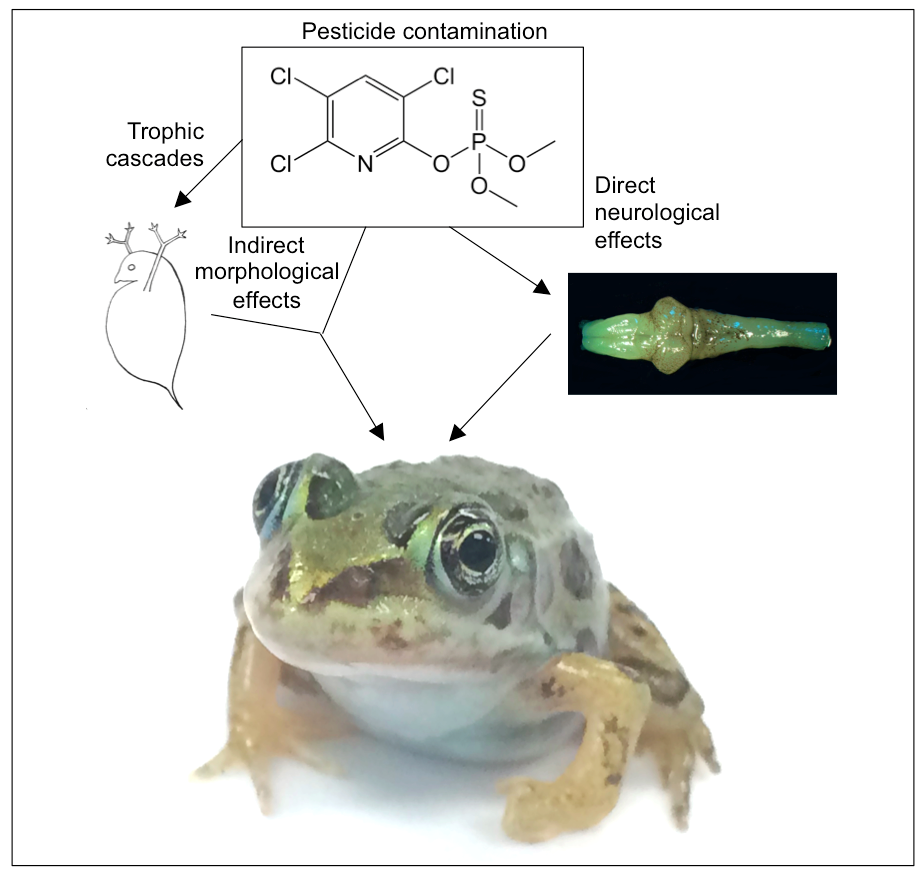
Sara McClelland, a biologist at Duquesne University in Pittsburgh, Pennsylvania, and her colleagues studied the impact of very low doses--1 millionth of a gram per liter of water--of the commonly-used pesticide chlorpyrifos on the brains and bodies of the tadpoles of northern leopard frogs. 

As they reported in the journal Environmental Toxicology and Chemistry, exposure to chlorpyrifos caused significant changes to the tadpoles' brains. Three brain areas were impacted, areas important to vision, hearing, breathing and motor control. Those changes turned out to be independent of the pesticide's effect on the tiny animals the tadpole's feed on.

 "Innocuous" pesticide dose directly impacts vertebrate brain development
Credit: McClelland et al., Environmental Toxicology and Chemistry

"This study demonstrates that exposure to very low, presumably innocuous levels of organophosphorous pesticides can alter neurodevelopment in amphibians," says McClellnd. "Due to developmental similarities in vertebrates, this work may have implications for how exposure to low doses of organophosphorous pesticides could affect human neurodevelopment."

Given that chlorpyrifos is just one of dozens or hundreds of toxins that we are exposed to, more research on their human impacts is urgently needed. As epidemiologist Miguel Porta points out, "Whatever we know, whatever we think we know about the adverse health effects of a given chemical compound, and about the adverse health effects of several different compounds, simply think that it will not be uncommon for them to be--each and all--present at high concentrations in a significant minority of your patients, constituency, citizens, family or friends. And then think about the plausible negative health effects of the combination or 'cocktail' at high and low concentrations."

-----

You can find a link to the Environmental Toxicology and Chemistry study here.

And a recent study linking a "cocktail" of pollutants to impaired fetal growth at this URL.

And click here for another recent study on the impact of toxic cocktails on brain development.

-----

If you enjoyed this post, please subscribe to follow or receive email alerts from zerospinzone.blogspot.com.


Thursday, August 30, 2018

CALIFORNIA POWERS AHEAD IN THE FIGHT AGAINST CLIMATE CHANGE

We need all the good news we can find these days, and California has just handed us a climate-change bouquet.

On August 28, 2018, the legislature passed a bill that requires 100 percent carbon-free electricity in the state by 2045. This massive change in the way power is produced in or imported to California will keep 70 million metric tons of greenhouse gases from being spewed into the atmosphere every year, equivalent to taking 12 million cars off the road.


California Wind Farm
a rapidly growing source of clean power
Credit: Creative Commons Zero; Max Pixel


If Governor Brown signs the bill into law, as expected, California will become the largest economy in the world to commit to 100% carbon neutral electricity before mid-century. (Yes! Governor Brown signed the bill into law on September 10, 2018).

Of course, much more than this is needed for the world to meet the goals of the Paris Climate Agreement and keep global temperatures no more than 1.5 or at most 2.0 degrees C (2.7/3.6 degrees F) above pre-industrial levels. Still, it's a giant step in the right direction, and one that we hope many more states, cities, countries, companies and industries will follow--and the sooner the better.

----------

You can find the text of California Senate Bill 100 here.

Friday, August 24, 2018

SCIENTISTS CAN NOW LINK WEATHER EXTREMES TO CLIMATE CHANGE

Climatologists have traditionally been leery of linking a specific event--an extended drought, an exceptional run of hurricanes, massive flooding--to climate change. The most they could be coaxed to say was something along the lines that climate change might have increased the odds of the extreme event, often with a comparison to rolling loaded dice or to an athlete on steroids.

Recently, however, some researchers have started to be more specific. For example, Frederika Otto, a climate scientist at Oxford University, and her colleagues recently reported that South Africa's three-year mega-drought, during which Cape Town came nerve-wrackingly close to running out of water, was demonstrably three times as likely as it would have been without human-caused climate change.

This new capability goes beyond just pinning down the increased odds of an extreme event. In three cases recently, researchers have felt confident enough to say that certain events simply could not have happened without human climate forcing. These included devastating heatwaves in Asia in 2016, the global heat record set the same year, and shockingly high sea temperatures in the Gulf of Alaska and the Bering Sea between 2014 and 2016. 

A review of 170 similar attribution studies between 2004 and 2018 found that two-thirds of the extreme weather events studied were more likely or more intense because of human caused climate forcing.

 South Africa's Theewaterskloof Reservoir, nearly empty on March 11, 2018
Credit: Zaian

So the question is, what's changed? Why are climate scientists now able to make such specific attributions of the impacts of human-caused climate change?

In principle, the answer is remarkably simple. Researchers use multiple state-of-the-art computerized climate models to run thousands of simulations with slightly different initial conditions. Some of the simulations run with current levels of greenhouse gas levels while others use pre-industrial levels. The researchers can then see how many times a comparable event shows up in each scenario. A drought as long and intense as the one that drained Cape Town's reservoirs to the brink of catastrophe happened three times more often under current atmospheric greenhouse gas levels than in models using pre-industrial levels.

In practice, it's a bit more challenging. The multiple computer simulations that are needed are costly and need a lot of time even on the fastest supercomputers. Otto and her colleagues got around this by tapping into weather@home, a network of thousands of volunteers who offer up time on their computer to help perform these massive calculations. In addition, current climate models are not fine-grained enough to model smaller events, such as a crop-destroying hailstorm or an outburst of tornadoes.

Still, scientists now have what it takes to specify to what extent many extreme events, such as a drought, massive flooding or a killer heat wave, can reliably be attributed to human-caused climate change. We can expect much more frequent, accurate and meaningful reports of this kind in the near future.

These attribution studies are not likely to convince dyed-in-the-wool climate change deniers, but they are already proving helpful to planners at all levels. For example, Helen Davies, with the Western Cape's Department of Economic Development and Tourism, now knows that the devastating drought was not a once-in-a-lifetime event. "This is an incredibly strong message which we cannot afford to ignore. We may need to work on a radically new approach to water management."

Otto hopes that this approach will soon be fast and accurate enough to be linked to extreme weather events in real time. Germany may become one of the first countries to do this on a regular basis. 'It’s part of our mission to illuminate the links between climate and weather,” says Paul Becker, Vice President of the German Weather Agency. “There is demand for that information, there is science to provide it, and we are happy to spread it.”

One example of real-time attribution is the assessment by scientists at the Lawrence Berkeley National Laboratory that Hurricane Florence is 50 miles wider and will inundate the Atlantic Coast with 50 percent more rain than a comparable hurricane before human-caused climate change.

And a new study using the supercomputers at the Lawrence Berkeley National Laboratory was able to detail the additional rainfall provoked by global warming in 15 hurricanes that took place in the last ten years, and predict even more rainfall and more intense winds if warming continues.

Let's hope that the entrenched climate change denial on the part of the current US president and congress does not keep this important emerging science from being used here at home.

---------------

The Nature article from which most of this information comes can be found here.

The article summarizing 170 different studies, including a useful interactive map, can be found at this URL.

------------

If you enjoyed this post, please sign up to follow or to receive email alerts from zerospinzone.


Friday, August 17, 2018

LINK BETWEEN AUTISM AND LONG-BANNED INSECTICIDE DDT

Remember DDT? It's an insecticide that was banned worldwide for most uses more than 30 years ago, but which lingers in the environment and in our bodies to this day. In its heyday, DDT was sprayed massively over farms, forests and cities to control mosquitoes and other insects. I remember as a child swimming in an outdoor pool as a plane flew overhead spraying DDT over the entire city. People accepted it as normal.

We're just now finding out that there's a possible link between DDT and autism, a severe, often disabling developmental disorder estimated to impact more than 25 million people worldwide, and 15 children out of ever thousand in the US (one out of every 42 boys!). Autistic children have difficulties with communication and relating to people, and often repeat certain movements or behaviors such as rocking over and over again.

 Autistic child and his mother
Credit: istock

A long-term study involving over one million mothers and children in Finland found that high levels of DDE--a breakdown product of DDT that ends up in the fatty tissues of animals and humans--in the blood of pregnant women doubled the risk of a child developing autism with intellectual disability. This link remained strong even after controlling for factors such as the mother's age and psychiatric history.

DDT is one of many Persistent Organic Pollutants (POPs), potentially toxic man-made chemical compounds that accumulate in soil, water and air, in the foodchain and in our bodies. Other research has shown that 10 percent of us have high concentrations of 10 or more POPs in our blood, and that high concentrations of POPs in the body are associated with a variety of metabolic abnormalities, including those leading to metabolic syndrome, diabetes and heart disease.

The current research is the first to reveal a link to autism. The authors suspect that DDT and its metabolite DDE may trigger autism because they lead to lower birthweight infants, and by interfering with the proper functioning of androgens, hormones necessary for the development of male characteristics.

"Unfortunately," says Alan Brown, an epidemiologist at Columbia University Medical Center,  "[these chemicals] are still present in the environment and are in our blood and tissues. In pregnant women, they are passed along to the developing fetus. Along with genetic and other environmental factors, our findings suggest that prenatal exposure to the DDT toxin may be a trigger for autism."

Clearly, homing in on the environmental causes of autism can help us find ways to reduce the high and still increasing incidence of this extremely disruptive condition.

-----
If you liked this post, please sign up to follow or receive email notifications from zerospinzone.


Wednesday, August 01, 2018

WILL CLIMATE-CHANGE DENIERS LEARN FROM PERSONAL EXPERIENCE?

Having followed and written about climate change and the science behind it for decades, I've also had to think a lot about climate-change denial. I've come to realize, ruefully, that science, starting with the most basic physics and including the most powerful supercomputer based climate models, has failed to convince many people who, for one reason or another, are wedded to climate-change denial. Neither have appeals to the health and safety of future generations, nor to the plight of the increasing millions of people whose lives are currently being disrupted by climate change (many of whom become the refugees and migrants whom many climate-change deniers fear).

Credit: INICIWEB

Through all that I've clung to the idea that when climate change comes home, as it inevitably will, when residents of Florida find their homes flooded because of rising sea levels, when Midwest corn farmers lose ten percent of their crop to extreme heat, when Texas see-saws between drought and floods, or when, as happened to my home town of Santa Rosa, California last year, wildfire sweeps through like a blowtorch, it can no longer be denied. Surely, I've thought, first-hand, life-changing personal experience will break through those layers of denial.

But I'm starting to realize that my faith in personal experience to slap people awake, like my earlier faith in the persuasive effect of science and empathy, is simply naive.

What brought this home to me was an article in the Guardian based on interviews with people who have been impacted by the deadly Northern California Carr fire, which happened to hit a staunchly conservative, Republican, Trump-supporting and climate-change-denying area. The Guardian reporter had no trouble finding people, from politicians to men and women on the street, whose ideas were unchanged even in the midst of the smoke and embers of this deadly fire. "It's bull," said one respondent. And even the one respondent who accepted that climate change was real clung to the meme that we humans are too puny to deal with it, leaving how to fix the problem in the hands of "the good Lord."

There's more evidence in a Guardian story speaking to residents of North Carolina in the aftermath of Hurricane Florence, which climate scientists tell us was 50 miles wider and dropped 50 percent more rain than it would have under pre-industrial conditions. Once again, the reporter found plenty of people still in full climate-change-denial mode.

Scholars who study the history of science often point out that for a new paradigm such as plate tectonics or quantum dynamics to replace an older set of ideas, the old guard simply have to be replaced by a new generation. If scientists, who after all are committed to experiment, hard data and putting every idea to the test, are unwilling or unable to let go of outmoded ways of thinking, I suppose I shouldn't be surprised if everyday people also refuse to learn, even if the lesson is right in front of their eyes.

 Perhaps young people will see more clearly than their elders
Credit: TAKVER

There's still room for hope, if younger generations realize that climate change is real, dangerous, and, can only be dealt with through concerted action. Perhaps Greta Thunberg can be the role model. She's a 15-year-old Swedish girl who is staying out of school and sitting in front of the Swedish Parliament to bring the urgency of the climate crisis home to her elders. Given the feeble steps we've managed to take to date, young people like her may be our last, best hope.

REA
-------------

Here's a related story involving people who have become committed to the idea that vaccination is some kind of dangerous, evil-minded plot. This couple almost lost their six-year-old son to tetanus, a terrible and potentially deadly disease to which most of us are immune because we've been inoculated against it. Doctors were able to save the boy's life, but only through radical interventions and weeks of intensive care, which racked up a bill of over $800,000. Despite this horrifying experience, the parents refused further vaccinations. It used to be said that there's no force on Earth more powerful than an idea whose time has come. Maybe we need to modify that to reflect that, for many people, there's no force on Earth more powerful than an idea that perfectly matches their preconceived view of the world.

-----

If you enjoyed this post, please sign up to follow or receive email alerts from zerospinzone.

-----


Tuesday, July 31, 2018

CALIFORNIA'S ECONOMY BOOMS WHILE ITS CARBON FOOTPRINT SHRINKS

As reported in Grist earlier this month, California's carbon emissions are down to the levels they were way back in the 1990s, while at the same time its economic productivity has soared. According to the state's Air Resources Board, “California now produces twice as many goods and services for the same amount of greenhouse gas emissions as the rest of the nation."

California windfarm--part of the state's energy success story
Credit: Creative Commons Zero--CC0 

If one believes economists and politicians who, like Donald Trump, are still pushing coal or other greenhouse-gas-spewing energy sources, California, which is leading the nation in the transition to renewable energy, should be failing. For those still interested in facts, nothing could be further from the truth. California's per capita greenhouse gas emissions are roughly one-half the US average, yet it produces twice as many goods and services for every unit of energy use.

Kudos to California for leading the way. However, there's still lots of room for improvement. Transportation still relies far too heavily on fossil fuels, and accounts for 41 percent of California's carbon emissions. To tackle this, the state has plans in place to multiply the number of electric vehicles on California's roads 12 times within the next 12 years.

If the state has the same success with that plan as it has had on its overall carbon emissions, it's likely to beat that deadline and still lead the country in terms of economic productivity, not to mention improved quality of life.

What are the rest of the states waiting for?

REA

------------
If you enjoyed this post, please subscribe to or sign up to receive email alerts from zerospinzone.

-----

Monday, July 30, 2018

TRUMP'S WALL--A MONUMENT TO HATE AND FEAR

Whether it's based on politics, racism or both, Donald Trump is placing a huge bet on immigration, an issue he's weaponized to energize his base.  On Sunday, he tweeted, "I would be willing to 'shut down' government if the Democrats do not give us the votes for Border Security, which includes the Wall!"

As we know, Trump hates to back down, and reflexively doubles down instead. So it's not surprising that after having to back away from his, Attorney General Sessions and Homeland Security Secretary Nielsen's disastrous, immoral and indefensible family separation debacle, Trump is now doubling down with this renewed threat to shut down the government if Congress doesn't authorize and fund his Great Wall.

From sea to shining sea
Border wall meets the Pacific Ocean
Credit: © Tomas Castelazo, www.tomascastelazo.com / Wikimedia Commons 

No matter how most of us react to him, Trump is a master at stirring up his faithful followers. I'm sure he's thrilled that his tweet garnered 120 thousand likes within the first 24 hours.

"The United States will not be a migrant camp," he declaimed in June of this year, "and it will not be a refugee holding facility. It won't be. You look at what's happening in Europe, you look at what's happening in other places, we can't allow that to happen to the United States, not on my watch."

Given that Trump has previously referred to migrants as pouring in and infesting our country, his current tweet just builds on a foundation of fear and hate that he has been building for years (we can date it back at least as far as Trump's pushing the so-called Obama birther conspiracy starting in 2011).

Back in September, 2016, two months before the election, I posted a comment on a poll that showed that two thirds of Trump supporters were "extremely enthusiastic" about voting for him, while fewer than half of Hillary supporters were similarly enthused. The polling company commented, presciently as we all now know, that " . . . turnout in a close election will likely decide the winner of the race."

Three months from now, Americans will be voting for 35 of their senators, all of their representatives and the governors of 36 states. Who wins may well determine Trump's political future, the makeup of the Supreme Court for decades to come, and the direction America will take on immigration, womens' rights, workers' rights, climate and the environment, and crucial international issues such as trade, nuclear arms, war and peace.

Again, many of those races will be close, and turnout will likely decide the winners.

We can count on Trump keeping his core supporters--roughly 41 percent of voters--riled up and eager to go to the polls to protect the US from those invading armies of dangerous immigrants, or from the Democrats, who after all are the immigrants' dangerous supporters, or from the press--America's "biggest enemy," or from Iran, or from you name it.

It's up to the rest of us--the 53 percent who do not support him--to be equally enthusiastic. We need to be sure we are registered, register or re-register if we're not, and vote.

If we didn't learn that lesson in November of 2016, 2020 may just be too late.

And going back to Trump's wall--how long can anything built on fear and hate stand? Rather than waiting, watching and someday finding out, let's elect progressives who will make sure it never gets built.

REA

------------

If you liked the post, please sign up to follow or receive email alerts from zerospinzone.


Sunday, July 29, 2018

WHILE AMERICA SLEPT

It's difficult not to compare the most recent summit in Helsinki between an aggressive dictator, Vladimir Putin, and a naïve Western leader, Donald Trump, with the infamous meeting, almost eighty years ago, between German Chancellor Adolph Hitler and British Prime Minister Neville Chamberlain. The famous picture of Chamberlain returning from Munich in September, 1938, waving a signed document and declaring the immortal words: "Peace for our time," has become one of the twentieth century's most durable and iconic images.

 Neville Chamberlain, 1938
"Peace for our time."
Credit: YouTube

Peace had indeed been preserved, but only temporarily, and with the enormous cost of giving in to Hitler’s demand for the dismemberment of Czechoslovakia. Along with French Premier Edouard Daladier, Chamberlain had acceded to Hitler’s threat to declare war on the neighboring country in the name of ‘protecting’ the rights of the German speaking population of the Sudetenland province.

Having tested Western resolve and found it lacking, Hitler moved swiftly to absorb the province, then engineer the takeover or Anschluss of Austria, and within the year launch his campaign to conquer Poland and subsequently the rest of Europe--igniting World War II.

Over the ensuing decades, the names Munich and Chamberlain have stood as notorious reminders to all those with historical memories of the dangerous consequences of appeasing dictators and giving in to aggression.

Trump's mysterious admiration of Putin, a Russian nationalist strongman who has already transformed European boundaries by military means in Georgia, Crimea (a Russian-speaking region of neighboring Ukraine), and by continuing to intervene and destabilize Eastern Ukraine, was on obsequious display last week in Helsinki. Even more puzzling, Trump's inability or unwillingness to accept the unanimous findings by his own intelligence services that Russia and Putin had mounted covert attacks on America's own electoral systems in 2016, and were planning to do so again in 2018, have left many Americans in a state of disbelief, unnerving even some of his most loyal Republican political supporters.


Donald Trump and Vladimir Putin, Helsinki, 2018
(Image by cnn.com)
More disturbing to America's European allies have been Trump's own sustained attacks on the cornerstone policies devised in the aftermath of the World War to keep the peace in Europe and further the development of democratic governments worldwide. Along with promoting tariff wars and a throwback "America First" policy reminiscent of isolationism in the 1930s, the American President appears to be either ignorant of or determined to rewrite eight decades of world history.

While Putin is no Hitler and Russia currently lacks Nazi Germany's global ambitions, a destabilized European Union and fractured NATO alliance certainly further the longstanding Russian goals of strongly influencing and even potentially dominating the continent, politically and economically if not militarily. Neighboring countries, until recently under direct Soviet control, and many with Russian-speaking minorities, have valid and renewed concerns about America's commitment to their protection.

True to form, and despite serious criticism at home and abroad, and evidently against the better judgment many in his own administration, Trump doubled-down on his policy by deciding to honor Putin with an invitation to visit the White House in the fall for another summit. Opposition from Republican Party leaders and political considerations relating to midterm elections may well have caused a delay in the proposed second Trump-Putin summit--or if Putin has his way, its transfer to Moscow!

Still, whenever or wherever it occurs it's hard to imagine a more appropriate--or ominous--way to commemorate the events in Munich those eight decades ago.
 
Les Adler Emeritus Professor of History
Sonoma State University 

-----
 If you enjoyed this post, please sign up to follow or to receive email alerts from zerospinzone.blogspot.com.

-----
 

Thursday, July 26, 2018

GOOD NEWS--EVEN RIDING AN E-BIKE BOOSTS FITNESS

It's rare when something that seems easy turns out to be good for you. Even though it seems too good to be true, new research finds that riding an e-bike to work for a month boosted cardiovascular fitness as much as riding to work on a conventional bicycle.

Cardio benefits of riding an e-bike
Credit: Richard Masoner

This research, reported in the Clinical Journal of Sports Medicine, took place in Basel, Switzerland. As part of a national bike-to-work month, the researchers recruited 32 "untrained, overweight" men and women. Their median age was 40 and their median Body Mass Index was 29, just on the border between overweight and obesity. 

The participants we're divided into two groups, those who rode normal bicycles to work for the month and those who rode e-bikes. They had to commute at least 6 km (3.75 miles), three days per week. All were tested for cardiovascular fitness before and after the one-month trial, as measured by peak VO2, the body's ability to absorb and utilize oxygen.

Measuring peak VO2
Credit: Cosmed

At the end of the month, both groups showed comparable and significant improvements in cardio fitness. Interestingly, the e-bike riders rode farther and took on more hills than those using normal bikes. "This indicates that the e-bike can increase motivation and help overweight and older individuals to maintain fitness training on a regular basis," says Arno Schmidt-Trucksäss, Professor of Sports Medicine at the University of Basel and part of the research team. 

When he takes into account other studies, Schmidt-Trucksäss is bullish about the benefits of e-bikes. "Those who use e-bikes on a regular basis benefit permanently, not only in terms of their fitness, but also in terms of other factors such as blood pressure, fat metabolism, and overall mental well-being.”

Not bad at all for something as practical and enjoyable as riding an e-bike.

--------

If you enjoyed this post, please sign up to follow or receive email notices from zerospinzone.blogspot.com

-----


Tuesday, July 24, 2018

STAYING HUMAN IN INHUMAN TIMES

In 1601, Shakespeare wrote these exquisite lines about our potential as human beings:

"What a piece of work is man, How noble in reason, how infinite in faculty, In form and moving how express and admirable, In action how like an Angel, In apprehension how like a god, The beauty of the world, The paragon of animals."

 
 Michelangelo's David
the Academia, Florence
Credit: REA

Shakespeare was not the first or the last to express a grand vision of what an individual human can be. Hamlet followed Michelangelo's David--an immortal illustration of a courageous individual facing an overpowering adversary--by a century, and preceded the Age of Enlightenment by many decades. From the 1680s until the end of the next century, philosophers, scientists and enlightened leaders--including the framers of the Declaration of Independence and the US Constitution--developed and advanced similar ideals, summed up by the German philosopher Emmanuel Kant as:

". . . the courage to use one's own mind without another's guidance. Dare to Know! . . . Have the courage to use your own understanding."

We find ourselves today in a situation where our government, many of our leaders, and other powers  including giant corporations, are bidding or manipulating us to act in ways, or go along with actions, that are inhuman, immoral, and intrinsically disgusting. One example is the Trump/Sessions decision to separate children, even infants, from their parents for purely political reasons, with no plan in place to reunite them or even care for them adequately.

Whether you identify yourself as a Republican, a Democrat, a member of the Tea Party, an Independent, a Libertarian, an Evangelical, an atheist, an advocate of some other group or cause, or none of the above, should not make any difference; tearing children from their parents' arms is simply and terribly wrong.

In this case, the outraged response of millions of people plus rejection by the courts forced the Trump administration to change course and begin to reunite the families it had torn apart. Tragically, many families are still separated, some may never be reunited*, and many children may have been irreparably traumatized by this policy.

However, with Trump and his administration still in power, and with a Congress and, increasingly, a judiciary willing to support him, and with implacable corporations seeking to maximize profits at any cost, we can be sure that this will not be the last outrageous and morally repugnant policy that we, the citizens of the United States, will be expected to accept and implement. Whether it is the grindingly slow pace of reuniting families, the horrible conditions immigrants face in our privatized prison system, the killing of innocent civilians in drone strikes, discharging immigrant soldiers, polluting the environment, destabilizing the climate, or, perhaps the worst case scenario, going to war with Iran or North Korea, we will inevitably be confronted by stark choices between our human values and national or corporate policies.

Clearly there are many people and groups who would like nothing more than to ring a dark curtain down on the Enlightenment, and replace its ideals of the value, rights  and responsibilities of each individual human being with a mindless and amoral obedience to (their) authority. As Trump said about North Korea's absolute ruler, Kim Jong Un, "He speaks and his people sit up at attention. I want my people to do the same."

At any given time, most of us will be bystanders or witnesses to these events. I would argue that this is not a time for passivity or inaction; we all need to speak out and act as our conscience dictates. Inevitably, however, some of us will be on the front lines of current or coming events. You may be an ICE or DHS agent, a prison guard, a lawyer being asked to justify an immoral policy, a psychologist asked to advise on torture, a pilot or flight attendant transporting immigrant children, a drone pilot asked to bomb "targets" thousands of miles away, or someone high or low in any number of organizations. If you are being asked or expected to do something that you find morally repugnant, I would plead with you to have the courage to blow the whistle, resist or refuse.

Here's a great example from a very courageous young woman who calmly stood her ground and single-handedly stopped a deportation--bravo to Elin Ersson

Dictators, tyrants, cult leaders and abusers of all kinds rely on followers willing to do their bidding. Let's recognize that any of us may find ourselves somewhere in their sphere of influence or line of command, and in preparation make our own declaration of independence. If, as Kant said, we have the courage to use and act on our own understanding, perhaps then we will see the results of following the better angels of our nature rather than the whims and wishes of the narcissists, fanatics, idealogues, oe the most profit- or power-hungry among us.

REA

*The latest reports indicates that it may take years to reunite many of these immigrant parents and children.  Why? Mark Greenberg, a fellow at the Immigrant Policy Institute, explains, shockingly, that ". . . there wasn't initial tracking to maintain a link between parents and their children."

The failure of the Trump administration even to maintain adequate records to eventually allow parents and children to find each other and be reunited is detailed in a recently released 25-page report by the US Office of the Inspector General. You can read the entire report here. The callous cruelty of this policy and the way it was carried out are profoundly repugnant.

-----

If you liked this post, please sign up to follow or receive email notificiations from zerospinzone.blogspot.com.

-----


MOUNTAINTOP COAL MINING FROM SPACE

In case you believe or argue that we humans are too puny and insignificant to change the Earth--a position sometimes advocated by those who find it congenial for one reason or another to deny the reality of  human-caused climate disruption--please take a look at this video. In 30 seconds you can see the impact of 30 years of mountaintop coal mining over a 10,000-square-mile chunk of Appalachia. See for yourself:

Credit: Christian Thomas, Sky Truth

REA

Monday, July 23, 2018

Surprise--liberal values promote economic growth

Liberals are often accused of blocking economic growth, what with our penchant for rules and regulations to protect the environment, mitigate climate change, rein in financial speculation and predation, provide equal rights and opportunities to minorities and other disadvantaged groups and "waste" money on frivolities such as health care and education.

New research, however, shows that this belief is simply wrong--a rise in liberal values, especially respect for individual rights, preceded and predicted economic growth in a variety of countries throughout the 20th Century.

Surprise--progressive values boost economic growth
Image credit: Creative Commons 


As reported in the prestigious journal Science Advances, researchers at the University of Bristol, in the UK, and at the University of Tennessee in the US used large data sets on European and world values, along with Gross Domestic Product (GDP) per capita to trace changes in secular vs. religious values and economic development throughout the 20th Century. They were able to rule out the hypothesis that economic growth came first and stimulated secularization or liberalization. Rather, increases in liberal values, especially tolerance of differences and respect for individual rights, consistently preceded and predicted growth in per capita GDP.

The authors point out that one powerful factor behind this effect is a fuller use of human resources. When the rights and value of women and other disadvantaged groups are respected, and they are included in the workforce, economic productivity surges.

The bottom line--the common presumption that progressive ideas impede economic growth is wrong. Instead, acceptance of "others," and opening doors to everyone's inclusion and development are powerful drivers of economic growth.

REA

--------------
 If you enjoyed this post, please sign up to follow or receive email alerts from zerospinzone.blogspot.com.

Saturday, July 21, 2018

THE AMERICAN CENTURY: AN OBITUARY

 It’s difficult to pinpoint precisely when ‘The American Century’ died, but close observers place its passing somewhere between the 9th and 16th of July, 2018 after a long Illness. Cause of death has been tentatively listed as complications due to ‘heart failure.’

Credit: USAF

Born in 1941, it was christened by Time/Life media founder Henry Luce just as the United States was emerging from a Depression decade marked by isolationism and severe economic hardship, and mere months before the nation would be plunged into the Second World War. The fresh and timely concept was quickly adopted, for better or worse, by key architects of the coming transformation of America’s postwar foreign policy into one of internationalism, intervention and global leadership.

            Reflecting the optimistic side of a victorious and expanding middle-class society, ‘The American Century’ grew to express a strong belief in sharing the benefits and bounty of a booming domestic economy along with the energetic promotion of democratic-capitalist ideology abroad. Despite debilitating setbacks and growing pains in the late 1960’s and 1970’s as a consequence of deep racial conflicts at home and the country’s failed policies in Southeast Asia, belief in the concept rebounded strongly in the 1980’s and 1990’s, particularly during the nation’s brief appearance as sole global hegemon following the fall of the Soviet Union.  

The 9/11 terrorist attack on the homeland, however, coupled with disastrous and inconclusive interventions abroad and a serious economic debacle in the early decades of the twenty-first century drained its reserves, leaving it much more vulnerable than many knew to the next new contagion that might come along.  Ironically, the fatal infection came from within in the guise of a virulent campaign to “Make America Great Again,” against which the national immune system proved ineffective.

With an alternative and distorted image of both the postwar world  and American values in mind, and in the service of his own much narrower and darker nationalist vision, once in power Donald Trump moved rapidly and effectively to devalue, reverse and ultimately erase the very policies Luce and other leaders of that era had spent decades putting in place to stabilize a troubled world. 

In rolling back America’s leadership promoting worldwide democracy, and in erecting barriers to free trade and the easy movement of goods, ideas and people across boundaries, demeaning and demonizing allies and carefully-constructed institutions like NATO and the EU, Trump offered in their place only a world of competition, conflict, contention—and often chaos.

 If Luce’s “Century” represented an overly optimistic missionary American spirit, often blind to its own failings, Trump’s stands for its opposite, one which is fearful, suspicious of others, anxiously hoarding its own resources, and hostile to realities which might challenge its own preconceptions. Rather than celebrating and spreading America’s political norms and the nation’s ideals of inclusion, equality and opportunity—even if imperfectly achieved—Trump celebrates their disruption, while actively generating and directing the resentments of those left behind against minorities and real or imagined aliens or other foreign elements.
   
The final blow came with Trump's public attacks on  core institutions and allies and his embrace of old foes. When the call came from Helsinki this week, it only confirmed what many had already suspected. The decedent's last words were incoherent--disjointed phrases about a missing server--and it was noted in passing that a Do Not Resuscitate order was on file. 

Les Adler
Emeritus Professor of History
Sonoma State University

------------------

A slightly different version of this commentary was also published on OpEdNews.

---------------

If you enjoyed this post, please sign up to follow or receive email notices from zerospinzone.blogspot.com.

Thursday, May 24, 2018

COSTA RICA'S ELECTRIFYING PLEDGE--A CARBON-FREE TRANSPORT SECTOR BY 2021

Costa Rica is remarkable in many ways. It's a stable democracy in an unstable region. It abolished its army in 1949. It protects 25 percent of the country as national parks or other conservation areas--the highest percentage in the world. It has a 98 percent literacy rate, a universal healthcare system, and a thriving high-tech economic sector. Renewable energy, mostly from hydropower, meets close to 100 percent of the country's electricity needs.

 La Fortuna waterfall, Costa Rica
Credit: Boris G

Now, to put the icing on the cake, Costa Rica is determined to be the first country to achieve total freedom from fossil fuels by powering its transportation sector with renewables within a few years.

Recently elected president Carlos Alvarado ran on a platform that set the goal of decarbonizing transport by 2021, the country's 200th anniversary of independence. “When we reach 200 years of independent life," he proclaimed, "we will take Costa Rica forward and celebrate … that we’ve removed gasoline and diesel from our transportation.”

It may not be possible to reach that lofty goal in just three years. However, even setting that as a national goal is an impressive step, and given Costa Rica's stellar history with respect to the environment and the quality of life of its citizens, it may well be the first country to achieve it. Hopefully, given that from 15 to 30 percent of climate destabilizing greenhouse gas emissions worldwide come from transportation, it will not be the last.


Sunday, May 20, 2018

CARDIAC FOUNTAIN OF YOUTH? EXERCISE 4 TO 5 TIMES A WEEK

Clearly, it's not for everyone, but new research shows that if you consistently exercise for 30 minutes or more four of five times per week, chances are your heart and major arteries will stay young and flexible as you age. While less frequent exercise still has many health benefits, it seems to take high frequency exercise to keep the biggest arteries in the body from stiffening with age.

 Cardio-box class; one form of heart-healthy exercise
Credit: Universidad Europea de Madrid

The new research, published in the Journal of Physiology, studied the lifelong exercise patterns of 102 men and women 60 years old or over. The researchers divided the participants into four groups--sedentary, casual exercisers, committed exercisers and master athletes, based on how frequently they had exercised over time. The results were clear--casual exercisers (two to three times per week) showed some heart and artery benefits, but it took four or more exercise sessions per week to be associated with preserved flexibility of the major vessels such as the carotid artery.

Human heart and major blood vessels
Credit: Bryan Brandenburg 

Of course, these cross-sectional findings alone can't pin down cause and effect, and the study was not designed to sort out other factors that might influence heart and arterial health, such as the type or intensity of exercise, diet or social and economic factors. However, they strongly suggest that consistent frequent exercise can help keep a person's heart and central arteries healthy and flexible into the later decades of life.

The researchers are using these preliminary findings as a guidepost towards exercise programs that could make a positive difference to people who don't have a lifelong history of frequent and consistent exercise. Benjamin Levine, at the Institute for Exercise and Environmental Medicine at the University of Texas in Dallas, hopes not just to preserve heart health, but to turn back the ravages of time. "Our current work is focusing on two years of training in middle aged men and women, with and without risk factors for heart diseases, to see if we can reverse the ageing of a heart and blood vessels by using the right amount of exercise at the right time."

-----

If you enjoyed this post, please sign up to follow or receive email alerts from zerospinzone.blogspot.com.

-----