
 Posts
Posts


According to the Centers for Disease Control, the incidence of neurodevelopmental disorders--any of a number of brain-related problems such as attention deficit, hyperactivity or autism--increased by 17 percent between 1997 and 2008. Attention deficit hyperactivity disorder (ADHD) rose by 33 percent, while autism exploded by an astonishing 289 percent during that period.
Most strikingly, autism has continued to rise. In 2008, about one US child out of 125 was diagnosed on the autistic spectrum, while by 2018, it was one out of 59, including one out of every 42 boys.
Most strikingly, autism has continued to rise. In 2008, about one US child out of 125 was diagnosed on the autistic spectrum, while by 2018, it was one out of 59, including one out of every 42 boys.
There's still debate about whether these dramatic increases are real, or are caused by increased awareness, more access to care or changing diagnostic criteria. Those may all be factors, but it seems unlikely that they can explain a tripling in the documented incidence of autism in such as short time.
A small but growing body of research suggests that the risk of autism or other neuro-developmental disorders is increased by exposure to pesticides or other persistent organic pollutants (POPs), which may disrupt crucial steps in brain development. We all carry numerous POPS in our bodies, and they have been shown to cause a wide range of metabolic abnormalities. Given the complexity and delicacy of fetal development, and especially the development of the brain, it would not be surprising to find that these ubiquitous pollutants are at least part of the story.
Some recent research with tadpoles may shed light on this question. Although humans and frogs may seem very distantly related, both are vertebrates (animals with backbones) and share many developmental steps and basic brain features.
Sara McClelland, a biologist at Duquesne University in Pittsburgh, Pennsylvania, and her colleagues studied the impact of very low doses--1 millionth of a gram per liter of water--of the commonly-used pesticide chlorpyrifos on the brains and bodies of the tadpoles of northern leopard frogs.
As they reported in the journal Environmental Toxicology and Chemistry, exposure to chlorpyrifos caused significant changes to the tadpoles' brains. Three brain areas were impacted, areas important to vision, hearing, breathing and motor control. Those changes turned out to be independent of the pesticide's effect on the tiny animals the tadpole's feed on.

"This study demonstrates that exposure to very low, presumably innocuous levels of organophosphorous pesticides can alter neurodevelopment in amphibians," says McClellnd. "Due to developmental similarities in vertebrates, this work may have implications for how exposure to low doses of organophosphorous pesticides could affect human neurodevelopment."
Given that chlorpyrifos is just one of dozens or hundreds of toxins that we are exposed to, more research on their human impacts is urgently needed. As epidemiologist Miguel Porta points out, "Whatever we know, whatever we think we know about the adverse health effects of a given chemical compound, and about the adverse health effects of several different compounds, simply think that it will not be uncommon for them to be--each and all--present at high concentrations in a significant minority of your patients, constituency, citizens, family or friends. And then think about the plausible negative health effects of the combination or 'cocktail' at high and low concentrations."
-----
You can find a link to the Environmental Toxicology and Chemistry study here.
And a recent study linking a "cocktail" of pollutants to impaired fetal growth at this URL.
And click here for another recent study on the impact of toxic cocktails on brain development.
-----
If you enjoyed this post, please subscribe to follow or receive email alerts from zerospinzone.blogspot.com.
Some recent research with tadpoles may shed light on this question. Although humans and frogs may seem very distantly related, both are vertebrates (animals with backbones) and share many developmental steps and basic brain features.
Sara McClelland, a biologist at Duquesne University in Pittsburgh, Pennsylvania, and her colleagues studied the impact of very low doses--1 millionth of a gram per liter of water--of the commonly-used pesticide chlorpyrifos on the brains and bodies of the tadpoles of northern leopard frogs.
As they reported in the journal Environmental Toxicology and Chemistry, exposure to chlorpyrifos caused significant changes to the tadpoles' brains. Three brain areas were impacted, areas important to vision, hearing, breathing and motor control. Those changes turned out to be independent of the pesticide's effect on the tiny animals the tadpole's feed on.
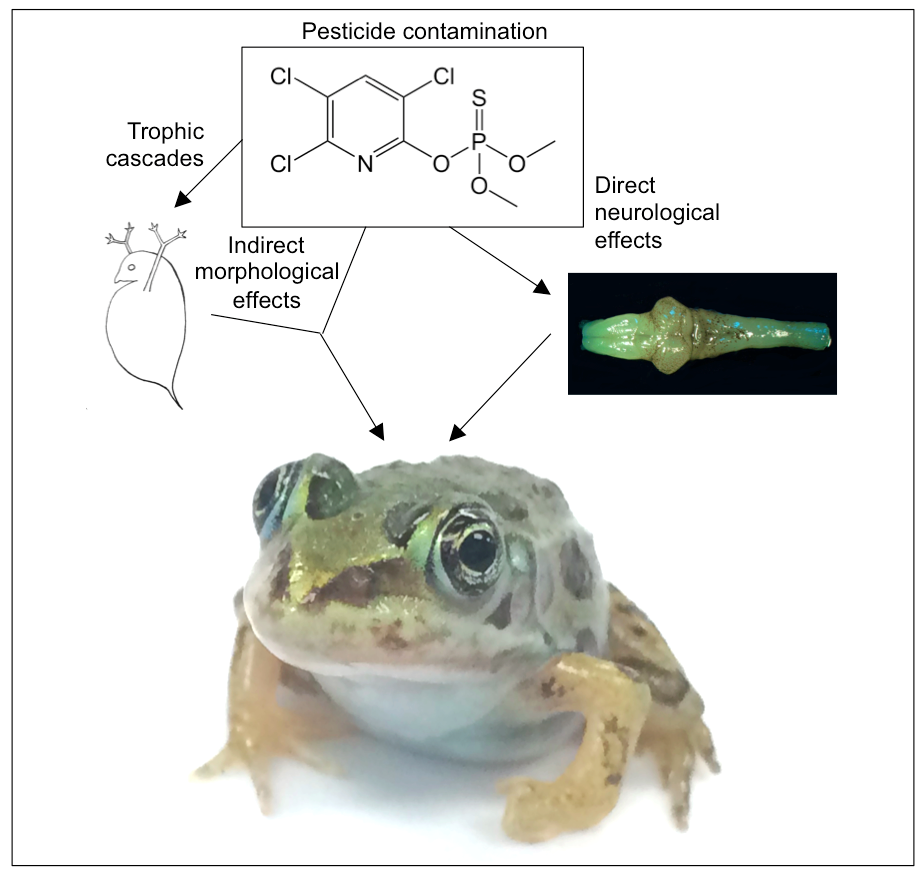
"Innocuous" pesticide dose directly impacts vertebrate brain development
Credit: McClelland et al., Environmental Toxicology and Chemistry
"This study demonstrates that exposure to very low, presumably innocuous levels of organophosphorous pesticides can alter neurodevelopment in amphibians," says McClellnd. "Due to developmental similarities in vertebrates, this work may have implications for how exposure to low doses of organophosphorous pesticides could affect human neurodevelopment."
Given that chlorpyrifos is just one of dozens or hundreds of toxins that we are exposed to, more research on their human impacts is urgently needed. As epidemiologist Miguel Porta points out, "Whatever we know, whatever we think we know about the adverse health effects of a given chemical compound, and about the adverse health effects of several different compounds, simply think that it will not be uncommon for them to be--each and all--present at high concentrations in a significant minority of your patients, constituency, citizens, family or friends. And then think about the plausible negative health effects of the combination or 'cocktail' at high and low concentrations."
-----
You can find a link to the Environmental Toxicology and Chemistry study here.
And a recent study linking a "cocktail" of pollutants to impaired fetal growth at this URL.
And click here for another recent study on the impact of toxic cocktails on brain development.
-----
If you enjoyed this post, please subscribe to follow or receive email alerts from zerospinzone.blogspot.com.


