Showing posts with label POPs. Show all posts

Saturday, September 15, 2018

ARE ENVIRONMENTAL TOXINS DAMAGING BABIES' BRAINS?

According to the Centers for Disease Control, the incidence of neurodevelopmental disorders--any of a number of brain-related problems such as attention deficit, hyperactivity or autism--increased by 17 percent between 1997 and 2008. Attention deficit hyperactivity disorder (ADHD) rose by 33 percent, while autism exploded by an astonishing 289 percent during that period.

Most strikingly, autism has continued to rise. In 2008, about one US child out of 125 was diagnosed on the autistic spectrum, while by 2018, it was one out of 59, including one out of every 42 boys.

There's still debate about whether these dramatic increases are real, or are caused by increased awareness, more access to care or changing diagnostic criteria. Those may all be factors, but it seems unlikely that they can explain a tripling in the documented incidence of autism in such as short time.

A small but growing body of research suggests that the risk of autism or other neuro-developmental disorders is increased by exposure to pesticides or other persistent organic pollutants (POPs), which may disrupt crucial steps in brain development. We all carry numerous POPS in our bodies, and they have been shown to cause a wide range of metabolic abnormalities. Given the complexity and delicacy of fetal development, and especially the development of the brain, it would not be surprising to find that these ubiquitous pollutants are at least part of the story.

Some recent research with tadpoles may shed light on this question. Although humans and frogs may seem very distantly related, both are vertebrates (animals with backbones) and share many developmental steps and basic brain features. 

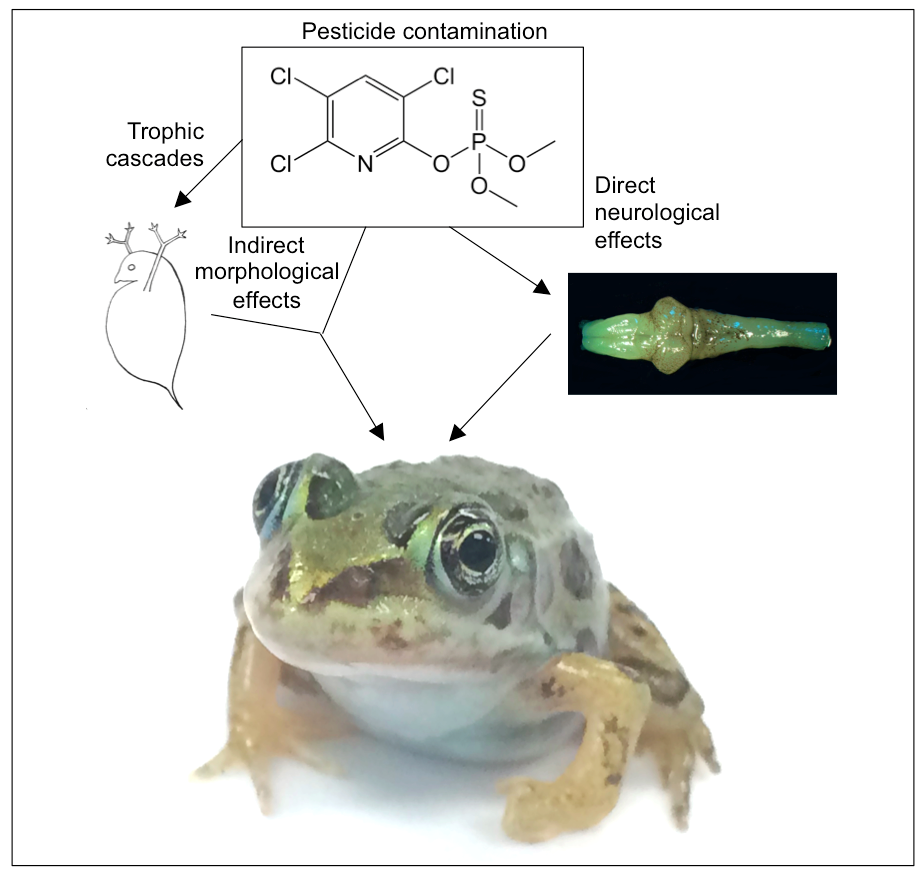
Sara McClelland, a biologist at Duquesne University in Pittsburgh, Pennsylvania, and her colleagues studied the impact of very low doses--1 millionth of a gram per liter of water--of the commonly-used pesticide chlorpyrifos on the brains and bodies of the tadpoles of northern leopard frogs. 

As they reported in the journal Environmental Toxicology and Chemistry, exposure to chlorpyrifos caused significant changes to the tadpoles' brains. Three brain areas were impacted, areas important to vision, hearing, breathing and motor control. Those changes turned out to be independent of the pesticide's effect on the tiny animals the tadpole's feed on.

 "Innocuous" pesticide dose directly impacts vertebrate brain development
Credit: McClelland et al., Environmental Toxicology and Chemistry

"This study demonstrates that exposure to very low, presumably innocuous levels of organophosphorous pesticides can alter neurodevelopment in amphibians," says McClellnd. "Due to developmental similarities in vertebrates, this work may have implications for how exposure to low doses of organophosphorous pesticides could affect human neurodevelopment."

Given that chlorpyrifos is just one of dozens or hundreds of toxins that we are exposed to, more research on their human impacts is urgently needed. As epidemiologist Miguel Porta points out, "Whatever we know, whatever we think we know about the adverse health effects of a given chemical compound, and about the adverse health effects of several different compounds, simply think that it will not be uncommon for them to be--each and all--present at high concentrations in a significant minority of your patients, constituency, citizens, family or friends. And then think about the plausible negative health effects of the combination or 'cocktail' at high and low concentrations."

-----

You can find a link to the Environmental Toxicology and Chemistry study here.

And a recent study linking a "cocktail" of pollutants to impaired fetal growth at this URL.

And click here for another recent study on the impact of toxic cocktails on brain development.

-----

If you enjoyed this post, please subscribe to follow or receive email alerts from zerospinzone.blogspot.com.


Friday, August 17, 2018

LINK BETWEEN AUTISM AND LONG-BANNED INSECTICIDE DDT

Remember DDT? It's an insecticide that was banned worldwide for most uses more than 30 years ago, but which lingers in the environment and in our bodies to this day. In its heyday, DDT was sprayed massively over farms, forests and cities to control mosquitoes and other insects. I remember as a child swimming in an outdoor pool as a plane flew overhead spraying DDT over the entire city. People accepted it as normal.

We're just now finding out that there's a possible link between DDT and autism, a severe, often disabling developmental disorder estimated to impact more than 25 million people worldwide, and 15 children out of ever thousand in the US (one out of every 42 boys!). Autistic children have difficulties with communication and relating to people, and often repeat certain movements or behaviors such as rocking over and over again.

 Autistic child and his mother
Credit: istock

A long-term study involving over one million mothers and children in Finland found that high levels of DDE--a breakdown product of DDT that ends up in the fatty tissues of animals and humans--in the blood of pregnant women doubled the risk of a child developing autism with intellectual disability. This link remained strong even after controlling for factors such as the mother's age and psychiatric history.

DDT is one of many Persistent Organic Pollutants (POPs), potentially toxic man-made chemical compounds that accumulate in soil, water and air, in the foodchain and in our bodies. Other research has shown that 10 percent of us have high concentrations of 10 or more POPs in our blood, and that high concentrations of POPs in the body are associated with a variety of metabolic abnormalities, including those leading to metabolic syndrome, diabetes and heart disease.

The current research is the first to reveal a link to autism. The authors suspect that DDT and its metabolite DDE may trigger autism because they lead to lower birthweight infants, and by interfering with the proper functioning of androgens, hormones necessary for the development of male characteristics.

"Unfortunately," says Alan Brown, an epidemiologist at Columbia University Medical Center,  "[these chemicals] are still present in the environment and are in our blood and tissues. In pregnant women, they are passed along to the developing fetus. Along with genetic and other environmental factors, our findings suggest that prenatal exposure to the DDT toxin may be a trigger for autism."

Clearly, homing in on the environmental causes of autism can help us find ways to reduce the high and still increasing incidence of this extremely disruptive condition.

-----
If you liked this post, please sign up to follow or receive email notifications from zerospinzone.


Sunday, July 23, 2017

PERSISTENT ORGANIC POLLUTANTS ASSOCIATED WITH METABOLIC ABNORMALITIES IN SEEMINGLY HEALTHY PEOPLE

Persistent organic pollutants--POPS--are pervasive in the environment and accumulate in our bodies. Pesticides, pharmaceuticals and many industrial chemicals contribute to this potentially toxic tide.

Some common organic pollutants
Credit CunhaEnviroSci

In an earlier post, I reported on findings by epidemiologist Miquel Porta and his colleagues revealing that ten percent of Americans have 10 or more different POPS in our blood at abnormally high concentrations.

Porta and his team are now studying the impacts of these long-lived organic compounds that many of us unknowingly carry in our bodies and bloodstream.

His most recent findings, reported in the American Journal of Epidemiology, reveal a strong correlation between people's toxic loads and metabolic abnormalities such as high blood pressure, insulin resistance, high blood sugar, unhealthy lipid profiles, and chronic inflammation--factors that increase the risk of metabolic syndrome, diabetes and heart disease.

Porta and his colleagues at the Hospital del Mar Medical Research Institute in Barcelona (IMIM), and the Autonomous University of Barcelona, evaluated 860 people enrolled in the Catalan Health Interview Survey. Participants included obese and normal-weight men and women from the age of 18 to 74. Statistical analyses controlled for the effects of age, sex, BMI, educational level and social-economic status. It's the first study looking at the relationship between POPs and metabolic abnormalities in  normal-weight individuals.

"The take-home message of our study," says Porta, "is that POPs contribute to cause unhealthy metabolic phenotypes as well as the metabolic syndrome."

 Intriguingly, the correlation was stronger for people of normal weight than for obese people. This may help to explain why many people of normal weight turn out to be metabolically unhealthy, and why some obese people remain metabolically normal.

It wasn't  a small effect--people of normal weight carrying high loads of POPs were four times more likely to be metabolically unhealthy than normal-weight peers with low toxic loads. Obese individuals with high toxic loads were 1.4 times as likely to suffer from metabolic abnormalities than those with low levels of toxins in their blood. And regardless of weight, metabolically unhealthy people carried nearly twice the load of toxins than their healthy peers.

A separate research study reports that normal-weight people who are metabolically unhealthy have three times the risk of heart attack, stroke or death compared to their metabolically healthy, normal-weight peers.

Although we are all exposed to organic pollutants from many sources--the air we breathe, the water we drink, furniture, fabrics, food containers and many other sources, the authors point out that fatty animal foods are the biggest source, and one that we can control by what we choose to eat.

They add, however, that individual efforts to eat a healthy diet and maintain a healthy weight are only part of the solution. Government action to minimize the accumulation of POPs and other toxins in the workplace, consumer goods and the environment are also needed, as well as similar efforts by private companies.

"Individual habits play a role, but so do public and private policies," says Porta, "that is, polices of governments and companies that have been shown to decrease 'internal contamination' by POPs."

-----

You can access the abstract of Porta's journal article at this URL.

-----
If you enjoyed this post, please sign up for email alerts from zerospinzone.blogspot.com (right column above).


Thursday, October 13, 2016

TEN PERCENT OF US HAVE HIGH CONCENTRATIONS OF TEN OR MORE TOXINS IN OUR BLOOD

It's common knowledge that we're all exposed to many different kinds of toxins from the air we breathe, the water we drink, the pesticides and other chemicals we're exposed to and many other sources, and that some of those accumulate and persist in our bodies.


Cycling of POPs. Credit: EUGRIS

What we didn't know but researchers have just discovered, is that at least some of those pollutants are not spread randomly through the population, with some individuals having more of one and others having more of a different one. Much like income or wealth, some people have just a little while some have a lot.

A new study of Persistent Organic Pollutants (POPs)--the first that looked at many different kinds of POPs in the same people at the same time--found that that they were strongly clustered, with more than 10% of the U.S. population carrying ten or more different POPs in their blood at concentrations above the 90th percentile. Blacks, people with low incomes, people with a high body mass index (BMI) and older individuals were more likely to carry heavy loads of multiple organic toxins.


Industrial smokestacks--one source of pollutants
Credit Peter Essick/National Geographic

When I asked physician and epidemiologist Miquel Porta, one of the study's authors, about the implications of his findings, he first cautioned about stirring up fear. "As a physician, I firmly believe that fear is seldom compatible with a broad vision of health," he wrote. 

However, he went on to emphasize that finding that a large number of people have 90th-percentile-or-higher concentrations of 10 or more known toxins needs to be noted by researchers and public health authorities:

"Whatever we know, whatever we think we know about the adverse health effects of a given chemical compound, and about the adverse health effects of several different compounds, simply think that it will not be uncommon for them to be--each and all--present at high concentrations in a significant minority of your patients, constituency, citizens, family or friends. And then think about the plausible negative health effects of the combination or 'cocktail' at high and low concentrations."

As reported in the journal PLOS One, Porta and his colleagues looked at the concentrations of 91 POPs in the blood of 4739 people living in the U.S. They found that 13% of the people studied had 10 or more of the most frequently detected organic pollutants at or above 90th percentile levels. You can view the original article here.

"Decades after the evidence on the presence of toxic chemical mixtures in humans became available, official approaches to assess the risks for human health of such mixtures continue to lag tragically behind scientific evidence of the adverse effects of individual compounds and the potential effects of mixtures," Porta writes.

"We provide a method to improve exposure assessment. Our method is an important complement to what is usually done."

In other words, it's no longer justifiable to study one toxin at a time in one group of people at a time. Now that we know that many different toxins pile up in certain populations, with the odds tilted by race, age, income and other factors, studies, recommendations and regulations that don't take that into account from the start are likely to seriously underestimate the risks to the health of a significant number of people.

-----
You can find a follow-up to this research, detailing some of the health impacts of POPs, here.
-----
If you enjoyed this post, please sign up for email alerts from zerospinzone.blogspot.com (right column above).