Showing posts with label brain. Show all posts

Thursday, January 02, 2020

NEW EVIDENCE: EXERCISE BOOSTS YOUR BRAIN

We all know that exercise is good for us, and if done right can build muscles, physical strength and cardiovascular fitness. Now new evidence is emerging that physical exercise is good for our brains as well.

Publishing in the Mayo Clinic Proceedings, a group of physicians and epidemiologists at the German Center for Neurodegenerative Diseases detail a large study measuring and comparing the cardiorespiratory fitness (CRF) and brain volume of 2103 German women and men between the ages of 21 and 84. The researchers found that fitter participants had significantly greater brain volume than their less-fit peers.

Physical fitness may also boosts brain fitness
Photo credit: Michael (Mike) L. Baird

Interestingly, highly detailed magnetic resonance images (MRIs) of the participant's brains showed that the parts of the brain that benefitted most from increased fitness were not areas associated with movement or coordination, but instead areas involved in thinking and--seniors take note--memory. The effects on the hippocampus, crucial for memory, were especially strong in older participants.

"This is another piece of the puzzle showing physical activity and physical fitness is protective against aging-related cognitive decline," says Michael Joyner, a Mayo Clinic anesthesiologist. He and two Mayo Clinic colleagues wrote an editorial to accompany the research report. They note that while previous research has linked exercise, physical fitness, blood flow to the brain, and cognitive functioning, this is the first research to show beneficial changes to the grey matter of the brain.
". . . these data are encouraging," says Clifford Jack Jr., a neuroradiologist at Mayo Clinic. "The findings regarding cardiorespiratory fitness and certain brain structures are unique."

You can read an earlier zerospinzone post about research linking exercise and brain connectivity here.

The new study's authors point out that while their cross-sectional research clearly showed that CRF and brain volume and structure are correlated, it can't prove cause and effect-- ". . . reverse causation (i.e., individuals with greater brain volumes have higher CRF) cannot be excluded," they write.

Even with that caveat, the researchers and the Mayo Clinic commentators conclude that these findings justify large-scale studies that follow participants over time to see if exercise and improved physical fitness actually help preserve grey matter in aging brains, or possibly even stimulate growth in regions of the brain such as the frontal lobes or hippocampus.

-----

You can access the full research paper and editorial commentary at this link

-----

 REA


Monday, April 22, 2019

EVEN LIGHT PHYSICAL ACTIVITY KEEPS YOUR BRAIN YOUNG

Here's the bad news: unless you're under 25, your brain is shrinking. The rate of brain loss is slow at first but speeds up gradually over the years. The brain volume of a typical 75 year old is about 15 percent less than it was at its peak. That gradual loss of brain volume goes hand in hand with the decline in memory and other cognitive functions commonly seen as people age.


 All you need is . . . to take a walk
Image source: Creative Commons

The good news is that even light physical activity--getting up, moving around, doing chores, taking a stroll, working standing rather than sitting--slows down brain shrinkage and ageing. A three-year study of more than 2300 men and women found that for every extra hour per day of light physical activity, people's brains measured more than a year younger, and the brains of people who clocked 10,000 or more steps a day were nearly two years younger than those of people who managed fewer than 5,000 steps a day.

The participants in this study were from the second and third generation of the famous Framingham Heart Study, a long term study centered in Framingham, Massachusetts, that has contributed greatly to our understanding of cardiovascular health and disease, diet and exercise. Activity was measured using accelerometers, and brain volume was tracked via MRIs.

These findings are encouraging to the millions of us--75 percent of Americans--who don't manage to meet the official physical activity guidelines of 150 to 300 minutes per week of moderate exercise or 75 minutes per week of vigorous, aerobic exercise. We can protect our brains with less intense activities.

"Every additional hour of light intensity physical activity was associated with higher brain volumes, even among individuals not meeting current Physical Activity-Guidelines," says Nicole Spartano, a researcher at Boston University School of Medicine and lead author of the study. "These data are consistent with the notion that potential benefits of physical activity on brain aging may accrue at a lower, more achievable level of intensity or volume."

The bottom line is that almost any kind or amount of daily exercise, even just an our or so of light physical activity, can give your brain the boost it needs to stay young and fit.

-----

If you enjoyed this post, please sign up to follow or receive email alerts from zerospinzone.


Monday, March 25, 2019

PUTTING THE NUT INTO NUTRITION--ESPECIALLY FOR YOUR BRAIN

This is certainly not the most serious thing I could be writing about, what with the Mueller report finally coming to a fizzling end, Venezuela falling into chaos, the Middle East arguably growing even more explosive, decades of relative restraint on the development and potential use of nuclear weapons being tossed aside by the US and Russia, and, lest we forget, climate change.

Still, a little bit of actually useful information is probably worthy of at least a few moments of your attention.

Here's the snippet of news: If you're over 55 and you eat more than 10 grams (.35 oz or 2 teaspoons) of nuts every day, you're 40 percent more likely to enjoy good thinking and memory than your non-nut-consuming peers.


Can a few peanuts a day keep senility away?
Credit: Aney/Wikimedia

This was the main finding in a study of almost 5000 Chinese seniors. Eating more than 10 grams of nuts every day--mostly peanuts for this study group--boosted cognition by about two-thirds of a point as measured on a 40 point scale. That's equivalent to shaving off two to three years of age.

With a greying population putting millions of people at risk of dementia, any intervention that can slow brain ageing can be of great value to individuals and to society as a whole.

Some people will pay thousands of dollars for surgery to make them look a few years younger. How much is it worth to you to have your brain actually work like it did when you were a few years younger? If the "cost" is munching a few teaspoons of nuts every day, it would seem to be extremely well worth it.

-----

You can reference the research report in the Journal of Nutrition, Health & Ageing here.

-----

If you enjoyed this post, please sign up to follow or receive email alerts from zerospinzone.

Saturday, September 15, 2018

ARE ENVIRONMENTAL TOXINS DAMAGING BABIES' BRAINS?

According to the Centers for Disease Control, the incidence of neurodevelopmental disorders--any of a number of brain-related problems such as attention deficit, hyperactivity or autism--increased by 17 percent between 1997 and 2008. Attention deficit hyperactivity disorder (ADHD) rose by 33 percent, while autism exploded by an astonishing 289 percent during that period.

Most strikingly, autism has continued to rise. In 2008, about one US child out of 125 was diagnosed on the autistic spectrum, while by 2018, it was one out of 59, including one out of every 42 boys.

There's still debate about whether these dramatic increases are real, or are caused by increased awareness, more access to care or changing diagnostic criteria. Those may all be factors, but it seems unlikely that they can explain a tripling in the documented incidence of autism in such as short time.

A small but growing body of research suggests that the risk of autism or other neuro-developmental disorders is increased by exposure to pesticides or other persistent organic pollutants (POPs), which may disrupt crucial steps in brain development. We all carry numerous POPS in our bodies, and they have been shown to cause a wide range of metabolic abnormalities. Given the complexity and delicacy of fetal development, and especially the development of the brain, it would not be surprising to find that these ubiquitous pollutants are at least part of the story.

Some recent research with tadpoles may shed light on this question. Although humans and frogs may seem very distantly related, both are vertebrates (animals with backbones) and share many developmental steps and basic brain features. 

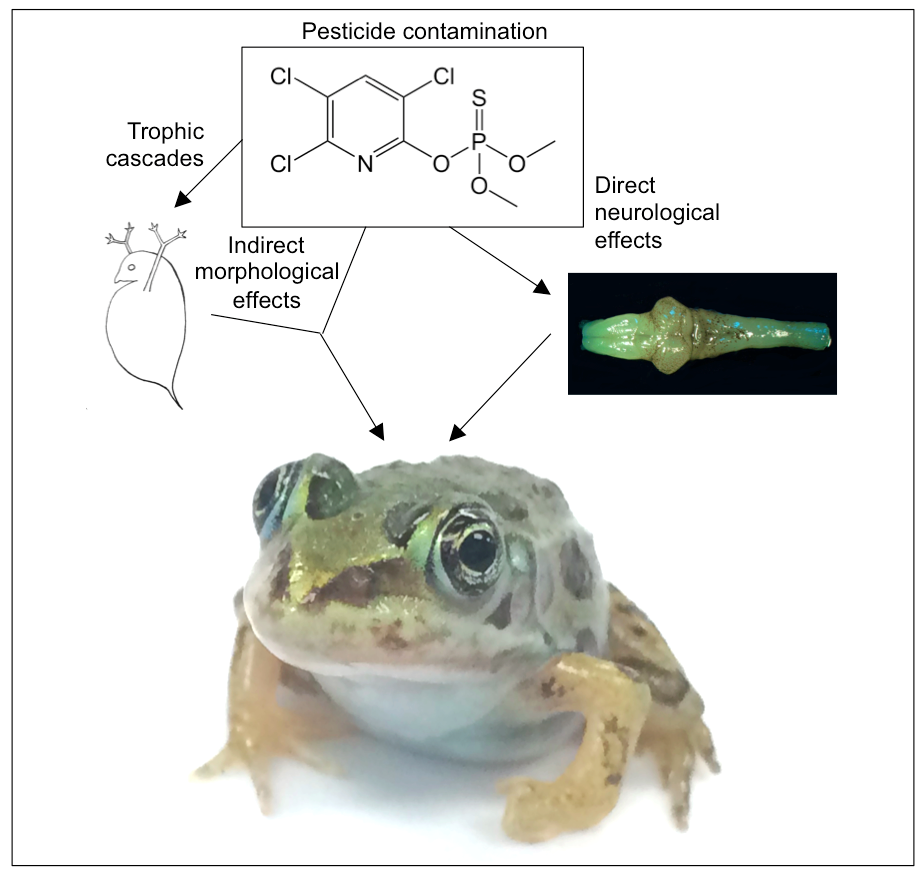
Sara McClelland, a biologist at Duquesne University in Pittsburgh, Pennsylvania, and her colleagues studied the impact of very low doses--1 millionth of a gram per liter of water--of the commonly-used pesticide chlorpyrifos on the brains and bodies of the tadpoles of northern leopard frogs. 

As they reported in the journal Environmental Toxicology and Chemistry, exposure to chlorpyrifos caused significant changes to the tadpoles' brains. Three brain areas were impacted, areas important to vision, hearing, breathing and motor control. Those changes turned out to be independent of the pesticide's effect on the tiny animals the tadpole's feed on.

 "Innocuous" pesticide dose directly impacts vertebrate brain development
Credit: McClelland et al., Environmental Toxicology and Chemistry

"This study demonstrates that exposure to very low, presumably innocuous levels of organophosphorous pesticides can alter neurodevelopment in amphibians," says McClellnd. "Due to developmental similarities in vertebrates, this work may have implications for how exposure to low doses of organophosphorous pesticides could affect human neurodevelopment."

Given that chlorpyrifos is just one of dozens or hundreds of toxins that we are exposed to, more research on their human impacts is urgently needed. As epidemiologist Miguel Porta points out, "Whatever we know, whatever we think we know about the adverse health effects of a given chemical compound, and about the adverse health effects of several different compounds, simply think that it will not be uncommon for them to be--each and all--present at high concentrations in a significant minority of your patients, constituency, citizens, family or friends. And then think about the plausible negative health effects of the combination or 'cocktail' at high and low concentrations."

-----

You can find a link to the Environmental Toxicology and Chemistry study here.

And a recent study linking a "cocktail" of pollutants to impaired fetal growth at this URL.

And click here for another recent study on the impact of toxic cocktails on brain development.

-----

If you enjoyed this post, please subscribe to follow or receive email alerts from zerospinzone.blogspot.com.


Thursday, January 11, 2018

AN INFECTIOUS IDEA -- A VIRUS-LIKE PROTEIN MAY BE CRUCIAL TO LEARNING AND MEMORY

We've all heard the phrase, "an infectious idea." It turns out that this may not just be a metaphor--new research has revealed that a virus-like protein in all of our brains may be vital for learning and memory.

"If it looks like a duck and quacks like a duck," the saying goes, "it probably is a duck." So, no matter how surprising it is, finding a crucial protein in the brain that looks like a virus and acts like a virus raises the intriguing possibility that our ability to learn and remember may stem from a chance infection of some ancestral four-legged creature by a retrovirus 350 to 400 million years ago.

The protein in question is called Arc. It's found in animals as different as flies, mice and humans. It's been known for some time that Arc is important for learning and memory. Mice lacking Arc forget what they've learned within 24 hours, and lack the kind of brain plasticity that lets young animals, most notably human children, soak up new information quickly and easily. Arc continues to be important for learning and memory throughout life, and impaired Arc functioning is associated with autism, amnesia and Alzheimer's disease.

Arc (long purple proteins inside the perimeter of the vesicle) can encapsulate and deliver its own genetic material to brain cells (light green branching blobs) in a manner similar to the way in which viruses infect host cells.  
Credit: Jacobo Lopez, Yi-Chu Su, Hugo Vaca

Jason Shepherd, a neuroscientist at the University of Utah, and his colleagues first suspected that something was different about Arc when they found that the protein self-assembles into structures called capsids that look like a lunar lander or the HIV retrovirus. Intrigued, they found that not only can the Arc capsid jump from cell to cell like a virus, it also transfers its own genetic material in the form of messenger RNA into the new cell.

Learning takes place when interconnected brain cells are activated at the same time. Intriguingly, the researchers found that when neurons "infected" by Arc are activated, they release newly minted Arc capsids. This suggests that the transfer of this virus-lilke protein from cell to cell may be a previously unknown and unsuspected mechanism for learning and memory.

Neuron expressing Arc and transferring it to other neurons
Credit: Elissa Pastuzyn 

“We went into this line of research knowing that Arc was special in many ways," says the study’s lead author, postdoctoral fellow Elissa Pastuzyn. "But when we discovered that Arc was able to mediate cell-to-cell transport of RNA, we were floored. No other non-viral protein that we know of acts in this way.”

Geneticists have been able to trace back the history of the Arc proteins found in all mammals. Sometime between 350 and 400 million years ago, a primitive four-limbed creature, or tetrapod, was infected by a retrovirus that left some of its genetic material in the animal's DNA. That chance addition to the mammalian genetic code has apparently proven extremely useful, perhaps laying the groundwork for the success of our mammalian ancestors, and even for our remarkable capacity for learning and remembering.

REA
-----

You can read more about this research at this URL.

The scientific article describing this research can be found in Cell, January 11, 2018.

-----

If you enjoyed this post, please sign up to follow or receive email alerts from zerospinzone.blogspot.com.


Wednesday, June 07, 2017

MRI SCANS REVEAL AUTISTIC BRAIN DIFFERENCES AT SIX MONTHS OF AGE

Although symptoms of autism don't usually appear until a child's second year, and most autistic children aren't diagnosed until they are three or older, recent research shows that the brains of 6-month-old infants who will go on to develop autism already differ from those of normal infants.

These findings may lead to earlier diagnosis and more effective treatment for children who are at risk of developing autism.

They also provide more evidence, if that's still needed, that autism is not caused by childhood vaccinations. As Robert Emerson, the study's lead author points out, "If these differences are already present at six months of age, they would represent a biological foundation for autism that is in place before several vaccines on the CDC schedule that are administered after six months of age, including the Measles, Mumps, Rubella (MMR) inoculation, which is typically given at one year."

A child showing autistic symptoms

Emerson and colleagues at the University of North Carolina at Chapel Hill used functional magnetic resonance imaging (fMRI) while children slept to track brain size, growth and connectivity in 59 infants who were at high risk for autism because they had autistic older siblings. Twenty percent of them could be expected to develop autism, compared to 1.5 percent of children without autistic siblings.

They found a variety of differences between the brains of infants who went on to develop autism and those who didn't.

In keeping with earlier research, those infants who eventually showed autistic symptoms had a faster rate of growth in brain volume and brain surface area between six months and two years of age

The researchers then used advanced artificial intelligence techniques to differentiate between the brains of those infants who did or did not develop autism. Machine-learning programs trained themselves on the brain scans, and were eventually able to identify correctly 82 percent of the children--9 of 11--who would become autistic and 100 percent of those who developed normally.

This very high rate of discrimination was based on nearly 1000 "functional correlations"--how separate regions of the brain connect and work together--that differed between infants who were on autistic versus normal developmental paths.

Schematics representing brain scan signatures at six months that predicted later autism diagnosis in infants. Red bars indicate weaker connections in autistic infant brains, blue bars stronger connections.
[Credit: R.W. Emerson et al., Science Translational Medicine (2017)]

The authors caution that these are preliminary results using state-of-the-art technology, so further research and the development of simpler and less expensive brain-scanning techniques are needed before they can be applied clinically. 

"If future studies confirm these results, detecting brain differences may enable physicians to diagnose and treat autism earlier than they do today," says Diana Bianchi, M.D., Director or the National Institute of Child Health and Development (NICHD).

According to the Centers for Disease Control (CDC), one child out of every 68 in the US will be diagnosed with autism. The earlier that those children can be correctly diagnosed and start to receive treatment--while the brain is most malleable--the better their outcomes.

You can find a summary of an earlier Nature article about this research here, and a link to the abstract of the current study, in Science Translational Medicine, at this URL.

---------

If you enjoyed this post, please subscribe or sign up for email alerts (above right) and let your friends know about zerospinzone.blogspot.com.


Sunday, October 30, 2016

EXPERIMENTAL DRUG SHOWS PROMISE AGAINST ALZHEIMER'S DISEASE

With an ageing population, more than 5 million Americans suffering from Alzheimer's Disease, and with Alzheimer's now the sixth leading cause of death, finding an effective treatment is an urgent national goal.

Healthy vs diseased brain/Credit: Wikimedia


A new, still-experimental drug known as NTRX-07 shows promise towards that goal. Studies in mice whose brains have degenerative changes similar to those from Alzheimer's in humans show reduced inflammation and increased removal of amyloid plaques, both implicated in the devastating impacts of Alzheimer's.

Beta-amyloid plaques/Credit: vestque

Presenting their findings at the Anesthesiology 2016 Annual Meeting, lead researcher Mohamed Naguib and his colleagues reported that NTRX-07 enhanced the ability of microglial immune cells to reduce inflammation and clear toxic amyloid plaques from the brain.

"NTRX-07 uses a different mechanism than many other Alzheimer's drugs currently available," says Naguib, "as it targets the cause of the disease, not just the symptoms."

Of course, the path from a compound that shows promise in an animal model of a disease to a safe and effective human drug is a long and uncertain one--12 years on average. We can only hope that NTRX-07 or some other drug (such as a promising BACE1 inhibitor) that can prevent or cure Alzheimer's will run that gauntlet successfully and soon.

-----

3/14/19:  For an update on the promise of BACE1 inhibitors, navigate here.

-----


Tuesday, October 25, 2016

FEELING MENTALLY FOGGY? PUMP SOME IRON!

Trouble remembering that phone number? Forget why you went into the kitchen? Doctor's appointment just slipped your mind? Lose track of what you're saying in the middle of a . . . ?

If that kind of mental glitch is all too familiar, then you, like millions of ageing Americans, may be suffering from mild cognitive impairment (MCI). This cluster of brain-related changes centering around memory but at times impacting attention, concentration and decision-making may simply be one of the frustrations of getting older, but it can also be a warning sign along the road to Alzheimer's disease or other kinds of dementia.

The good news is that something as simple as increasing your muscle strength by lifting weights or working out on resistance machines can turn back the clock.


Credit: The University of Sydney

A new study just published in the Journal of the American Geriatrics Society found that people 55 and above with MCI who did progressive resistance exercises two times a week for six months not only gained physical strength but significantly improved their cognitive functioning as well. 

"The stronger people became, the greater the benefit for their brain," says lead author Yorgi Mavros, at the University of Sydney.

The weight-training participants--ranging in age from 55 to 86--lifted at 80 percent of their maximum capacity in order to gradually increase muscle strength.

To top off the good news, the participants' improved mental sharpness lasted for a year or more after the strength training ended.

This carefully designed and controlled study allowed the researchers to confirm a causal relationship between the strength-increasing exercise and cognitive improvement for the first time. The most consistent and across-the-board improvements came with increased lower body strength.

Previous research at the same center using MRI scans showed that weight training actually caused an increase in the size of particular brain regions, and that those brain changes correlated with improved cognitive functioning.

Remarkably, weight training boosted cognitive functioning more than computerized cognitive training did.

"The more we can get people doing resistance training like weight lifting, the more likely we are to have a healthier ageing population," said Mavros. 

"The key however is to make sure you are doing it frequently, at least two times a week, and at a high intensity so that you are maximizing your strength gains. This will give you the maximum benefit for your brain."

You can read the paper's abstract and supporting documents here.

And, to help you remember what you've just learned, a new study shows that 30 minutes of aerobic exercise improves retention and memory for new information.


Monday, October 24, 2016

POLITICIANS BEWARE--LYING CHANGES YOUR BRAIN

"Oh what a tangled web we weave
When first we practice to deceive!"
Marmion, Sir Walter Scott

It turns out that Sir Walter was even more perceptive than he thought. New research shows that lying--especially when it benefits the liar--causes changes deep within the tangled web of the brain that make future (and bigger) lies easier and easier.

The Amygdala, twin almond-shaped nuclei deep within the brain--
important in memory, decision-making and emotional reactions.
Credit: National Institutes of Health (NIH)

Researchers at University College London (UCL) scanned the brains of volunteers while they made estimates that could either be accurate or skewed to benefit themselves, themselves and a partner, or just their partner.

The first time that participants fudged their estimates to benefit themselves at their partner's expense, even just a little, their amygdalas lit up, indicating a strong negative emotional response. However, with each subsequent lie, the amygdala reacted less, and the lies got larger. Bigger and bigger lies elicited smaller and smaller emotional reactions--a classical "slippery slope."

"When we lie for personal gain, our amygdala produces a negative feeling that limits the extent to which we are prepared to lie," says Tali Sharot, principal investigator at UCL's Affective Brain Lab. "However this response fades as we continue to lie, and the more it falls the bigger our lies become."

Neil Garrett, the study's lead author, adds that this pattern may apply to other antisocial behaviors. "We only tested dishonesty in this experiment, but the same principle may apply to escalations in other actions such as risk-taking or violent behavior."

It would be interesting to see how the amygdalas of, for example, certain prominent politicians, react to telling lies. Or perhaps, as their noses get longer an longer, those deep brain centers simply shrivel up and disappear.

Pinocchios in a Florence shop window: Credit: Vladimir Menkov

Your can find the original Nature Neuroscience article, "The brain adapts to dishonesty," here.