Showing posts with label treatment. Show all posts

Saturday, February 12, 2022

Extremely promising spinal-injury treatment

 Every year in the US nearly 18,000 people suffer spinal cord injuries (SCIs) serious enough to cause partial or total paralysis, and approximately 300,000 Americans live with permanent disabilities because of SCIs. Now, new research appearing in the prestigious journal Nature Medicine offers the promise that some of those paralyzed men and women may be able to walk again.

Two previously paralyzed patients walk again

Credit: NeuroRestore/Jimmy Ravier/Nature Medicine

Building on decades of previous research, an international team with a panoply of specialized skills designed and fabricated a new, patient-specific electrical stimulator that they implant along the lower part of the spinal cord of paralyzed patients. After optimizing the implant's connectivity to the unique neuro-anatomy of each patient, computer-generated patterns of stimulation allow individuals to stand, walk, cycle or swim. Fine-tuning the system to the point that patients can take their first steps take less than a day.

So far the researchers have demonstrated this methodology with three previously paralyzed patients. All three have been able to stand, walk and perform other activities almost immediately, with support in the clinical setting. Further months of physical therapy, exercise and practice with the system allowed them to extend these newly regained skills into the community, independently.

Here's one of the patient's first-hand report:

"I had an accident in 2017 on a motobike. I saw a presentation on this project and I contacted them. After two years I enrolled. The surgery was in August of 2020. After 10 days of recovery, I started the rehabilitation. After one day I saw my legs moving--it was very emotional. That same day, I could walk without support. After 9 months of daily training, which I continue at home with the devices, I see improvement every day. I use it for walking or standing. Now I can do everything alone, with no problem. It's very good."

The researchers are actively continuing this project, aiming to further individualize the spinal-cord stimulator and refine and miniaturize the computer interface. Their goal is to allow patients to control the various programs for standing, walking, swimming, cycling, exercising, etc.--from a smartphone or tablet.

They hope to be able to make this currently experimental treatment more widely available within the next several years.

You can read a brief summary of the research here. (The full article is behind the Nature Medicine paywall.)


Thursday, March 14, 2019

CAN ALZHEIMER'S BE ERASED?

New research in mice has shown for the first time that it's possible to stop the formation of amyloid plaques--one of the key pathological features of Alzheimer's disease--and for the brain to clear them away entirely. This line of research has the potential to lead to medications that can slow, stop, or perhaps even reverse the ravages of this dread, mind-destroying disease.


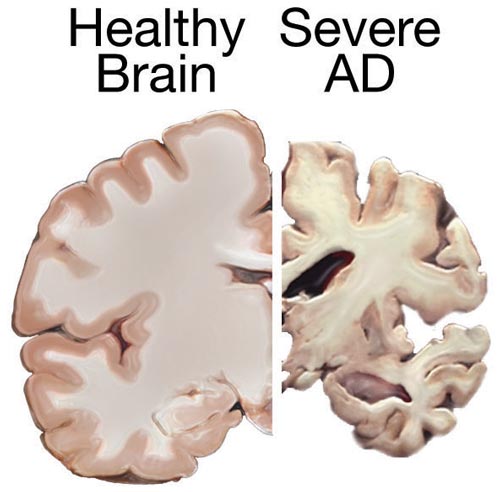
 Comparison of a healthy brain and a brain with severe Alzheimer's disease
Credit: Wikimedia

As many people know through personal experience with friends or family members, Alzheimer's is an implacably progressive neurodegenerative disease that  robs individuals of their memory, cognitive functions, ability to care for themselves, personalities and, eventually, their lives. It's currently the sixth leading cause of death in the U.S. and, strikingly, ". . . is the only disease in the 10 leading causes of deaths in the United States that cannot be cured, prevented or slowed."

A new study, however, opens up the possibility that Alzheimer's may in fact one day be slowed or prevented, if not cured. Working with mice genetically modified to develop Alzheimer's disease, neuroscientist Riqiang Yan* and his colleagues at the Cleveland Clinic-Lerner Research Institute in Cleveland, Ohio, found that gradually reducing an enzyme called BACE1 blocked the development of amyloid plaques, which are a central part of Alzheimer's pathology.

Although their study was complex and highly technical, the logic behind it is clear. BACE1 is one of two enzymes that snip amyloid precursor protein, or APP, into the shorter pieces that glom together into the plaques that are thought to disrupt and eventually kill neurons. Since BACE1 has important biological functions, removing it early in life or completely creates serious neuro-developmental problems. Still, the researchers reasoned, reducing it gradually in adult mice might slow or stop Alzheimer's without causing unacceptable side effects. That's exactly what they found.

"In our study," says Yan, " we showed that if we delete BACE1 in the adult mice, even after plaque formed, with sequential and increased deletion of BACE1 the plaque was removed. That indicates that if we can get to a patient early enough, it will be beneficial in removing amyloid plaque."

Yan was not surprised to see that lowered levels of BACE1 slowed or stopped the formation of new plaques. He was both surprised and excited to find already existing plaques cleared away--the first time that this has been seen. "To our knowledge," he says, "this is the first observation of such a dramatic reversal of amyloid deposition in any study of Alzheimer’s disease mouse models. We didn't expect the pre-existing plaque would be removed. That was the very interesting part, and warrants additional study to find out why."

While completely blocking BACE1 causes developmental and cognitive problems, a gradual lowering in adult mice appeared appeared safer. Those mice performed better on learning and memory tasks than untreated Alzheimer's prone mice.  However, they still showed some abnormalities in synaptic signalling. Despite this problem, Yan thinks that compounds can be developed that, when applied at the right time and at the right dose, will slow or stop the development of plaques, allow the brain to clear away existing ones, and so keep Alzheimer's at bay.

Prevention is more powerful than treatment

Yan compares this to the enormously successful use of statins to control cholesterol levels enough to block the development of atherosclerosis and heart disease, even though cholesterol has vital functions in the body. "The critical thing is will this lead to some safe drugs?" he asks. "We need to find something very safe like a vitamin that people can take every day without any concerns. Another similarity is to the statins, taking statins to prevent cholesterol from building up. The idea is that prevention is even more powerful that treatment." 

The next step for Yan and colleagues is to track the effects of reduced BACE1 on the mouse brain in more detail and on older mice. "Human patients are typically older than in the mouse model," he explains. "In the mouse model we started to delete [BACE1] at 4 months, which is like 20 years old for people. We now want to delete it in older mice. We need a new mouse model for this later stage."

Robert Vassar is a professor of neurology at Northwestern University, in Illinois, and a pioneer in the study of the role of BACE1 in Alzheimer's disease. He's very supportive of Yan's new findings, and, like Yan, thinks they hold significant promise for Alzheimer's prevention. Vassar too likes the analogy with statins and cardiovascular disease. "You can't turn off the tap of cholesterol, but you can turn it down enough to not accumulate the plaques in the heart that cause heart disease," he says. "It's saved the lives of many people. The BACE1 inhibitors can do the same, if we find the right dose and the right stage of the disease--how much to inhibit and when to treat." 

Vassar and Yan are both aware that years of further research with animals and humans are needed to turn these promising findings into a safe and effective preventative treatment for people. They foresee a long road, but one that urgently needs to be followed. "We have to bold about this disease," says Vassar.  "We're headed for an epidemic of this with the baby boomers, so we've got to do something."

As a baby boomer myself, I couldn't agree more!

-----

You can access Yan and his colleagues' full research paper here.

-----

*Professor Yan is currently Chair of the Department of Neuroscience and William Beecher Scoville Professor in Neuroscience at the University of Connecticut, in Farmington, Connecticut.

-----

If you enjoyed this post, please sign up to follow or receive email alerts from zerospinzone

-----


TK


TK


Wednesday, June 07, 2017

MRI SCANS REVEAL AUTISTIC BRAIN DIFFERENCES AT SIX MONTHS OF AGE

Although symptoms of autism don't usually appear until a child's second year, and most autistic children aren't diagnosed until they are three or older, recent research shows that the brains of 6-month-old infants who will go on to develop autism already differ from those of normal infants.

These findings may lead to earlier diagnosis and more effective treatment for children who are at risk of developing autism.

They also provide more evidence, if that's still needed, that autism is not caused by childhood vaccinations. As Robert Emerson, the study's lead author points out, "If these differences are already present at six months of age, they would represent a biological foundation for autism that is in place before several vaccines on the CDC schedule that are administered after six months of age, including the Measles, Mumps, Rubella (MMR) inoculation, which is typically given at one year."

A child showing autistic symptoms

Emerson and colleagues at the University of North Carolina at Chapel Hill used functional magnetic resonance imaging (fMRI) while children slept to track brain size, growth and connectivity in 59 infants who were at high risk for autism because they had autistic older siblings. Twenty percent of them could be expected to develop autism, compared to 1.5 percent of children without autistic siblings.

They found a variety of differences between the brains of infants who went on to develop autism and those who didn't.

In keeping with earlier research, those infants who eventually showed autistic symptoms had a faster rate of growth in brain volume and brain surface area between six months and two years of age

The researchers then used advanced artificial intelligence techniques to differentiate between the brains of those infants who did or did not develop autism. Machine-learning programs trained themselves on the brain scans, and were eventually able to identify correctly 82 percent of the children--9 of 11--who would become autistic and 100 percent of those who developed normally.

This very high rate of discrimination was based on nearly 1000 "functional correlations"--how separate regions of the brain connect and work together--that differed between infants who were on autistic versus normal developmental paths.

Schematics representing brain scan signatures at six months that predicted later autism diagnosis in infants. Red bars indicate weaker connections in autistic infant brains, blue bars stronger connections.
[Credit: R.W. Emerson et al., Science Translational Medicine (2017)]

The authors caution that these are preliminary results using state-of-the-art technology, so further research and the development of simpler and less expensive brain-scanning techniques are needed before they can be applied clinically. 

"If future studies confirm these results, detecting brain differences may enable physicians to diagnose and treat autism earlier than they do today," says Diana Bianchi, M.D., Director or the National Institute of Child Health and Development (NICHD).

According to the Centers for Disease Control (CDC), one child out of every 68 in the US will be diagnosed with autism. The earlier that those children can be correctly diagnosed and start to receive treatment--while the brain is most malleable--the better their outcomes.

You can find a summary of an earlier Nature article about this research here, and a link to the abstract of the current study, in Science Translational Medicine, at this URL.

---------

If you enjoyed this post, please subscribe or sign up for email alerts (above right) and let your friends know about zerospinzone.blogspot.com.


Monday, December 19, 2016

YOU'RE LESS LIKELY TO DIE IN HOSPITAL IF YOU'RE TREATED BY A FEMALE PHYSICIAN

Women doctors treat differently, save lives

Male and female physicians practice medicine differently. For example, women doctors spend more time with their patients, communicate more, offer more encouragement, and are more likely to adhere to the latest clinical guidelines.

A major new national study shows that those or other differences save lives. The study found that hospitalized elderly patients treated by female rather than male internists were 4 percent less likely to die and 5 percent less likely to be re-hospitalized within 30 days of admission. This was true across a wide range of conditions. And the sicker the patient, the bigger the difference between patient outcomes for female vs. male physicians.

Female physicians practice medicine differently--and more effectively
Credit: Ilmicrofono Oggiono

"The difference in mortality rates surprised us," said Yusuke Tsugawa, a researcher at Harvard University's T. H. Chan School of Public Health and the study's lead author. "The gender of the physician appears to be particularly significant for the sickest patients."

A four or five percent difference in survival rates may not seem like a lot, but since 10,000,000 patients like those in this study are hospitalized in the US every year, the authors estimate that if male physicians performed as well as their female colleagues, 32,000 lives would be saved--more than the number of Americans who die in traffic accidents every year.

The study, published today in the prestigious JAMA Internal Medicine, tracked the outcomes of more than 1.5 million Medicare hospitalizations from 2011 through 2014. All of the patients were 65 years old or older, 40 percent were men, 60 percent women. These were seriously ill patients--within 30 days of being admitted to the hospital, more than 15 percent were re-hospitalized and more than 11 percent died. About one third of patients were treated by female internists or hospitalists, two thirds by male physicians. Although earlier research has identified a number of differences between how female and male physicians practice, this is the first national study to see if those differences impact patient outcomes.

Although this study shows conclusively that the physician's gender does affect the risk that hospitalized elderly patients will die or be re-hospitalized, it does not pin down just what produces those differences.

"There was ample evidence that male and female physicians practice medicine differently," says Ashish Jha, Director of the Harvard Global Health Institute. "Our findings suggest that those differences matter and are important to patient health. We need to understand why female physicians have lower mortality so that all patients can have the best possible outcomes."

In the meantime, an accompanying editorial in the same journal points out that the medical profession needs to take a hard look at the gap in both pay and career advancement between female physicians and their male colleagues.

You can listen to an interview with the authors at this URL.


Sunday, October 30, 2016

EXPERIMENTAL DRUG SHOWS PROMISE AGAINST ALZHEIMER'S DISEASE

With an ageing population, more than 5 million Americans suffering from Alzheimer's Disease, and with Alzheimer's now the sixth leading cause of death, finding an effective treatment is an urgent national goal.

Healthy vs diseased brain/Credit: Wikimedia


A new, still-experimental drug known as NTRX-07 shows promise towards that goal. Studies in mice whose brains have degenerative changes similar to those from Alzheimer's in humans show reduced inflammation and increased removal of amyloid plaques, both implicated in the devastating impacts of Alzheimer's.

Beta-amyloid plaques/Credit: vestque

Presenting their findings at the Anesthesiology 2016 Annual Meeting, lead researcher Mohamed Naguib and his colleagues reported that NTRX-07 enhanced the ability of microglial immune cells to reduce inflammation and clear toxic amyloid plaques from the brain.

"NTRX-07 uses a different mechanism than many other Alzheimer's drugs currently available," says Naguib, "as it targets the cause of the disease, not just the symptoms."

Of course, the path from a compound that shows promise in an animal model of a disease to a safe and effective human drug is a long and uncertain one--12 years on average. We can only hope that NTRX-07 or some other drug (such as a promising BACE1 inhibitor) that can prevent or cure Alzheimer's will run that gauntlet successfully and soon.

-----

3/14/19:  For an update on the promise of BACE1 inhibitors, navigate here.

-----


Tuesday, September 20, 2016

OF MICE, MEN AND DEPRESSION

Why do antidepressants not always work?

As many people suffering from depression know all too well, even the best available antidepressant medications often don't work. A new study sheds some light on this problem.

Vincent Van Gogh/1890/Wikipedia

Silvia Poggini and her colleagues studied the effects of selective seretoninin reuptake inhibitors (SSRIs) in mice.  Writing in the 27 July edition of Brain, Behavior and Immunity, they report that the SSRIs don't directly reduce depression, but instead seem to make the brain more responsive to the environment and more open to change.

“This work indicates that simply taking an SSRI is probably not enough. To use an analogy, the SSRIs put you in the boat, but a rough sea can determine whether you will enjoy the trip. For an SSRI to work well, you may need to be in a favorable environment, "says Poggini.

It's always a stretch to generalize from animal research to people, but this certainly suggests that people suffering from depression can't rely only on antidepressant medication, but need to work on their life circumstances as well.