Showing posts with label prevention. Show all posts

Tuesday, July 20, 2021

A SIP OF GOOD NEWS, AT LEAST FOR COFFEE LOVERS

It's rare to find out that something you like is actually good for you. But today we can report that coffee really is. Here's the good news, freshly poured:

As part of a large multi-year study, researchers were able to compare coffee consumption and a variety of health outcomes for more than 185,000 people in California and Hawaii. As reported in the July 11, 2021 issue of the prestigious Annals of Internal Medicine, over the course of the study coffee drinkers lived longer and suffered fewer cases of heart disease, cancer, stroke, diabetes, respiratory illness and kidney disease. 


Credit: stokpik/Pixabay

How large were these benefits? On the average people were followed for 16 years, starting at ages from 45 to 75. Over the course of the study 31 percent of the participants died, with cardiovascular disease and cancer being the biggest risks. People who drank one cup of coffee a day were 12 percent less likely to die during the study period than non-coffee-drinkers, and people who drank two or three cups per day were 18 percent less likely to die. 

So not only did coffee add years to people's lives, it also added years of good health.

Veronica Setiawan, an associate professor of preventative medicine at USC's Keck School of Medicine, and the study's lead author, is impressed enough with these findings that she's suggesting that non-coffee-drinkers reconsider. "We cannot say drinking coffee will prolong your life, but we see an association," she says. "If you like to drink coffee, drink up! If you're not a coffee drinker, then you need to consider if you should start."

One of this study's strongest points is the rich ethnic mix of its participants. It enrolled large cohorts of African-Americans, Native Hawaiians, Japanese-Americans, Latinos and whites. It turned out that all of these groups showed comparable benefits from coffee consumption. "This study is the largest of its kind and includes minorities who have very different lifestyles," Setiawan says. "Seeing a similar pattern across different populations gives stronger biological backing to the argument that coffee is good for you whether you are white, African-American, Lationo or Asian."

An interesting wrinkle was the finding that it made no difference whether participants drank caffeinated or decaffeinated coffee. Instead, Setiawan suspects antioxidants and other chemicals in coffee provide the health benefits she found. "Coffee contains a lot of antioxidants and phenolic compounds that play an important role in cancer prevention," she says.  "Although this study does not show causation or point to what chemicals in coffee may have this 'elixir effect,' it is clear that coffee can be incorporated into a healthy diet and lifestyle."

As I finish off my third cup of Joe for the day, it's great to be able to report some news that put a smile on my face, and I suspect will do the same for many others as well.

---

REA 7/20/21

---

And, as a bonus, another large long-term study finds that, contrary to its reputation, coffee doesn't add to the risk of developing cardiac arrhythmias. In fact, each additional daily cup of coffee was associated with a 3 percent reduction in the incidence of arrhythmia.

However, there really can be too much of a good thing. Just-published research from Australia indicates that people who drink more than six cups of coffee a day are putting themselves at significantly higher risk of stroke and dementia. The devil, it seems, is in the dose.


Thursday, June 11, 2020

TO MASK OR NOT TO MASK, THAT IS THE QUESTION

Two new studies make this question much easier to answer than Hamlet's dilemma. If we all wear face masks in public, that alone will go a long way towards choking off the coronavirus pandemic.

Writing in the prestigious Proceedings of the Royal Academy A, epidemiologist Richard Stutt and colleagues at the UK's Cambridge and Greenwich universities modeled 18 months of the pandemic with different levels of mask-wearing effectiveness.

Students wearing face masks (and saving lives)
Credit: Gustavo Fring

Not surprisingly, the biggest impact on the virus came when 100 percent of the population wore masks that were highly effective both in keeping infected people from expelling virus-laden droplets and protecting healthy people from inhaling them. The models showed that that combination could push the infamous R-value--the number of infections an infected person passes on--below 1, and so snuff out the pandemic.

Even more encouragingly, even if the masks were just slightly more than 50 percent effective, or if only slightly more than 50 percent of the population wore them, that crucial R value could be pushed below the magic number 1.

Here's the striking bottom line of this study, assuming face masks that are 50 percent effective:

"We note that 100% facemask adoption without lock-down achieves a greater reduction in the final size of epidemic, a lower 'total removed' and a lower peak of active cases than lock-down without facemasks."

Let me repeat that. According to their models, if everyone wore face masks, that would be more effective in limiting the size and impact of the epidemic than a total lockdown. If we compare the social and economic impacts of universal face mask-wearing to a full-scale lockdown, there's no contest. Wearing a face mask is a significant nuisance, but it allows most activities to continue--as we see in many Asian countries where face masks are a normal part of life. Lockdowns, as we've seen, are immensely life-changing and economically devastating.

A second research team, reporting in the equally prestigious Proceedings of the National Academy of Sciences, analyzed the spread of the coronavirus in three of the worst-hit parts of the world, Wuhan, China, Italy and New York City. The researchers tracked the course of the epidemic in each location as different measures were put in place to try to control it.

Their conclusion was striking--mandated face covering was ". . . the determinant in shaping the trends of the pandemic." Renyi Zhang, at Texas A&M Univeristy, and colleagues, calculated that face masks alone prevented 78,000 COVID-19 cases in Italy between April 6 and May 9, and over 66,000 in New York between April 17 and May 9. Given the percentage of diagnosed COVID-19 patients who died in Italy and New York, wearing face masks likely saved more than 15,000 lives in Italy and New York City during those weeks.

This research team's bottom line:

"We conclude that wearing face masks in public corresponds to the most effective means to prevent interhuman transmission, and this inexpensive practice, in conjunction with simultaneous social distancing, quarantine and contact tracing represents the most likely fighting opportunity to stop the COVID-19 pandemic."

Again, note that wearing face masks in public, maintaining a safe distance from others, quarantining people who are infected and tracing their contacts, while challenging are still far less damaging to normal life and to the economy than lockdowns.


So, two separate studies using completely different methodologies came to essentially the same conclusion. Wearing face masks in public can be extremely effective in snuffing out this world-shaking pandemic.

I'm wearing my mask whenever I step out my front door. Please do all of the world a huge favor and wear yours too!

-----

Here's a link to another researcher who has reviewed the research literature and comes to the same conclusion. Jeremy Howard, a distinguished research scientist at the University of California, San Francisco, and his colleagues, clarify that masks work by keeping most virus-carrying droplets from being expelled into the environment. Again, the more people who wear them, the safer we all are.

REA


Thursday, March 14, 2019

CAN ALZHEIMER'S BE ERASED?

New research in mice has shown for the first time that it's possible to stop the formation of amyloid plaques--one of the key pathological features of Alzheimer's disease--and for the brain to clear them away entirely. This line of research has the potential to lead to medications that can slow, stop, or perhaps even reverse the ravages of this dread, mind-destroying disease.


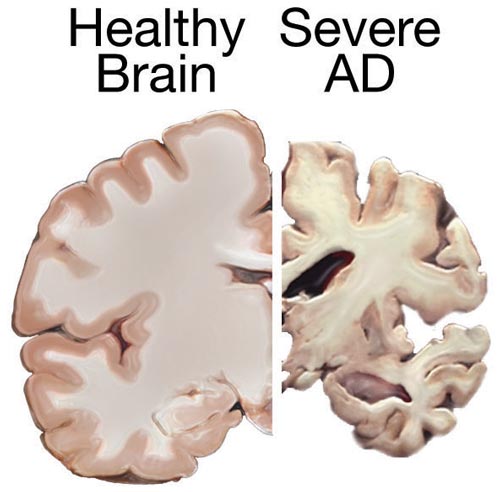
 Comparison of a healthy brain and a brain with severe Alzheimer's disease
Credit: Wikimedia

As many people know through personal experience with friends or family members, Alzheimer's is an implacably progressive neurodegenerative disease that  robs individuals of their memory, cognitive functions, ability to care for themselves, personalities and, eventually, their lives. It's currently the sixth leading cause of death in the U.S. and, strikingly, ". . . is the only disease in the 10 leading causes of deaths in the United States that cannot be cured, prevented or slowed."

A new study, however, opens up the possibility that Alzheimer's may in fact one day be slowed or prevented, if not cured. Working with mice genetically modified to develop Alzheimer's disease, neuroscientist Riqiang Yan* and his colleagues at the Cleveland Clinic-Lerner Research Institute in Cleveland, Ohio, found that gradually reducing an enzyme called BACE1 blocked the development of amyloid plaques, which are a central part of Alzheimer's pathology.

Although their study was complex and highly technical, the logic behind it is clear. BACE1 is one of two enzymes that snip amyloid precursor protein, or APP, into the shorter pieces that glom together into the plaques that are thought to disrupt and eventually kill neurons. Since BACE1 has important biological functions, removing it early in life or completely creates serious neuro-developmental problems. Still, the researchers reasoned, reducing it gradually in adult mice might slow or stop Alzheimer's without causing unacceptable side effects. That's exactly what they found.

"In our study," says Yan, " we showed that if we delete BACE1 in the adult mice, even after plaque formed, with sequential and increased deletion of BACE1 the plaque was removed. That indicates that if we can get to a patient early enough, it will be beneficial in removing amyloid plaque."

Yan was not surprised to see that lowered levels of BACE1 slowed or stopped the formation of new plaques. He was both surprised and excited to find already existing plaques cleared away--the first time that this has been seen. "To our knowledge," he says, "this is the first observation of such a dramatic reversal of amyloid deposition in any study of Alzheimer’s disease mouse models. We didn't expect the pre-existing plaque would be removed. That was the very interesting part, and warrants additional study to find out why."

While completely blocking BACE1 causes developmental and cognitive problems, a gradual lowering in adult mice appeared appeared safer. Those mice performed better on learning and memory tasks than untreated Alzheimer's prone mice.  However, they still showed some abnormalities in synaptic signalling. Despite this problem, Yan thinks that compounds can be developed that, when applied at the right time and at the right dose, will slow or stop the development of plaques, allow the brain to clear away existing ones, and so keep Alzheimer's at bay.

Prevention is more powerful than treatment

Yan compares this to the enormously successful use of statins to control cholesterol levels enough to block the development of atherosclerosis and heart disease, even though cholesterol has vital functions in the body. "The critical thing is will this lead to some safe drugs?" he asks. "We need to find something very safe like a vitamin that people can take every day without any concerns. Another similarity is to the statins, taking statins to prevent cholesterol from building up. The idea is that prevention is even more powerful that treatment." 

The next step for Yan and colleagues is to track the effects of reduced BACE1 on the mouse brain in more detail and on older mice. "Human patients are typically older than in the mouse model," he explains. "In the mouse model we started to delete [BACE1] at 4 months, which is like 20 years old for people. We now want to delete it in older mice. We need a new mouse model for this later stage."

Robert Vassar is a professor of neurology at Northwestern University, in Illinois, and a pioneer in the study of the role of BACE1 in Alzheimer's disease. He's very supportive of Yan's new findings, and, like Yan, thinks they hold significant promise for Alzheimer's prevention. Vassar too likes the analogy with statins and cardiovascular disease. "You can't turn off the tap of cholesterol, but you can turn it down enough to not accumulate the plaques in the heart that cause heart disease," he says. "It's saved the lives of many people. The BACE1 inhibitors can do the same, if we find the right dose and the right stage of the disease--how much to inhibit and when to treat." 

Vassar and Yan are both aware that years of further research with animals and humans are needed to turn these promising findings into a safe and effective preventative treatment for people. They foresee a long road, but one that urgently needs to be followed. "We have to bold about this disease," says Vassar.  "We're headed for an epidemic of this with the baby boomers, so we've got to do something."

As a baby boomer myself, I couldn't agree more!

-----

You can access Yan and his colleagues' full research paper here.

-----

*Professor Yan is currently Chair of the Department of Neuroscience and William Beecher Scoville Professor in Neuroscience at the University of Connecticut, in Farmington, Connecticut.

-----

If you enjoyed this post, please sign up to follow or receive email alerts from zerospinzone

-----


TK


TK


Monday, November 05, 2018

GUNS AND KIDS IN THE US

We all know that guns are a hot-button issue here in the United States. The Constitution grants and the Supreme Court affirms Americans' right to bear arms, and we do that to a fault. According to the Independent, US citizens own 40 percent of all the privately owned arms in the world, more than the next 25 most heavily armed countries combined. That's a remarkable 12 guns for every 10 of us, men, woman and children.

Many of those 393 million guns don't just sit unloaded, securely stored and unavailable to children. While millions of responsible gun owners do keep their weapons safely away from children, millions do not. Here's one sad result whose magnitude shocked me: According to Stephanie Chao, a pediatric surgeon and professor of surgery at Stanford University, children aged 15-19 in the US are 82 times more likely to die from gun homicide than in any other developed country.

Nearly 3000 US children die from firearm injuries every year
Photo credit: Mediapart

Please excuse my emphasis here: American teenagers are not twice as likely to die from a deliberate gunshot, not 10 times more likely, not 50 times more likely, but 82 times more likely. Than in any other developed country.

The statistics for younger children, and for suicide and accidental deaths from guns are not quite so horrendous, but the US is a consistent and clear outlier on every measure relating to gun deaths.

As a pediatric surgeon dealing with trauma every day, Chao would very much like to find ways to reduce or prevent these tragic deaths. Here's a clue that she found. State by state, laws make a difference.

"Firearm-related injuries are the second leading cause of death among children in the United States," she says, "but we found a clear discrepancy in where those deaths happen that corresponds with the strength of states' firearm legislation. In states with lenient laws, children die at alarmingly greater rates."

How much difference can gun laws make? Chao and her colleagues found that in states with the most relaxed gun laws 5 children out of every 100,000 die from gun-related injuries every year. States with the strictest gun-control laws cut that death rate nearly in half, down to 2.6 children out of every 100,000.

Saving half of children at risk from gun-related death would be a very good thing. Saving all of them would be even better. "Each and every one of these deaths is preventable," says Chao. "Our study demonstrates that state-level legislation prevents children from dying from guns."

When it comes to our children, perhaps we can get away from slogans and fiery rhetoric, and work towards sensible gun-safety laws in more states. Three thousand US children don't need to die from gunshots next year.

-----

As I write this, the 2018 midterm elections are just a day away. If you would like to find out about gun-control legislation and pro-gun-control candidates in your state, here's an excellent resource. Your vote could save young lives.

-----

There's a strong relationship between gun ownership and youth suicide. You can read a zerospinzone post about that here.


Tuesday, December 07, 2010

An Aspirin a Day Keeps the Doctor Away

Baby Aspirin Reduces Cancer Risk
It's well documented that taking low doses of aspirin every day reduces the risk of heart attacks and strokes. That's why millions of people worldwide are prescribed their daily baby aspirins.

A new analysis combining the results from eight long-term studies of the effects of low-dose aspirin now finds a significant reduction in deaths from a variety of cancers, most notably those of the digestive tract, but also cancer of the brain, lungs, prostate and pancreas.

Overall,taking low-dose aspirin for five years or more appeared to reduce the overall death rate from cancer by more than 20 percent.

You can read a summary of these findings on Suite101.

And, if you're interested, you can read the original paper in The Lancet.

Robert Adler