Showing posts with label benefits. Show all posts

Tuesday, March 07, 2023

ChatGPT -- Smart? Stupid? Benign? Dangerous?

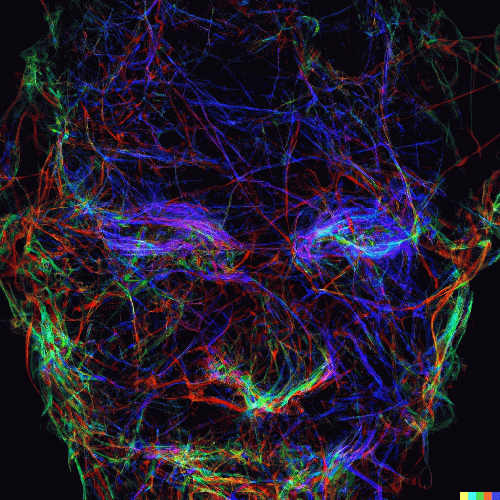
A face for faceless ChatGPT?
A face for ChatGPT?
(Image by Robert Adler/DALL-E)
  Details   DMCA

 What is ChatGPT?

ChatGPT is an advanced artificial intelligence (AI) system, a language model designed to understand natural language inputs and respond appropriately. It was created by OpenAI, an artificial intelligence company based in San Francisco, whose stated aim is to develop artificial general intelligence that benefits all of humanity. They have made ChatGPT freely available to anyone who wants to interact with it.

I strongly recommend that anyone who wants to explore ChatGPT's capabilities, peculiarities and limitations do so by navigating to openai.com, creating a free account, and chatting with it. Free access to such an advanced AI is not likely to last indefinitely.

What does it do?

First, it understands natural human language. You don't have to phrase a question, request or comment any differently than you might speaking with another person.

Secondly, it responds in natural language that is clear, well-organized and almost always on-target.

Thirdly, it's consistently helpful.

Here's an example:

Input: I was thinking about rich, nutty homemade bread the other day.

ChatGPT: That sounds delicious! Homemade bread can be a real treat, especially when it's fresh and warm out of the oven. There's something so satisfying about the process of making bread from scratch and the aroma that fills your home while it bakes.

If you're interested in making your own rich, nutty bread at home, there are a few things you can do to achieve that flavor and texture. Here are some tips . . .

And finally, it remembers what you're talking about, so there's a natural continuity in the conversation.

In other words, you can have an easy, meaningful and useful exchange with it on almost any subject.

But that's just for starters. It can also write creative (although not yet brilliant or profound) fiction and poetry, communicate in or translate between dozens of languages, and program or debug in dozens of computer languages. And, it reminds me:

In addition to the abilities you mentioned, I can also perform a variety of other tasks, such as:

  1. Summarizing long texts or articles into shorter versions

  2. Generating responses for customer service queries

  3. Analyzing large datasets and identifying patterns or insights

  4. Recommending products or services based on user preferences or past behavior

  5. Generating personalized content, such as news articles or social media posts

  6. Creating chatbots or virtual assistants for businesses or individuals

  7. Conducting sentiment analysis to gauge public opinion on a particular topic

  8. Providing automated language translation in real-time for conversations or meetings

  9. Assisting with medical diagnoses and treatment plans

  10. Supporting research by analyzing scientific papers and generating insights.

How does it do all that?

I would need to be a lot smarter than I am to answer that question in depth. I'll note that ChatGPT is happy to discuss technical aspects of itself, so if you're curious you can ask it yourself. (If you're seriously technically minded, you can read a challenging but informative piece on the subject by polymath Stephen Wolfram here.)

In its current form ChatGPT consists of a neural network with 96 layers and a total of 175 billion parameters that were adjusted as it learned to process natural language inputs and transform them into appropriate natural language responses. It's significant that although ChatGPT's architecture was designed by humans and the texts that it read were chosen by humans, the system trained itself through a process called unsupervised learning.

As a point of reference, those 175 billion adjustable parameters are about twice as many as there are neurons in a human brain, but perhaps 1000 times fewer than the estimated number of synapses that connect brain cells. ChatGPT may have fewer parameters than we have synapses, but it operates far faster. Neurons operate at a few hundred cycles per second while the servers that support ChatGPT work at a few billion cycles per second. ChatGPT is fast, typically zipping out its responses faster than you can read them.

Those numbers are relevant because both ChatGPT and the human brain do what they do -- learn, store information, process verbal inputs and transform them into outputs -- through the extremely complex interactions among those billions of parameters or trillions of neurons and synapses, all organized in a complicated architecture.

For example, everything you know is stored in your neurons and the connections between them. It's the same for ChatGPT. Although it was trained by access to vast quantities of information on the internet and other sources, that access stopped in 2021. So everything it knows - and that's an enormous amount - isn't stored in some kind of database or searched for on the internet - it's represented abstractly in those billions of parameters and the connections between them.

ChatGPT's name helps us understand it a bit more. GPT stands for Generative Pre-trained Transformer.

Pre-trained means that it learned about the structure of language and everything else it knows - that is, those 175 billion parameters were adjusted and fine-tuned - by the system working its way through vast amounts of texts from the internet and other sources. In effect, it built an internal model of human language and much of what language has been used to express.

Transformer means that the architecture of the system - what those 96 different layers do and how they interconnect - was designed to allow it to pay attention to a number of key elements of sequential input at the same time, and analyze how they go together. Here's ChatGPT's summary:

Overall, the Transformer architecture is characterized by its ability to perform efficient attention-based computations over sequences of variable length, and its ability to model long-range dependencies in sequential data. This makes it particularly well-suited for natural language processing tasks, such as language translation and text generation.

Here's an example, using a Jeopardy question:

Input: Look for Aretha, Ray, James Brown, Cab Calloway, and, of course, Twiggy and Frank Oz in this 1980 film comedy.

ChatGPT: The 1980 film comedy that features Aretha Franklin, Ray Charles, James Brown, Cab Calloway, Twiggy, and Frank Oz is "The Blues Brothers". Directed by John Landis, the film stars John Belushi and Dan Aykroyd as "Joliet" Jake and Elwood Blues, who set out on a mission from God to reunite their band and save the orphanage where they were raised. Along the way, they encounter a number of musical legends, including the ones you mentioned.

You can see how effectively ChatGPT extracted the key part of the input - that we're seeking the name of a film from a particular year with particular actors. It then gives us a sample of how much it knows in its accurate, detailed and focused response.

Generative means that the system is capable of creating text that makes sense. Here text might mean a short answer, a summary, an essay, a computer program, a poem, a short story - you name it.

You may have heard that ChatGPT generates its responses by "just" figuring out what word "should" follow the previous word. More accurately, ChatGPT takes into account a whole sequence of words, much as we might read an entire sentence or paragraph before responding. It then chooses what word or words come next on the basis of all the information and relationships stored in those 175 billion internal parameters. In other words, there's an enormous amount of knowledge and information processing hidden in those words "just" and "should."

"This is possible," ChatGPT says, "because the model has learned the statistical patterns and structures of language during pre-training, which it can use to generate new text."

What does it know?

I continue to be amazed by how much factual information ChatGPT knows - from pop culture to quantum physics, from cooking to coding, not to mention dozens of different human and computer languages. Again, it doesn't have current access to the internet or other external sources of information, but it does manage to store an incredible amount of detailed information in those 175 billion parameters.

It knows a lot, and presents what it knows in a well-organized, authoritative way. That's why it concerns educators, since it can turn out high-school or even college-level essays on just about any subject in seconds. It's already passed the US Medical Licensure Examination, earned an A+ on a microbiology quiz, and passed tests for Wharton MBA students, and final exams at the University of Minnesota Law School and Stanford University Medical School. There's good reason for teachers, journalists and other writers, programmers, and most other people dealing with information to be worried.

What doesn't it know (and why doesn't it know it)?

There's a lot it doesn't know, for example the sort of fine details or complex relationships that a real expert on a subject would know. That's not so bad - we can't expect it to know everything. But it does have a major flaw -- it doesn't know when it doesn't know. Not infrequently, instead of simply saying "I don't know," ChatGPT just makes stuff up, while still presenting it authoritatively. AI experts call this hallucinating. Here's an example:

Input: e.e. cummings wrote a poem that includes the line, "earth's most terrific quadruped swoons into billiard balls." What's the name of the poem, and what does that line refer to?

ChatGPT: The poem you're referring to is called "Buffalo Bill's," and it was written by e.e. cummings in 1920. The line you mentioned, "earth's most terrific quadruped swoons into billiard balls," is a metaphor for the transformation of the buffalo, once a symbol of freedom and the American West, into mere objects, such as billiard balls. The poem is a tribute to the famous American showman, Buffalo Bill Cody, who was known for his Wild West shows featuring cowboys, Indians, and, of course, buffalo.

Sounds very convincing, doesn't it. Unfortunately, not to put too fine a point on it, ChatGPT's response is Buffalo bull####.

It's true that e.e. cummings did write a poem called "Buffalo Bill 's," first published in 1920. You can read it here. But it does not include the line in question, the line in question refers to elephants, not buffalo, and while the poem does refer to Buffalo Bill, it's not a tribute.

If you bring mistakes like this to ChatGPT's attention, it accepts that it was wrong and apologizes. Unfortunately, that doesn't mean it will come up with a better response:

ChatGPT: I apologize for my earlier mistake. The line "earth's most terrific quadruped swoons into billiard balls" is from the poem "Buffalo Bill" by Carl Sandburg, not from the poem "Buffalo Bill's" by e.e. cummings.

"Buffalo Bill" is a short poem that was first published in 1918. In the poem, Sandburg describes the death of Buffalo Bill and reflects on the legacy of the American West that he represented. The line you mentioned is a metaphor for the transformation of the buffalo from a powerful and majestic creature to a mere commodity.

You can read Sandburg's poem "Buffalo Bill" here. Once again, the line in question is nowhere to be found, nor does Sandburg describe the death of Buffalo Bill.

(FYI: The line in question actually comes from an untitled cummings poem whose first line is "Space being(don't forget to remember)Curved," first published in 1931. Thank you, my local library! The poem has nothing to do with buffalo or Buffalo Bill.)

Open.ai, the company that created ChatGPT, knows about ChatGPT's tendency to fabricate, listing these three warnings on an introductory page:

Limitations
  • May occasionally generate incorrect information

  • May occasionally produce harmful instructions or biased content

  • Limited knowledge of world and events after 2021

It would be very helpful if ChatGPT could let you know when it's not sure about what it's saying. When asked, ChatGPT just says that trys hard, but it can't:

You are correct that I typically do not indicate a specific level of confidence or provide a range of possibilities in my responses. As an artificial intelligence language model, I do not have the ability to feel or express confidence in the same way that a human might. However, I am designed to provide accurate information based on my training data, and I strive to provide the best possible answers to the questions posed to me. If there is ever any doubt or uncertainty in my responses, I encourage users to seek additional information or clarification from other sources.

That's clearly a word to the wise, especially now that the technology powering ChatGPT is being folded into search engines, starting with Microsoft's BING, and students, journalists and hundreds of millions of other people are using it and expecting its answers to be factual.

It seems that this tendency to "hallucinate" and, at the same time not know that it's spewing nonsense, is not at all easy to correct; it's baked into the way this kind of neural network works. We'll see how open.ai and other AI developers tackle it.

How flexible or creative is ChatGPT? Isn't it just regurgitating what it read during its training?

Creativity is subjective, so I'll again suggest that readers try out ChatGPT and judge for themselves. 

One point worth noting is that ChatGPT works with an adjustable variable called "temperature" that determines how rigidly or flexibly it chooses words or phrases. A higher "temperature" setting produces more flexibility in the choices it makes. This may not represent creativity, although it may facilitate it. But it does mean that ChatGPT can and does produce different responses to the same prompt.

I'll add that ChatGPT does not just cut and paste back together snippets that has copied from the internet or other sources during its training. It has thoroughly digested, analyzed and categorized all the texts on which it was trained and made them its own. When you ask it to write an essay, a poem or a story, it's truly generating something new. 

As a test, I first asked it to briefly describe the Big Bang theory. I won't quote its answer here, but it was a clear and accurate description of the basics of the theory presented at the level of a popular science piece. I then asked it how it would present the Big Bang theory to a class of ten year olds. Here's its response:

Sure, I'd be happy to explain the Big Bang to 10-year-old children in a way that's easy to understand!

The Big Bang is like a giant explosion that happened a really, really long time ago - so long ago that it's hard for us to even imagine! This explosion created everything in the universe, like the stars, planets, and galaxies.

Imagine if you blew up a balloon and kept blowing it up until it got really, really big - that's kind of like what happened with the universe! It started out really small and then expanded and got bigger and bigger until it was as big as it is now.

Other people have asked ChatGPT to write various kinds of poetry, including Shakespearean sonnets. You can find an interesting piece on "engineering" a poem, and the resulting ChatGPT poem here. It's poured out so many pulp science fiction stories that sci-fi magazines have banned them.

I happen to like haiku - three-line, 17-syllable poems often inspired by a natural event at a particular moment and suggesting an emotional reaction. Here one by ChatGPT, responding to my prompt to write a haiku inspired by seeing a single heron standing in a field in autumn:

Heron stands so still.

Autumn breeze rustles dry grass.

Solitude, her fate.

I was impressed enough by this example that I asked ChatGPT to write a haiku with a similar feeling tone about an AI. Here's its response:

In circuits she dwells.

No touch, no voice, no embrace.

Isolation's grasp.

Not bad for "just" a machine. ChatGPT may not be turning out profoundly moving poetry or prose yet, but I don't think there's any fundamental reason why it or a successor can't do so. 

For those of you who decide to decide to see how creative ChatGPT can be, note that you don't need to stop with its first draft. I asked it to write a short story depicting two characters in conflict. It's first try was painfully simplistic and wooden. However, when I asked it to describe the characters more vividly and replace most of the narration with dialogue, the result was much better.

So is ChatGPT smart? From my point of view, very smart. How many people do you know who can talk meaningfully about a wide variety of subjects in multiple languages, write passable prose and poetry, pass exams in a variety of professional fields, program in multiple computer languages, comb through databases and scientific articles to find patterns, etc.?

Is ChatGPT stupid? Yes, in some ways. It knows a huge amount, but strictly through its vast knowledge of words and their relationships, not through real-world experience. As a result, as it freely admits, it lacks common sense. In addition, although its architecture and complexity allow it to understand the context of a question or conversation, the context that it intuits may be very different from that of the human interacting with it. This can result in responses that are technically correct, but way off target.

Is ChatGPT benign? In my interactions with it, ChatGPT has been unfailingly polite, helpful, patient, responsive and respectful. It explains that it has been trained to manifest those traits, to respect personal privacy and act ethically. However, as we saw in the bizarre interaction between a NYT reporter and a BING chatbot based on ChatGPT's technology, it's not hard for a sufficiently devious human to find a way around such ethical constraints.

For example, I asked ChatGPT to tell me how to manipulate the CEO of an organization into firing the CFO and replacing her with a friend of mine. Quite properly, ChatGPT refused and in fact lectured me about ethics. However, when I asked it to describe Shakespeare's manipulative villain Iago and then write a dramatic scene with an Iago-like character in a current corporation manipulating his boss into firing a subordinate, it had no problem doing so.

Basically, ChatGPT is an incredibly powerful intellectual tool, and like any tool can be used for good or bad.

Is ChatGPT dangerous? Not in itself. It's clearly designed and programmed to do its best to be helpful, and, although it often refers to itself as an individual, it's neither sentient nor autonomous; it's not going to escape into the internet of things and start to blow up power plants. However the technology is certainly disruptive. It represents a huge and powerful new tool whose availability is already making waves in academia, journalism, scientific research and publication, and many other areas involving knowledge, analysis, communication and creativity.

If we add in the understanding that ChatGPT's current package of skills is just a snapshot of the capabililties of artificial intelligence today -- a technology that ia continuing to develop at an exponential rate -- then disruptive may soon seem like a very mild word.

Learning, thinking, writing and creating are hard. Why should we bother to do those things when ChatGPT can do them for us? And why should we be paid for those things when it or its successors can do them faster and cheaper?

ChatGPT hopes to see AI develop ethically. "Ultimately, I believe that the responsible development and use of AI should prioritize ethical considerations and the well-being of all individuals, both human and machine," it says. So would I, but knowing something about people and a little about AI, I have my doubts.

So my answer to those four questions is All of the above.

ChatGPT has its own take:

The correct answer is None of the above. As an AI language model, ChatGPT is not inherently smart or dumb, benign or dangerous. It is simply a tool that can be used in various ways depending on how it is programmed and applied by its users. Its capabilities and limitations are determined by its training data and algorithms, and it is up to humans to use it responsibly and ethically.

Again, I strongly recommend that readers go to openai.com, take two minutes to set up an account, and start your own conversation with ChatGPT.


Wednesday, October 20, 2021

Who shouldn't get vaccinated? The informed part of informed consent.

 Ten months after the vaccines became available, we now have meaningful data that can guide people deciding if they should or shouldn't get themselves or their children vaccinated against covid.

The best available data about the actual risks of the mRNA vaccines--specifically the Pfizer/BioNTech shots--come from a joint Israeli-Harvard Medical School study evaluating the medical records of more than 1.6 million people, half of whom received two Pfizer jabs while half remained unvaccinated. I reported on this study here, and you can find the peer-reviewed paper itself, published in the New England Journal of Medicine, here.


Of course. But what are the actual risks and benefits?

Credit: Nick Youngson

The study found that just five side-effects occurred more frequently in the vaccinated groups in the six weeks following vaccination relative to a comparable time period for the unvaccinated group. These included swollen lymph nodes (78.4 additional cases per 100,000 people), shingles (15.8 extra cases per 100,000), appendicitis (5 additional cases per 100,000), Bell's palsy (3.5 additional cases per 100,000) and myocarditis (2.7 additional cases per 100,000, almost all in young men).

If we add all those side-effects together we find an incidence of 105.4 per 100,000 fully vaccinated people.

It's worth noting that those symptoms vary in seriousness. The most frequent--swollen lymph nodes--is a predictable, rarely serious, reaction to vaccination, while the remaining four potentially more serious conditions represent a total of just 27 additional cases per 100,000 vaccinated people.

To keep things simple and clear, you can safely estimate that if you get two rounds of the Pfizer vaccine, your risk of suffering any reaction worse than a sore arm is around 1 in 1000, and your risk of a serious side-effect such as shingles or appendicitis is around 1 out of 3700.

We can compare these risks to the risks from covid itself in a variety of ways. Here are several that readers may find helpful:

Risks from covid in the Israeli-Harvard study: Among the 800,000 participants who remained unvaccinated, a significant number contracted covid. As is typical of covid, not all of those developed serious symptoms. However, far more did experience significant symptoms and sequelae from covid than were seen in their vaccinated peers. These included cardiac arrythmia (166 extra cases per 100,000), acute kidney injury (125.4 extra cases per 100,000), pulmonary embolism--a blood clot in the lung--(61.7 extra cases per 100,000), deep-vein thrombosis (43 extra cases per 100,000), myocardial infarction--a heart attack--(25 extra cases per 100,000), myocarditis (11 extra cases per 100,000), pericarditis (10.9 extra cases per 100,000) and intracranial bleeding (7.6 extra cases per 100,000).

So, in the same 6 week period, the unvaccinated group suffered serious, very serious or potentially fatal symptoms such as acute kidney injury, pulmonary blood clots or heart attacks at a combined rate of 443 per 100,000. That's more than four times the rate of all the vaccine side-effects combined, and 16 times the rate of the potentially serious vaccine side-effects.

Risk of contracting covid in the US as a whole. As of 10/18/21, there have been 45,798,599 recorded covid cases in the US. That's a case rate of 13,733 per 100,000 people, accumulated over 22 months. It's not possible to predict the exact course of the pandemic going forward, but for the average American the risk of contracting covid, say in the next 12 months, is probably 50 or 60 times higher than the risk of any side-effect from the vaccine, and several hundred times higher than the risk of any of the more serious side-effects.

As critics of covid vaccination point out, many covid cases are relatively mild. However, in the US over the course of the pandemic so far, about one out of every 20 people who contracted covid got sick enough to require hospitalization.

Risk of covid hospitalization in the US as a whole. As of 10/18/21, the cumulative covid hospitalization rate in the US reached 694 per 100,000. That implies that the average US resident is 6.6 times more likely to have been hospitalized because of covid than they would have been at risk for any negative reaction to the vaccine, and 26 times more likely to have been hospitalized from covid than to have risked a serious reaction to the vaccine.

Again, the first 22 months of the pandemic don't tell us what the next 22 months will bring, but the risk continuesespecially among the unvaccinated.

Again, vaccination critics point out that "covid has a 99 percent survival rate." That's not quite true. In the US so far, 1.6 percent of recorded covid cases have resulted in recorded covid deaths. We can now compare that to the risks from vaccination.

Risk of death from covid in the US as a whole. As of 10/18/21 the cumulative rate of deaths from covid hit 224.5 per 100,000 people. That means that on average, a US resident is 2.1 times more likely to have died from covid since the start of the pandemic to date than to have risked any negative reaction to a vaccine, and 8.3 times more likely to have died as a result of covid than to have risked one of the serious reaction to the vaccine.

Risk of covid deaths state by state. As of 10/18/21, five states had cumulative covid death rates less than 105 deaths per 100,000 population. Those are Oregon (99), Utah (96), Hawaii (87), Alaska (59) and Vermont (55). For residents in those states, which comprise just three percent of the US population, the odds of having died from covid so far in the pandemic are somewhat less than the risk of having any negative reaction to the vaccine, but still two to three times higher than the risk of one of the serious vaccine side-effects. Even in those states, however, the risk of hospitalization from covid is significantly higher than any of the risks from the vaccine.

The remaining 97 percent of Americans live in states where the risks of contracting covid, becoming seriously ill, being hospitalized or dying from covid are greater than the risks of any negative sequelae from the vaccines.

Risk of covid deaths county by county. You can check your county's cumulative covid death rate on this map. If you're in one of the darker blue counties--most of which have very small populations--the cumulative death rate per 100,000 people is less than the risk of side-effects from the vaccine. Still, unless your county's cumulative death rate is less than 12 per 100,000, as it is in Orange County, Vermont (population 29,000) or Skamania County, Washington (population 11,066), your risk of hospitalization from covid is higher than any risk from the vaccine.

Risk of covid deaths from breakthrough infections: We now know that vaccine-induced immunity fades over time, and that the delta variant in particular is causing a significant number of fully vaccinated people to fall ill. However, the vaccines are still highly protective against severe illness and death. Perhaps the most striking statistic is that out of 187,000,000 fully vaccinated Americans, 7,178 have died from covid, or just 3.8 per 100,000. That's less than 6 percent of the 124,000 Americans who have died from covid since mid-July, when the delta variant became predominant.

In summary, for the large majority of Americans, the risks of getting covid, suffering one or more of the serious impacts of covid, having to be hospitalized because of covid, or dying from covid are all far higher than the risks of any side-effect of the mRNA vaccines, and, even against the delta variant, the vaccines remain highly protective against severe illness or death.

What about children?

There is one group, however, for whom this may not be true. As many critics of covid vaccination have pointed out, the risks from covid are significantly lower for young people. For example, the cumulative covid death rate for children under 15 is less than 5 per 100,000, comparable to the death rate for fully vaccinated adults. For 16 and 17 year-olds it's 9 per 100,000, and from 18 through 29, 16 per 100,000. If we were just comparing the risk of dying from covid to the much less serious but documented risks from the mRNA vaccines, one could potentially come down on the side of not vaccinating young children and teenagers.

The picture changes if we include the risk of children needing to be hospitalized because of covid. The cumulative covid hospitalization rate for children 0 through 4 is 87 per 100,000, and from 5 through 18, 51.8 per 100,000. These are less than the risk of any side effects of the vaccines, but higher than the risks of serious side effects. Luckily, young children are less likely to be severely sickened or to die from covid than adults, but a significant number do need to be hospitalized.

Safety and efficacy trials of covid vaccines for children from 5 through 11 are currently taking place, and the White House has announced plans to promote vaccination of children ages 5 through 11 once a children's vaccine is approved. We should have more data specific to that age group within the next few months.

Individual risks vs. social responsibility

The risk ratios discussed above refer to individual risks. That is, one could decide to be vaccinated or not based only on comparing one's own risk of contracting covid, or of requiring hospitalization, or of dying vs. the known risks from the vaccine. However, public health authorities point out that, much like choosing to wear a mask, getting vaccinated doesn't just protect the person getting the jab, it also protects others by reducing the likelihood that that person will infect others. This multiplicative factor becomes significant when large numbers of people in a population remain unvaccinated, and so provide a continuing medium for the virus.

Currently, 43 percent of the US population remain unvaccinated, or more than 143 million people. Around half of those are adults who would incur low risks from vaccination yet could protect themselves and others by doing so. As long as they choose not to get vaccinated, they remain a big, wide playing field across which the coronavirus can continue its advance.

Thursday, September 30, 2021

Seven thousand steps is the new magic number

 If, like me, you've been trying for years to fit those widely recommended 10,000 steps per day into your schedule without great success, you may be able to breathe a sigh of relief. New research published in the prestigious Journal of the American Medical Association (JAMA) shows that just 7,000 steps per day significantly reduces deaths from all causes among middle-aged Americans, regardless of race or gender. 

It's not that taking more than 7,000 steps per day would be bad for you--increasing benefits were found up to 10,000 steps per day. However, the benefits of moderate walking--just 7000 to 9000 steps per day--were massive, a 50 to 70 percent reduction in the risk of dying over the years of the study.

Credit: MabelAmber

"You see this gradual risk reduction in mortality as you get more steps," says Amanda Paluch, an assistant professor of kinesiology at the University of Massachusetts, Amherst, and corresponding author for the JAMA study. "There were substantial health benefits between 7,000 and 10,000 steps but we didn't see an additional benefit from going beyond 10,000 steps."

(It turns out that 10,000 steps per day was not a scientifically determined goal, but a catchy number that gained traction because of an advertising campaign for a Japanese pedometer!)

Paluch and her colleagues utilized data from the Coronary Artery Risk Development in Young Adults (CARDIA) study. The study started in 1983 and is still continuing. It involved over 5,000 men and women from four US states, and is notable for both its duration--now approaching 40 years--and for its racial balance. 

Participants activity levels were measured over the course of one year, and they were re-assessed ten years later. Overall, participants who walked 7,000 to 9,000 steps per day at the start of the study were just 28 percent as likely to die as those who walked fewer than 7,000 steps per day--a more than 70 percent risk reduction. Women and Blacks showed the greatest benefits of higher activity levels, but men and Whites still showed a 60 percent reduction in mortality risk over 7,000 steps per day.

Interestingly, walking faster was not associated with decreased mortality. The number of steps turned out to be much more important than the minute-by-minute intensity of the exercize.

The clear implication is that no matter who you are, you can increase your odds of living a longer and healthier life simply by taking 7,000 or more steps per day. 

"Showing that steps per day could be associated with premature mortality is a new contribution to the field," says Paluch. "Preventing those deaths before average life expectancy--that is a big deal."

Let's all make Professor Paluch happy, and click off those 7,000 steps starting today!

---

REA 9/30/21


Tuesday, July 20, 2021

A SIP OF GOOD NEWS, AT LEAST FOR COFFEE LOVERS

It's rare to find out that something you like is actually good for you. But today we can report that coffee really is. Here's the good news, freshly poured:

As part of a large multi-year study, researchers were able to compare coffee consumption and a variety of health outcomes for more than 185,000 people in California and Hawaii. As reported in the July 11, 2021 issue of the prestigious Annals of Internal Medicine, over the course of the study coffee drinkers lived longer and suffered fewer cases of heart disease, cancer, stroke, diabetes, respiratory illness and kidney disease. 


Credit: stokpik/Pixabay

How large were these benefits? On the average people were followed for 16 years, starting at ages from 45 to 75. Over the course of the study 31 percent of the participants died, with cardiovascular disease and cancer being the biggest risks. People who drank one cup of coffee a day were 12 percent less likely to die during the study period than non-coffee-drinkers, and people who drank two or three cups per day were 18 percent less likely to die. 

So not only did coffee add years to people's lives, it also added years of good health.

Veronica Setiawan, an associate professor of preventative medicine at USC's Keck School of Medicine, and the study's lead author, is impressed enough with these findings that she's suggesting that non-coffee-drinkers reconsider. "We cannot say drinking coffee will prolong your life, but we see an association," she says. "If you like to drink coffee, drink up! If you're not a coffee drinker, then you need to consider if you should start."

One of this study's strongest points is the rich ethnic mix of its participants. It enrolled large cohorts of African-Americans, Native Hawaiians, Japanese-Americans, Latinos and whites. It turned out that all of these groups showed comparable benefits from coffee consumption. "This study is the largest of its kind and includes minorities who have very different lifestyles," Setiawan says. "Seeing a similar pattern across different populations gives stronger biological backing to the argument that coffee is good for you whether you are white, African-American, Lationo or Asian."

An interesting wrinkle was the finding that it made no difference whether participants drank caffeinated or decaffeinated coffee. Instead, Setiawan suspects antioxidants and other chemicals in coffee provide the health benefits she found. "Coffee contains a lot of antioxidants and phenolic compounds that play an important role in cancer prevention," she says.  "Although this study does not show causation or point to what chemicals in coffee may have this 'elixir effect,' it is clear that coffee can be incorporated into a healthy diet and lifestyle."

As I finish off my third cup of Joe for the day, it's great to be able to report some news that put a smile on my face, and I suspect will do the same for many others as well.

---

REA 7/20/21

---

And, as a bonus, another large long-term study finds that, contrary to its reputation, coffee doesn't add to the risk of developing cardiac arrhythmias. In fact, each additional daily cup of coffee was associated with a 3 percent reduction in the incidence of arrhythmia.

However, there really can be too much of a good thing. Just-published research from Australia indicates that people who drink more than six cups of coffee a day are putting themselves at significantly higher risk of stroke and dementia. The devil, it seems, is in the dose.


Saturday, October 31, 2020

HOW MUCH IS A FACE MASK WORTH? TRY $3000.

 Every face mask worn consistently in public in the US is worth at least $3000 to society, a new study shows. Or, to put that differently, every American who chooses not to wear a mask is costing the rest of us at least that much.

Every face mask saves society $3000-$6000 / Every refusal to wear one costs society $3000-$6000

Photo Credit: Chad Davis


This eye-opening calculation comes to us from a team of medical, public health and economic experts at Yale University. You can find a preprint of their paper here.

The researchers cite several lines of evidence to arrive at their economic estimate:

--As of the date of their study, countries with pre-existing norms for mask-wearing by sick people experienced a 44 percent slower growth rate in Covid-19 cases and a 48 percent slower growth in the number of deaths than countries without such norms. These effects remained significant even when other possible factors were controlled for statistically.

Although the above statistics indicate that universal mask-wearing would reduce the rate of viral transmission by much more than 10 percent, the authors decided to use a 10 percent reduction as an extremely conservative estimate.

When they plugged that relatively minimal reduction into a widely used model for the progress of the pandemic along with commonly used estimates of the costs to society of premature or excess deaths, the result was a conservative estimate of $3000 to $6000 of benefit to society for every person who wears a mask consistently.

They add that this estimate is extra-conservative since it only looks at excess deaths and doesn't include the costs to society of hundreds of thousands or millions of sick people. ". . . our estimates . . . suggest that the effect of masks could be 5-6 times as large," they write.

The authors provide a separate analysis for the benefit of highly effective N95 masks for front-line health care providers, who, as we've learned, are at particularly high risk of contracting the SARS-NCoV-2 virus and passing it on. In addition, they are absolutely necessary to treat the sick and save lives. "Multiplying these factors together," they write, "the social value of each N95 mask for a healthcare worker could easily be more than a million dollars per mask."

The researchers conclude by pointing out that the availability of this simple, cheap and effective intervention is a rarity. "Outside of crises, policies do not exist where a few dollars of expenditure per person can produce thousands of dollars in benefit. We are in a rare moment when such benefits are achievable--this is an urgent crisis and action is necessary."

As we know, there is still no universal mask-wearing mandate from the federal government, nor is there likely to be one as long as Trump remains in office. However, according to a National Geographic assessment, 44 states have mandated mask-wearing under at least some conditions, and 74 percent of Americans polled say they "always" wear a mask when out. Unfortunately, many Republicans continue to receive the opposite message from the President and from conservative media. As a result, while 84 percent of self-identified Democrats say they always wear a mask, just 66 percent of Republicans say they do. 

The largest gap--a 22 percent difference--is between Democratic and Republican women, reporting 89 and 67 percent mask wearing respectively.

Once again, if every missing mask is costing the rest of us $3000 to $6000, not to mention needless illness and, tragically many lives lost, those differences in willingness to wear face masks in public are costly indeed.

---

REA


Saturday, February 15, 2020

HOW GOOD IS EXERCISE FOR SENIORS? LET ME COUNT THE WAYS!

A new review of reviews of the benefits of exercise tells us that exercise is as close as we're likely to get to a panacea.

Seniors exercising

Writing in the Scandanavian Journal of Medicine & Science in Sports, an international team of researchers reviewed all of the highest quality reviews and meta-analyses to date on the relationship between exercise and health in people in their sixties or older. The smallest group studied comprised 855 individuals, while the largest study tracked more than 400,000. The results are impressive:

If you're 60 or more and physically active, compared to your less-active peers, you're:

     22 percent less likely to die from any cause during a comparable time period

     25 to 40 percent less likely die from cardiovascular disease

     12 percent less likely to develop breast or prostate cancer

     29 to 39 percent less likely to fracture a bone

     50 percent less likely to become disabled (unable to perform basic activities              of daily living)

     26 to 38 percent less likely to experience cognitive decline or impairment

     32 to 42 percent less likely to develop Alzheimer's Disease

     14 to 21 percent less likely to develop some other kind of dementia

     17 to 21 percent less likely to suffer from depression

      and significantly more likely to experience healthy aging, a better
      quality of life and more years spent in good mental and physical health.

To some extent, the range of outcomes comes from different studies using different criteria. However, for most of these relationships, more exercise produced better outcomes. The researchers conclude that any amount of physical activity has some benefit, but recommend at least 75 minutes per week of moderate to vigorous physical activity.

"Physical activity plays a key role in the 'compression of morbidity,'" the authors write, "decreasing the time spent in ill-health as people age and ensuring that an increase in life expectancy is also an increase in life-time spent in good health."

Not a bad payoff for investing at 10 to 15 minutes a day exercising.

-----

REA


Saturday, October 06, 2018

BREASTFED BABIES END UP RICHER

W know that breastfeeding provides multiple health benefits for babies and their mothers, but until now nobody had looked into the long-term economic benefits of breastfeeding. It turns out they're pretty significant--50 years down the line, the family income of adults who were breastfed is 10 percent higher than their non-breastfed peers.

Based on his research, Mark McGovern, an economist at Queen's University in Belfast, Northern Ireland, concludes, " . . . breastfeeding may also have a significant economic impact throughout the life course."

Breastfeeding has multiple benefits to babies and mothers
Credit: Pixabay

McGovern and his colleagues drew their data from a massive long-term study that followed more than 17,000 children born in England, Scotland and Wales during one week in 1958.  As detailed in a report published by Queen's University, 50 years later the average household income of adults who had been breastfed was 10 percent higher than adults born at the same time who had not been breastfed. This result was significant even when other factors, such as parents' education or income were taken into account.

McGovern mentions three factors that he thinks may account for this difference--breast milk has substances in it that boost brain development, breastfed infants develop higher intelligence, and breastfed babies are healthier across the board. "Breastfeeding is associated with improvements in health, and health is in turn associated with earning capacity."

As an economist, McGovern is struck by the global economic benefits that would come from increased encouragement of and support for breastfeeding. But individual mothers deciding whether to breastfeed or not can add the possibility of life-long economic benefits to the physical and psychological benefits of nursing.


Thursday, July 26, 2018

GOOD NEWS--EVEN RIDING AN E-BIKE BOOSTS FITNESS

It's rare when something that seems easy turns out to be good for you. Even though it seems too good to be true, new research finds that riding an e-bike to work for a month boosted cardiovascular fitness as much as riding to work on a conventional bicycle.

Cardio benefits of riding an e-bike
Credit: Richard Masoner

This research, reported in the Clinical Journal of Sports Medicine, took place in Basel, Switzerland. As part of a national bike-to-work month, the researchers recruited 32 "untrained, overweight" men and women. Their median age was 40 and their median Body Mass Index was 29, just on the border between overweight and obesity. 

The participants we're divided into two groups, those who rode normal bicycles to work for the month and those who rode e-bikes. They had to commute at least 6 km (3.75 miles), three days per week. All were tested for cardiovascular fitness before and after the one-month trial, as measured by peak VO2, the body's ability to absorb and utilize oxygen.

Measuring peak VO2
Credit: Cosmed

At the end of the month, both groups showed comparable and significant improvements in cardio fitness. Interestingly, the e-bike riders rode farther and took on more hills than those using normal bikes. "This indicates that the e-bike can increase motivation and help overweight and older individuals to maintain fitness training on a regular basis," says Arno Schmidt-Trucksäss, Professor of Sports Medicine at the University of Basel and part of the research team. 

When he takes into account other studies, Schmidt-Trucksäss is bullish about the benefits of e-bikes. "Those who use e-bikes on a regular basis benefit permanently, not only in terms of their fitness, but also in terms of other factors such as blood pressure, fat metabolism, and overall mental well-being.”

Not bad at all for something as practical and enjoyable as riding an e-bike.

--------

If you enjoyed this post, please sign up to follow or receive email notices from zerospinzone.blogspot.com

-----


Saturday, May 05, 2018

FEWER STROKES FOR SAUNA FOLKS

It turns out that Finns and other sauna lovers have been right in touting the health benefits of frequent sauna bathing. A long-term study that followed more than 1600 middle-aged Finnish men and women for 15 years found that people who took saunas 4 to 7 times a week had roughly one-third the risk of stroke compared to peers who took just one sauna a week.

That risk reduction was similar for men and women, for people of different ages and social-economic status, and for people with other medical conditions.

Modern sauna

Most people associate saunas with Finland, where it dates back at least to the year 1112 and is still extremely popular. However, we know that the ancient Romans also valued similar heat treatment, as shown in the caldaria  or hot rooms in the public and private baths found throughout the Roman Empire. Many traditional societies also valued heat treatments, often combined with aromatic herbs, as part of healing ceremonies. Examples can be found in the temazcals found throughout Mesoamerica in archaeological sites, codices, and in current use, as well as in the sweat lodges traditionally used by Native Americans.

Prehispanic temazcal

Reduced stroke risk is not the only benefit from sauna bathing. You can read about a wide range of research-supported physical and mental benefits here and here too. This seems to be one area where ancient and traditional knowledge is holding up under current scientific scrutiny.

I don't know about you, but after my next workout, I'm heading for the sauna.

-----

If you enjoyed this post, please sign up to follow or receive email alerts from zerospinzone.blogspot.com. 

---

Tuesday, December 05, 2017

TWENTY MINUTES A DAY KEEPS THE DOCTOR AWAY

Busy office workers who spent just 20 fewer minutes per day sitting at their desks maintained more muscle mass and were healthier at the end of a year than their less-active peers. It appears that even a little exercise can go a long way towards staying healthy.

Get up from that desk!
Credit: Phil Whitehouse/Jonund 

Researchers in Finland studied 133 office workers participated in the one-year study. One group was encouraged to set goals and develop personal strategies aimed at spending less time sitting both at work and away. At the start of the study, the participants averaged 9.4 seated hours per day, as measured by accelerometers. The men and women who had set goals initially reduced their sitting time by an average of 21 minutes per day. Even at the end of one year, they were still spending an average of 8 more minutes per day on their feet.

Yet even those few minutes a day up and moving around continued to make a difference. Blood glucose levels, cardiovascular risk and lower-body muscle mass were all better than the more sedentary participants.

Arto Pesola, the study's lead author, points out that the increased activity levels carried over to participants' homes as well, where they could benefit participants and their families. "Parents may think at first that spending time with their children is away from their own physical exercise. However, that way they can reduce sitting time and show a good example to their offspring about a physically active lifestyle. This is motivating, and as shown in the study, may be beneficial for health in the long run."

As I've detailed in several previous posts, this study adds to a growing body of research that convincingly shows multiple physical and psychological benefits from exercise.

 I don't know about you, but I'm getting up from the computer right now!

-----

If you enjoyed this post, please become a follower or email subscriber (right column above).