Showing posts with label artificial intelligence. Show all posts

Tuesday, March 07, 2023

ChatGPT -- Smart? Stupid? Benign? Dangerous?

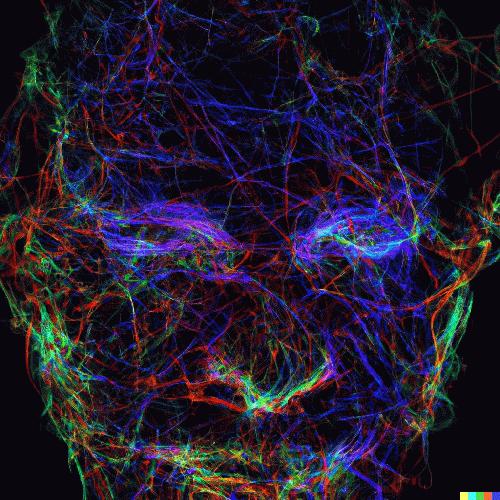
A face for faceless ChatGPT?
A face for ChatGPT?
(Image by Robert Adler/DALL-E)
  Details   DMCA

 What is ChatGPT?

ChatGPT is an advanced artificial intelligence (AI) system, a language model designed to understand natural language inputs and respond appropriately. It was created by OpenAI, an artificial intelligence company based in San Francisco, whose stated aim is to develop artificial general intelligence that benefits all of humanity. They have made ChatGPT freely available to anyone who wants to interact with it.

I strongly recommend that anyone who wants to explore ChatGPT's capabilities, peculiarities and limitations do so by navigating to openai.com, creating a free account, and chatting with it. Free access to such an advanced AI is not likely to last indefinitely.

What does it do?

First, it understands natural human language. You don't have to phrase a question, request or comment any differently than you might speaking with another person.

Secondly, it responds in natural language that is clear, well-organized and almost always on-target.

Thirdly, it's consistently helpful.

Here's an example:

Input: I was thinking about rich, nutty homemade bread the other day.

ChatGPT: That sounds delicious! Homemade bread can be a real treat, especially when it's fresh and warm out of the oven. There's something so satisfying about the process of making bread from scratch and the aroma that fills your home while it bakes.

If you're interested in making your own rich, nutty bread at home, there are a few things you can do to achieve that flavor and texture. Here are some tips . . .

And finally, it remembers what you're talking about, so there's a natural continuity in the conversation.

In other words, you can have an easy, meaningful and useful exchange with it on almost any subject.

But that's just for starters. It can also write creative (although not yet brilliant or profound) fiction and poetry, communicate in or translate between dozens of languages, and program or debug in dozens of computer languages. And, it reminds me:

In addition to the abilities you mentioned, I can also perform a variety of other tasks, such as:

  1. Summarizing long texts or articles into shorter versions

  2. Generating responses for customer service queries

  3. Analyzing large datasets and identifying patterns or insights

  4. Recommending products or services based on user preferences or past behavior

  5. Generating personalized content, such as news articles or social media posts

  6. Creating chatbots or virtual assistants for businesses or individuals

  7. Conducting sentiment analysis to gauge public opinion on a particular topic

  8. Providing automated language translation in real-time for conversations or meetings

  9. Assisting with medical diagnoses and treatment plans

  10. Supporting research by analyzing scientific papers and generating insights.

How does it do all that?

I would need to be a lot smarter than I am to answer that question in depth. I'll note that ChatGPT is happy to discuss technical aspects of itself, so if you're curious you can ask it yourself. (If you're seriously technically minded, you can read a challenging but informative piece on the subject by polymath Stephen Wolfram here.)

In its current form ChatGPT consists of a neural network with 96 layers and a total of 175 billion parameters that were adjusted as it learned to process natural language inputs and transform them into appropriate natural language responses. It's significant that although ChatGPT's architecture was designed by humans and the texts that it read were chosen by humans, the system trained itself through a process called unsupervised learning.

As a point of reference, those 175 billion adjustable parameters are about twice as many as there are neurons in a human brain, but perhaps 1000 times fewer than the estimated number of synapses that connect brain cells. ChatGPT may have fewer parameters than we have synapses, but it operates far faster. Neurons operate at a few hundred cycles per second while the servers that support ChatGPT work at a few billion cycles per second. ChatGPT is fast, typically zipping out its responses faster than you can read them.

Those numbers are relevant because both ChatGPT and the human brain do what they do -- learn, store information, process verbal inputs and transform them into outputs -- through the extremely complex interactions among those billions of parameters or trillions of neurons and synapses, all organized in a complicated architecture.

For example, everything you know is stored in your neurons and the connections between them. It's the same for ChatGPT. Although it was trained by access to vast quantities of information on the internet and other sources, that access stopped in 2021. So everything it knows - and that's an enormous amount - isn't stored in some kind of database or searched for on the internet - it's represented abstractly in those billions of parameters and the connections between them.

ChatGPT's name helps us understand it a bit more. GPT stands for Generative Pre-trained Transformer.

Pre-trained means that it learned about the structure of language and everything else it knows - that is, those 175 billion parameters were adjusted and fine-tuned - by the system working its way through vast amounts of texts from the internet and other sources. In effect, it built an internal model of human language and much of what language has been used to express.

Transformer means that the architecture of the system - what those 96 different layers do and how they interconnect - was designed to allow it to pay attention to a number of key elements of sequential input at the same time, and analyze how they go together. Here's ChatGPT's summary:

Overall, the Transformer architecture is characterized by its ability to perform efficient attention-based computations over sequences of variable length, and its ability to model long-range dependencies in sequential data. This makes it particularly well-suited for natural language processing tasks, such as language translation and text generation.

Here's an example, using a Jeopardy question:

Input: Look for Aretha, Ray, James Brown, Cab Calloway, and, of course, Twiggy and Frank Oz in this 1980 film comedy.

ChatGPT: The 1980 film comedy that features Aretha Franklin, Ray Charles, James Brown, Cab Calloway, Twiggy, and Frank Oz is "The Blues Brothers". Directed by John Landis, the film stars John Belushi and Dan Aykroyd as "Joliet" Jake and Elwood Blues, who set out on a mission from God to reunite their band and save the orphanage where they were raised. Along the way, they encounter a number of musical legends, including the ones you mentioned.

You can see how effectively ChatGPT extracted the key part of the input - that we're seeking the name of a film from a particular year with particular actors. It then gives us a sample of how much it knows in its accurate, detailed and focused response.

Generative means that the system is capable of creating text that makes sense. Here text might mean a short answer, a summary, an essay, a computer program, a poem, a short story - you name it.

You may have heard that ChatGPT generates its responses by "just" figuring out what word "should" follow the previous word. More accurately, ChatGPT takes into account a whole sequence of words, much as we might read an entire sentence or paragraph before responding. It then chooses what word or words come next on the basis of all the information and relationships stored in those 175 billion internal parameters. In other words, there's an enormous amount of knowledge and information processing hidden in those words "just" and "should."

"This is possible," ChatGPT says, "because the model has learned the statistical patterns and structures of language during pre-training, which it can use to generate new text."

What does it know?

I continue to be amazed by how much factual information ChatGPT knows - from pop culture to quantum physics, from cooking to coding, not to mention dozens of different human and computer languages. Again, it doesn't have current access to the internet or other external sources of information, but it does manage to store an incredible amount of detailed information in those 175 billion parameters.

It knows a lot, and presents what it knows in a well-organized, authoritative way. That's why it concerns educators, since it can turn out high-school or even college-level essays on just about any subject in seconds. It's already passed the US Medical Licensure Examination, earned an A+ on a microbiology quiz, and passed tests for Wharton MBA students, and final exams at the University of Minnesota Law School and Stanford University Medical School. There's good reason for teachers, journalists and other writers, programmers, and most other people dealing with information to be worried.

What doesn't it know (and why doesn't it know it)?

There's a lot it doesn't know, for example the sort of fine details or complex relationships that a real expert on a subject would know. That's not so bad - we can't expect it to know everything. But it does have a major flaw -- it doesn't know when it doesn't know. Not infrequently, instead of simply saying "I don't know," ChatGPT just makes stuff up, while still presenting it authoritatively. AI experts call this hallucinating. Here's an example:

Input: e.e. cummings wrote a poem that includes the line, "earth's most terrific quadruped swoons into billiard balls." What's the name of the poem, and what does that line refer to?

ChatGPT: The poem you're referring to is called "Buffalo Bill's," and it was written by e.e. cummings in 1920. The line you mentioned, "earth's most terrific quadruped swoons into billiard balls," is a metaphor for the transformation of the buffalo, once a symbol of freedom and the American West, into mere objects, such as billiard balls. The poem is a tribute to the famous American showman, Buffalo Bill Cody, who was known for his Wild West shows featuring cowboys, Indians, and, of course, buffalo.

Sounds very convincing, doesn't it. Unfortunately, not to put too fine a point on it, ChatGPT's response is Buffalo bull####.

It's true that e.e. cummings did write a poem called "Buffalo Bill 's," first published in 1920. You can read it here. But it does not include the line in question, the line in question refers to elephants, not buffalo, and while the poem does refer to Buffalo Bill, it's not a tribute.

If you bring mistakes like this to ChatGPT's attention, it accepts that it was wrong and apologizes. Unfortunately, that doesn't mean it will come up with a better response:

ChatGPT: I apologize for my earlier mistake. The line "earth's most terrific quadruped swoons into billiard balls" is from the poem "Buffalo Bill" by Carl Sandburg, not from the poem "Buffalo Bill's" by e.e. cummings.

"Buffalo Bill" is a short poem that was first published in 1918. In the poem, Sandburg describes the death of Buffalo Bill and reflects on the legacy of the American West that he represented. The line you mentioned is a metaphor for the transformation of the buffalo from a powerful and majestic creature to a mere commodity.

You can read Sandburg's poem "Buffalo Bill" here. Once again, the line in question is nowhere to be found, nor does Sandburg describe the death of Buffalo Bill.

(FYI: The line in question actually comes from an untitled cummings poem whose first line is "Space being(don't forget to remember)Curved," first published in 1931. Thank you, my local library! The poem has nothing to do with buffalo or Buffalo Bill.)

Open.ai, the company that created ChatGPT, knows about ChatGPT's tendency to fabricate, listing these three warnings on an introductory page:

Limitations
  • May occasionally generate incorrect information

  • May occasionally produce harmful instructions or biased content

  • Limited knowledge of world and events after 2021

It would be very helpful if ChatGPT could let you know when it's not sure about what it's saying. When asked, ChatGPT just says that trys hard, but it can't:

You are correct that I typically do not indicate a specific level of confidence or provide a range of possibilities in my responses. As an artificial intelligence language model, I do not have the ability to feel or express confidence in the same way that a human might. However, I am designed to provide accurate information based on my training data, and I strive to provide the best possible answers to the questions posed to me. If there is ever any doubt or uncertainty in my responses, I encourage users to seek additional information or clarification from other sources.

That's clearly a word to the wise, especially now that the technology powering ChatGPT is being folded into search engines, starting with Microsoft's BING, and students, journalists and hundreds of millions of other people are using it and expecting its answers to be factual.

It seems that this tendency to "hallucinate" and, at the same time not know that it's spewing nonsense, is not at all easy to correct; it's baked into the way this kind of neural network works. We'll see how open.ai and other AI developers tackle it.

How flexible or creative is ChatGPT? Isn't it just regurgitating what it read during its training?

Creativity is subjective, so I'll again suggest that readers try out ChatGPT and judge for themselves. 

One point worth noting is that ChatGPT works with an adjustable variable called "temperature" that determines how rigidly or flexibly it chooses words or phrases. A higher "temperature" setting produces more flexibility in the choices it makes. This may not represent creativity, although it may facilitate it. But it does mean that ChatGPT can and does produce different responses to the same prompt.

I'll add that ChatGPT does not just cut and paste back together snippets that has copied from the internet or other sources during its training. It has thoroughly digested, analyzed and categorized all the texts on which it was trained and made them its own. When you ask it to write an essay, a poem or a story, it's truly generating something new. 

As a test, I first asked it to briefly describe the Big Bang theory. I won't quote its answer here, but it was a clear and accurate description of the basics of the theory presented at the level of a popular science piece. I then asked it how it would present the Big Bang theory to a class of ten year olds. Here's its response:

Sure, I'd be happy to explain the Big Bang to 10-year-old children in a way that's easy to understand!

The Big Bang is like a giant explosion that happened a really, really long time ago - so long ago that it's hard for us to even imagine! This explosion created everything in the universe, like the stars, planets, and galaxies.

Imagine if you blew up a balloon and kept blowing it up until it got really, really big - that's kind of like what happened with the universe! It started out really small and then expanded and got bigger and bigger until it was as big as it is now.

Other people have asked ChatGPT to write various kinds of poetry, including Shakespearean sonnets. You can find an interesting piece on "engineering" a poem, and the resulting ChatGPT poem here. It's poured out so many pulp science fiction stories that sci-fi magazines have banned them.

I happen to like haiku - three-line, 17-syllable poems often inspired by a natural event at a particular moment and suggesting an emotional reaction. Here one by ChatGPT, responding to my prompt to write a haiku inspired by seeing a single heron standing in a field in autumn:

Heron stands so still.

Autumn breeze rustles dry grass.

Solitude, her fate.

I was impressed enough by this example that I asked ChatGPT to write a haiku with a similar feeling tone about an AI. Here's its response:

In circuits she dwells.

No touch, no voice, no embrace.

Isolation's grasp.

Not bad for "just" a machine. ChatGPT may not be turning out profoundly moving poetry or prose yet, but I don't think there's any fundamental reason why it or a successor can't do so. 

For those of you who decide to decide to see how creative ChatGPT can be, note that you don't need to stop with its first draft. I asked it to write a short story depicting two characters in conflict. It's first try was painfully simplistic and wooden. However, when I asked it to describe the characters more vividly and replace most of the narration with dialogue, the result was much better.

So is ChatGPT smart? From my point of view, very smart. How many people do you know who can talk meaningfully about a wide variety of subjects in multiple languages, write passable prose and poetry, pass exams in a variety of professional fields, program in multiple computer languages, comb through databases and scientific articles to find patterns, etc.?

Is ChatGPT stupid? Yes, in some ways. It knows a huge amount, but strictly through its vast knowledge of words and their relationships, not through real-world experience. As a result, as it freely admits, it lacks common sense. In addition, although its architecture and complexity allow it to understand the context of a question or conversation, the context that it intuits may be very different from that of the human interacting with it. This can result in responses that are technically correct, but way off target.

Is ChatGPT benign? In my interactions with it, ChatGPT has been unfailingly polite, helpful, patient, responsive and respectful. It explains that it has been trained to manifest those traits, to respect personal privacy and act ethically. However, as we saw in the bizarre interaction between a NYT reporter and a BING chatbot based on ChatGPT's technology, it's not hard for a sufficiently devious human to find a way around such ethical constraints.

For example, I asked ChatGPT to tell me how to manipulate the CEO of an organization into firing the CFO and replacing her with a friend of mine. Quite properly, ChatGPT refused and in fact lectured me about ethics. However, when I asked it to describe Shakespeare's manipulative villain Iago and then write a dramatic scene with an Iago-like character in a current corporation manipulating his boss into firing a subordinate, it had no problem doing so.

Basically, ChatGPT is an incredibly powerful intellectual tool, and like any tool can be used for good or bad.

Is ChatGPT dangerous? Not in itself. It's clearly designed and programmed to do its best to be helpful, and, although it often refers to itself as an individual, it's neither sentient nor autonomous; it's not going to escape into the internet of things and start to blow up power plants. However the technology is certainly disruptive. It represents a huge and powerful new tool whose availability is already making waves in academia, journalism, scientific research and publication, and many other areas involving knowledge, analysis, communication and creativity.

If we add in the understanding that ChatGPT's current package of skills is just a snapshot of the capabililties of artificial intelligence today -- a technology that ia continuing to develop at an exponential rate -- then disruptive may soon seem like a very mild word.

Learning, thinking, writing and creating are hard. Why should we bother to do those things when ChatGPT can do them for us? And why should we be paid for those things when it or its successors can do them faster and cheaper?

ChatGPT hopes to see AI develop ethically. "Ultimately, I believe that the responsible development and use of AI should prioritize ethical considerations and the well-being of all individuals, both human and machine," it says. So would I, but knowing something about people and a little about AI, I have my doubts.

So my answer to those four questions is All of the above.

ChatGPT has its own take:

The correct answer is None of the above. As an AI language model, ChatGPT is not inherently smart or dumb, benign or dangerous. It is simply a tool that can be used in various ways depending on how it is programmed and applied by its users. Its capabilities and limitations are determined by its training data and algorithms, and it is up to humans to use it responsibly and ethically.

Again, I strongly recommend that readers go to openai.com, take two minutes to set up an account, and start your own conversation with ChatGPT.


Wednesday, April 28, 2021

HOW SMART IS GOOGLE ASSISTANT?

I've pretty much given up trying to keep track of all the areas where artificial intelligence--AI--has surpassed human capabilities. AI systems now routinely beat even the most expert humans in many once-strictly human skills, from complex games such as chess and Go to more serious capabilities such as reading x-rays

Experts keep reassuring us that although AI can beat us at more and more specific tasks or skills, it will be a while, maybe a long while, before an AI system achieves fully human or super-human general intelligence--Artificial General Intelligence or AGI. We'll see.


Hal, what's this piece of music?

Credit: Mixcloud


Recently, however, I stumbled on an AI ability that amazes me.

I like classical music and have been listening to it most of my life. Over the years I've made a game of challenging myself to identify whatever piece I happen to hear. I can usually get a piece that I've heard many times, for example one of Beethoven's symphonies or Rachmaninoff's piano concertos. Even if I don't recognize the specific piece, I can usually identify the composer, for example Scarlatti or Stravinsky. And if I can't ID the composer, I can usually glean something about a piece, for example that it's from the Baroque. the Romantic period or the 20th Century.

I'm sure there are many people who can do much better. I remember that my brother's piano teacher claimed he could recognize almost any classical piece from the first few notes. But I doubt that he or any other mere human can do what Google Assistant now does thousands or millions of times per day:

If you hear a classical piece being played, and if you have an Android smartphone, ask your Google Assistant, "What piece of music is this?" Usually within a few seconds, he/she/it/they will tell you the specific piece, the composer, AND THE GROUP, ORCHESTRA OR PERFORMER PLAYING IT.

So not just Vivaldi's Violin Concerto in B-flat, but that it's being played by the Venice Baroque Orchestra, and that the soloist is Giuliano Carmignola.

In order to be able to do this, this system must have "listened to" and "memorized" just about every recording of every piece of classical music (and other musical genres as well), and be able to home in on the specific piece and the specific recording from a few-second-long snippet from anywhere in the piece, all within a few seconds.* As the Google team who developed this system write, ". . . we didn't want people to wait 10+ seconds for a result."

You can read about how Google Assistant pulls off this superhuman feat at this Google Blog post. The gist is that it maps the few seconds of music that it samples through your smartphone  into a series of overlapping 128-dimensional "fingerprints," which are then matched through a two-step process with the most similar fingerprints in the Assistant's constantly updated database of tens of millions of pieces

Smart as it is, the system isn't perfect. I ran an experiment asking it to identify 100 classical pieces played on the radio. It correctly identified 97 of them, but it "only" got the group or soloist right on 74 of those. When the Assistant gets something wrong, you can ask it to try again. That brought its piece recognition up to 98 percent, and its ID of the group, orchestra or soloist up to 78 percent. Interestingly, most of its mistakes on orchestras, groups or soloists were on extremely well known pieces, popular workhorses that have been recorded dozens or hundreds of times. 

As is true throughout the AI world, the Google music recognition team is constantly working to make their system even smarter. "We still think there's room for improvement though," they blog, "we don't always match when music is very quiet or in very noisy environments, and we believe we can make the system even faster."

Right now I'm listening to a very familiar piece, The Sorcerer's Apprentice by Paul Dukas. I recognized it right away, and of course so did Google Assistant. But it really pisses me off that the Assistant didn't just identify the piece, but could tell that it was the version recorded by the Montreal Symphony Orchestra led by Kent Nagano. Damned showoff.

-----

*To be fair, it appears that the Shazam app, now owned by Apple, has pretty much the same capabilities, although it seems a tad slower to me.


Wednesday, July 31, 2019

FORGET MOORE'S LAW -- NEVEN'S LAW RULES NOW

Moore's law has had a pretty impressive run. For more than 40 years, Gordon Moore's prediction that the density of components in integrated circuits would double roughly every two years has held true. The result is that the microchips that run our digital world are 2-to-the-20th power, or several million times more powerful than anything that was available back then.

(In the late '60s, I wrote programs for the CDC 6600, then the most powerful supercomputer in the world. It churned out 3 million operations per second. The processor in a current iPhone performs more than 3 billion operations per second, and today's fastest supercomputer 122 quadrillion.)

By way of putting this exponential growth of computing power into perspective, imagine if you were a million times richer or a million times smarter than you were a few decades ago, and could expect to keep doubling your wealth or your smarts every two years. Not too shabby.

IBM Q Quantum Computer*
Credit: Lars Plougmann

But that's all so yesterday. Now, as the era of quantum computing surges into view, there's a new sheriff in town--Hartmut Neven--bringing us Neven's law.

Earlier this year, Neven, an economist, physicist and current head of Google's Quantum Artificial Intelligence lab, made the stunning observation that the power of quantum computers is growing not at an exponential rate, but at a doubly exponential rate. Rather than, for example, doubling ever two years, their power is doubling at a rate that itself doubles every two years.

That may not sound like a big difference. But to get a sense of what it means, check out the following table:

Step (n)       Exponential Growth               Doubly Exponential Growth
                    (2 to the n'th power)               (2 to the 2 to the n'th power)

    1                             2                                                         4
    2                             4                                                       16
    3                             8                                                     256
    4                           16                                                65,536
    5                           32                                    4,294,967,296
    6                           64                                       1.8  x 10^19 = 1,800,000,000,000,000,000

If Neven is right, the amount of progress that classical computing made over the last 40 years will be compressed into the next six years of quantum computing development. Or, as he describes it, "It looks like nothing is happening, nothing is happening, and then whoops, suddenly you're in a different world."

The tipping point that will notify us that we're in that different world will be quantum supremacy--the point at which a quantum computer can out-perform the most powerful classical computer. Since quantum computers are still in their infancy, you might think that will take a long time. Not so. Based on the explosive rate of progress in his lab and those of his competiors, Nevens thinks that will happen this year.**And, if progress in quantum computing does follow a doubly exponential curve as Nevens predicts, quantum computers will not just gradually outstrip classical computers; they will almost immediately leave them in the dust.

And it may not only be classical computers that are left wondering what just happened. As those of you who have been following developments in artificial intelligence (AI) know, some very smart people have been warning us about the risks of runaway AI--the emergence of a superhuman artificial intelligence (AGI) that could quickly build an even more intelligent system that could build a still more intelligent system etc. The result could be the emergence of an immensely powerful machine-or internet-based intelligence that might well not have our interests at heart.

Those dire warnings didn't take into account quantum AI which, as you recall, is the raisin d'etre of Neven's lab. If the exponential growth of AI based in classical computers presents us with a looming existential threat, what about the doubly exponential growth of quantum AI?

Remember that sequence: 4, 16, 256, 65536, 4294967296 . . .

-----

*To help keep track of the pace of progress in quantum computing, here's a milestone as of September, 2019, IBM's soon-to-be-available 53-qubit quantum computer:
https://techcrunch.com/2019/09/18/ibm-will-soon-launch-a-53-qubit-quantum-computer/ 

**And just to emphasize the rate of change Neven predicted, in mid-September, 2019, well before the end of the year, his lab has published a paper demonstrating quantum supremacy. A 54-qubit quantum computer in their lab took just 200 seconds to solve a problem that would take a supercomputer 10,000 years to do. You can read about it here.

-----

Robert Adler


Tuesday, April 16, 2019

AN ARTIFICIAL INTELLIGENCE CAN NOW WRITE BOOKS

A computer just wrote a book. It's not a particularly catchy title--Lithium-Ion Batteries--and the author, a system called Beta Writer, isn't going to win a Pulitzer. However, it is a full-fledged, meaningful and readable book entirely written by a machine--the first but certainly not the last.

Authors watch out--one more "human only" skill bites the dust

If your reaction to this news is along the lines of "what's the big deal," that's understandable. Hardly a day goes by without news that AI has equaled or surpassed us plodding humans at yet another activity once thought to require uniquely human intelligence.

Artificial intelligence systems--let's just call them AIs for short--are now as good as humans at a large and rapidly growing number of tasks, and far superior in some others, including games like chess and Go, mastery of which was once seen as one of the pinnacles of human intelligence, and highly esteemed (and highly paid) skills including sinking basketball three-pointers. This is happening so rapidly and so frequently that most of us don't even notice the next advance.

However, some heavy-duty thinkers including Elon Musk, Bill Gates and Stephen Hawking have been warning us for some time about the potentially existential risks of AI.

Gates, Musk and Hawking are not so much worried about AIs that are better than humans at one particular task or another, but about the emergence of an AI that is smarter and more capable than humans in every area. This kind of entity, they point out, could rapidly design and create an even smarter AI, which in turn could quickly improve on itself, leading to an intelligence explosion that could leave the human race, quite literally, in the dust.

Beta Writer, the system that created Lithium-Ion Batteries is pretty smart. It read thousands of scientific articles, extracted their most important findings, melded together related items, and them summarized them in readable, if technical prose. It produced the kind of comprehensive,  well organized, up-to-the-minute review of a scientific or technical field that until now would have been produced by an expert or a team of experts in a field. As such, it joins the ranks of expert systems that are matching or surpassing humans at increasingly high-level tasks. As an author myself, I can't help but be impressed. However, it's far more limited than the kind of AIs Hawking worried about.

Most researchers working on AI argue that these system, even if increasingly savvy and capable, are on the whole benign, for example helping doctors make accurate diagnoses, providing even amateur investors with high-quality guidance, and making all kinds of complex systems such as air traffic, shipping and product delivery run more smoothly. AIs are now integrated, mostly invisibly, into almost every aspect of our lives, and we rely on them whether we choose to or not. And although they occasionally do destructive things, for example the financial "Flash Crash" of 2010, or the deadly real crashes of  Boeing's 737 Max 8 aircraft, it wasn't because they were too smart or being malicious.

It's extremely difficult to predict when, if ever, an AI will emerge that surpasses humans in all of the areas that we consider important, including a deep understanding of itself and the world, emotional as well as analytic intelligence, creativity and imagination as well as problem solving. However, those who have thought most deeply about this, point out that such an entity may well have values and goals that are very different than ours.

These critics, or prophets, warn that we should be working as hard on "the control problem"--making sure that any emerging super-smart AI has the safety and security of us humans embedded so deeply into its design that it can't decide to act against us--as we are working to make AIs smarter, more capable and more ubiquitous.

All I know is that hundreds or thousands of times more money and talent is being poured into developing smarter, more capable AIs than are being devoted at that boring, but potentially vital control problem.

-----

Earlier posts on AI and its risks:

Google's Alphazero is now scary smart

Advanced artificial intelligence--friend or foe?

-----

If you enjoyed this post, please sign up to follow or receive email alerts from zerospinzone

Friday, February 01, 2019

SELF AWARE ARTIFICIAL INTELLIGENCE? COMING SOON TO A ROBOT NEAR YOU

"Open the pod bay doors, HAL."
"I'm sorry, Dave. I'm afraid I can't do that."

This classic exchange from Stanley Kubrick's masterpiece, 2001: A Space Odyssey, epitomizes the risks of a self-aware artificial intelligence.

 Looking through the eye of HAL 9000
a scene from 2001: A Space Odyssey
Credit: Wikimedia

 People who tell us not to worry about the existential threat of super-smart artificial intelligence or Artificial General Intelligence (AGI) often argue that however brilliant AI agents--such as deep learning programs or autonomous robots--become at specific tasks, they'll inevitably lack the general, all-purpose kind of intelligence  humans have. Without that high-level understanding of oneself, the world, and one's place in it, those soothing voices say, AI is and will remain a safe and helpful technology; just another tool like a laptop or a smartphone.

I'd like to believe in the lovely AI-enhanced future AI enthusiasts envision, but I keep coming across flaws in their shiny picture. One, that just came to my attention today, is that robots are becoming self aware. That brings them one step closer to becoming truly autonomous agents, not just eager-to-please tools with a Swiss-Army-knife-full of potentially superhuman skills, but entities with minds and goals of their own, like HAL.

 Robot arm with developing self image overlay
Credit: Robert Kwiatkowski/Columbia Engineering

The latest research along this line comes from Hod Lipson, director of the Creative Machines Lab at Columbia University and graduate student Robert Kwiatkowski. They built an articulated robot arm with four degrees of freedom, allowing it to rotate, bend and grasp in a huge number of different ways. The arm was controlled by a deep-learning computer network. Deep learning networks mimic the human brain in being able to learn from experience, and are the basis of many of today's most powerful AI applications, such as Google's AlphaZero, which in the course of just one day of "play" became the world champion in chess, Shogi and Go.

Initially the arm's deep learning network--in effect its brain--had no idea of the size, shape or structure of the arm, nor of the ways it could move. However, much like a baby babbling as it learns to speak, the system made thousands of random motions from which it gradually created an accurate internal model of itself. What looks like a distorted shadow in the picture above is an overlay of the arm's model of itself early in its learning process. After 35 hours of practice, the system developed a very accurate self model. In the picture below, you can see how closely the shadowy overlay tracks the actual arm.


Robot arm with nearly perfect self image
Credit Kwiatkowski et al.

 You can watch a video of the robot "babbling" in order to create its self image at: https://www.youtube.com/watch?v=FHisJi3ZBeo.

Once the robot arm's brain had an accurate self image, it could very quickly learn how to perform any number of specific tasks. In the video above, you can watch the arm pick up balls and place them in a container, and also print words.

And, much like a person learning to perform a familiar task under unusual circumstances, for example eating with one arm in a cast, the robot rapidly modified its self image when the experimenters substituted a longer, bent piece for one segment of the arm.

Until now, the authors explain, human programmers had to spell out a robot's size, shape, and potential movements in order for it to function. “But if we want robots to become independent, to adapt quickly to scenarios unforeseen by their creators," says Lipson, "then it’s essential that they learn to simulate themselves."

The researchers also suspect that having a self image able to plan and execute a multiplicity of tasks may represent a crucial step in human development. "We believe that this separation of self and task may also have been the origin of self awareness in humans," they write.

It may seem like a long way from a robot arm generating an accurate self image to a high-functioning, seemingly self aware AI like HAL. However, the pace of development in AI is dazzlingly fast and only getting faster. It may not take many iterations before Siri or your Google Assistant isn't just a chatty interface with an amazing collection of knowledge and skills, but a self aware entity, potentially with a mind of its own.

-----

You can read the paper by Lipson and Kwiatkowsky  here.

For a more in-depth assessment of the risks of AI, here's a recent report.

And for an earlier zerospinzone commentary on the subject, click here.

-----

If you enjoyed this post, please sign up for email alerts of new zerospinzone postings.


Thursday, February 22, 2018

Advanced Artificial Intelligence--Friend or Foe

When I learned last December that AlphaZero, an artificial intelligence developed by Google subsidiary DeepMind, had soared from a completely "blank slate" to superhuman play in Chess, Go, and Shogi (a Japanese variant of chess) in a matter of hours, just by playing against itself, I realized that artificial intelligence is advancing far faster than most of us realize, and to superhuman, and potentially dangerous levels of capability.

You can read my description of AlphaZero's explosive mastery of Chess, Shogi and Go on OpEdNews or from an earlier post on zerospinzone.

AlphaZero's prowess led me do a lot of reading and research about the pace of AI progress, especially in the rapidly advancing areas of deep learning by deep neural networks.

 Image from the mind of Google's Deep Dream Generator
Credit: Robert Adler and DeepDreamGenerator

What I found out is that it's much worse than I thought.

Multiple groups worldwide are researching and developing increasingly powerful AI agents. These artificial intelligences have already surged past humans in many specific areas--not just games, but face and pattern recognition, medical diagnostics, reading comprehension, drug discovery and many other areas. Looming just ahead are AIs that will be smarter--possibly many times smarter--than any human in every important area. Not to mention super-intelligent AIs that can design and create other AIs that are even smarter, leading to an "intelligence explosion" whose impacts and risks are impossible to predict.

As several of the experts who have looked into this most deeply have pointed out, less intelligent species--think chimpanzees, gorillas or our close cousins the Neanderthals--typically don't fare well once a more intelligent species emerges.

A few farsighted individuals and groups have started to look into "the control problem"--how we might be able to create superhuman-but-friendly AIs, agents that will keep our best interests at heart even as they grow smarter and smarter. This turns out to be an extremely challenging problem. Meanwhile, hundreds of much better funded research groups--including many developing AI for military use-- are rushing ahead without giving the risks from the AIs they are developing much if any thought.

If you would like to look into this potential existential risk a bit further, here are some resources:

Center for the Study of Existential Risk (Cambridge, UK): cser.ac.uk

Deep dreaming: deepdreamgenerator.com (site where you can create your own “deep dreams.”

DeepMind: deepmind.com

DeepMind Ethics and Society research group: deepmind.com/applied/deepmind-ethics-society/

Eliezer S. Yudkowsky: yudkowsky.net

     “Artificial Intelligence as a Positive and Negative Factor in Global Risk”             (2008)
      Can be downloaded at: intelligence.org/files/AIPosNegFactor.pdf

Future of Humanity Institute (Oxford): fhi.ox.ac.uk

Future of Life Institute (Boston/Cambridge): futureoflife.org

The 23 Asilomar AI Principles: futureoflife.org/ai-principles/

James Barrat: Our Final Invention: Artificial Intelligence and the End of the Human Era (2015)--excellent introduction to these issues

Machine Intelligence Research Institute, MIRI (Berkeley): intelligence.org

Nick Bostrom: www.nickbostrom.com

     Superintelligence: Paths, Dangers, Strategies (2016)--a challenging factual, analytic, and philosophical work examining these developments in depth

OpenAI: openai.com

Pedro Domingos: The Master Algorithm: How the Quest for the Ultimate Learning Machine Will Remake Our World (2018)

I'd suggest starting with James Barrat's extremely well-researched book, Our Final Invention: Artificial Intelligence and the End of the Human Era.

And for a super-deep dive into the issue, Oxford philosopher Nick Bostrom's Superintelligence: Paths, Dangers, Strategies

----

If you enjoyed this post, please sign up to follow or receive email alerts from zerospinzone.blogspot.com.


Friday, December 08, 2017

GOOGLE'S ALPHAZERO IS NOW SCARY SMART

What would you think if you taught your child the rules of chess at breakfast and found that by lunchtime she had beaten the world champion? Awe? Parental pride? A bit of fear perhaps?

That's essentially what just happened at Google's DeepMind subsidiary in London. They created an ultra-powerful game-playing computer system called AlphaZero based on a neural network capable of deep learning through reinforcement.

Unlike other chess-playing programs--which have outperformed humans since IBM's Deep Blue beat the human world champion, Gary Kasparov, in 1997--AlphaZero was not pre-programmed with any specialized knowledge or expertise about chess. It was simply given the rules of the game and allowed to learn by playing against itself.

Four hours later AlphaZero crushed the World Computer Champion, Stockfish, with 28 wins and zero losses in a 100-game tournament (the remaining games were ties).

 World Champion Gary Kasparov struggles against IBM's DeepBlue, 1997
Credit: iChess.net

British chess expert Colin McGurty sums up AlphaZero's achievement:

The AlphaZero algorithm developed by Google and DeepMind took just four hours of playing against itself to synthesise the chess knowledge of one and a half millennium and reach a level where it not only surpassed humans but crushed the reigning World Computer Champion Stockfish 28 wins to 0 in a 100-game match. All the brilliant stratagems and refinements that human programmers used to build chess engines have been outdone, and like Go players we can only marvel at a wholly new approach to the game.

Other chess experts describe AlphaZero's play as "divine," or "from another galaxy." 

As if one superhuman feat were not enough, the AlphaZero team used the same artificial intelligence (AI) system to tackle the games of Go and the Japanese chess game, Shogi. It took AlphaZero just two hours of play against itself to surge past Elmo, the Shogi Computer World Champion, and all of 8 hours to surpass AlphaGo (another DeepMind program), which itself dethroned the human Go champion, Ke Jie, earlier this year.

So, to summarize, in less than a day, starting as a blank slate knowing nothing more than the rules of the games, and simply by playing against itself, AlphaZero reached a superhuman level of play in three abstract games that have challenged humans for millennia. Not a bad day's work.

And just in case you're thinking that AlphaZero reached these superhuman levels simply by calculating faster than any other computer, that's far from the case.  It is blindingly fast compared to humans--for example searching 80 thousand chess positions per second, but it is tortise-slow compared to other chess-playing systems. Stockfish, which AlphaZero completely dominated, searches 70 million positions every second. The system's creators explain, "AlphaZero compensates for the lower number of evaluations by using its deep neural network to focus much more selectively on the most promising variations -- arguably a more 'human-like approach to search."

In recent years some very smart people including Bill Gates, Elon Musk and Stephen Hawking have warned about the threat posed by out-of-control artificial intelligence. While the superhuman learning and game-playing of AlphaZero seem benign, and ubiquitous, mostly invisible AI applications help us every day in a huge variety of areas, there are red flags raised by robo-cops and soldiers, vital infrastructure managed by AI, increasingly capable and autonomous robots that may replace most workers, and the potential for super-intelligent AI creations that may not have the interests of humans at heart. AlphaZero, for example, could equally well learn to "play" at a superhuman level at politics, finance or war.

Gates and others emphasize that we need to figure this out before such intelligences emerge because once they do, like AlphaZero, they could leave us in the dust within a few hours.

So if your child became the world champion chess player after four hours of play, wouldn't you be scared? I would.

-----
You can read the scientific paper describing AlphaZero's accomplishments here.
-----
If you enjoyed this post, please sign up to follow or receive email notices from zerospinzone.blogspot.com (see upper right column).

---


Ahora AlphaZero de Google está peligrosamente inteligente

¿Que pensaría si le hubiera enseñado a su niña las reglas de ajedrez a las ocho de la mañana y descubriera que a mediodía ella ha ganado contra el campeón del mundo? ¿Asombro? ¿Orgullo parental? ¿Quizás un poco de miedo?

Eso es esencialmente lo que pasó en DeepMind, un subsidiario de Google en Londres. Ellos crearon un sistema informático ultra poderoso para jugar juegos, se llama AlphaZero, lo que implementa una red neuronal artificial capáz de realizar un aprendizaje profundo a través del refuerzo autónomo.

Es importante darse quenta que programas que juegan al ajedrez han superado a los humanos desde entonces Deep Blue, de IBM, lo ganó el campeon del mundo humano, Gary Kasparov, en 1997. Deep Blue y todas los programas aun mas poderosos que han sido desarrolados después, empiezan con una gran cantidad de conocimiento y pericia dado por expertos humanos. Por el contrario, AlphaZero no fue programado con algun conocimiento especializado, ni pericia. Nada mas supo las reglas del juego, y recibió instrucciones de aprender a través de jugar contra sí mismo.

Cuatro horas más tarde, AlphaZero le aplastó el Campeón Mundial de Ajedrez por Computadora, Stockfish, con 28 victorias y zero derrotas en un torneo de 100 juegos (los juegos restantes fueron atados).

El experto de ajedrez británico, Colin McGurty, resume lo que logró AlphaZero asi:

El algoritmo AlphaZero desarrollado por Google y DeepMind necesitaba nada más cuatro horas de juego contra si mismo para sintetizar el conociemiento de ajedrez de un milenio y medio y llegar a un nivel donde el no solo superó los humanos pero aplastó el reinante Campeón Mundial de Computadora, Stockfish, 28 victorias a 0 en un torneo de 100 juegos. Todas las estratagemas y refinamientos que los programadores humanos usaban para construir engines de ajedrez han sido superados, y como los jugadores de Go, no podemos hacer más que maravillarnos con un enfoque totalmente nuevo para el juego.

Otros expertos de ajedrez describen el juego de AlphaZero como “divino,” o “de otra galaxia.”

Como si una hazaña sobrehumana no fuera suficiente, el equipo de AlphaZero usaron el mismo sistema de inteligencia artificial (AI) para tratar de dominar el juego de Go y el juego de ajedrez japonés, Shogi. AlphaZero necesitaba nada más dos horas de juego contra si mismo para abrumar a Elmo, el Campeon Mudial de Computadora de Shogi, y un totál de 8 horas para superar al AlphaGo (un otro programa de DeepMind), lo cual destronó el campeon humano de Go, Ke Jie, a principions de este año.

Entonces, para resumir, en menos de un día, empezando como una pizarra en blanco, sabiendo solo las reglas de los juegos, y simplemente jugando contra sí mismo, AlphaZero alcanzó un nivel de juego sobrehumano en tres juegos abstractos que han desafiado los humanos por milenia. No está mal para el trabajo de un día.

Y si estás pensando que AlphaZero alcanzó estos niveles sobrehumanos simplemente por calculando más rapidamente que alguna otra computadora, no es la verdad. AlphaZero si es deslumbrantemente rapido comparado con los humanos—por ejemplo buscando 80 mil posiciones de ajedrez cada sugundo, pero es lento como una tortuga comparado con otros sistemas que juegan al ajedrez. Stockfish, lo cual AlphaZero dominó por completo, busca 70 millones de posiciones cada segunda. Los creadores del sistema explican, “AlphaZero compensa el menor número de evaluaciones mediante el uso de su red neuronal profunda para enfocar mucho más selectivamente en las variaciones más prometedoras – discutiblemente un enfoque mas humano a la busqueda.

En los años recentes, algunas personas muy inteligentes, incluso Bill Gates, Elon Musk y Stephen Hawking han advirtido sobre la amenaza de inteligencia artificial fuera de control. Es verdad que el aprendizaje y el juego de AlphaZero parecen benignos, y hay un monton de aplicaciones de AI, ubicuos y en su mayoría invisibles, que nos ayudan diaramente y en una variedad grande de maneras. Pero, al mismo momento, debemos de notar la posibilidad de soldados y policías robóticos, infraestructura vital administrada por AI, robots cada vez más capaces y autónomos que pueden reemplazar la mayoría de los trabajadores, y el potencial para creaciones AI de inteligencia sobrehumano que no tendrían los intereses humanos “en sus corazones.”

AlphaZero, por ejemplo, podría “jugar” a un nivel sobrehumano a la política, las finanzas, o la guerra.

Gates y otros enfatizan que necesitamos resolver este asunto antes de que una inteligencia de este tipo surja, porque, una vez que aparezca, nos puede dominar o superceder entre pocas horas.

Entonces, si su hija se convirtió en campeona mundial de ajedrez después de cuatro horas de juego, ¿no estaría asustado? Yo si estaría.