Showing posts with label heart disease. Show all posts

Tuesday, July 20, 2021

A SIP OF GOOD NEWS, AT LEAST FOR COFFEE LOVERS

It's rare to find out that something you like is actually good for you. But today we can report that coffee really is. Here's the good news, freshly poured:

As part of a large multi-year study, researchers were able to compare coffee consumption and a variety of health outcomes for more than 185,000 people in California and Hawaii. As reported in the July 11, 2021 issue of the prestigious Annals of Internal Medicine, over the course of the study coffee drinkers lived longer and suffered fewer cases of heart disease, cancer, stroke, diabetes, respiratory illness and kidney disease. 


Credit: stokpik/Pixabay

How large were these benefits? On the average people were followed for 16 years, starting at ages from 45 to 75. Over the course of the study 31 percent of the participants died, with cardiovascular disease and cancer being the biggest risks. People who drank one cup of coffee a day were 12 percent less likely to die during the study period than non-coffee-drinkers, and people who drank two or three cups per day were 18 percent less likely to die. 

So not only did coffee add years to people's lives, it also added years of good health.

Veronica Setiawan, an associate professor of preventative medicine at USC's Keck School of Medicine, and the study's lead author, is impressed enough with these findings that she's suggesting that non-coffee-drinkers reconsider. "We cannot say drinking coffee will prolong your life, but we see an association," she says. "If you like to drink coffee, drink up! If you're not a coffee drinker, then you need to consider if you should start."

One of this study's strongest points is the rich ethnic mix of its participants. It enrolled large cohorts of African-Americans, Native Hawaiians, Japanese-Americans, Latinos and whites. It turned out that all of these groups showed comparable benefits from coffee consumption. "This study is the largest of its kind and includes minorities who have very different lifestyles," Setiawan says. "Seeing a similar pattern across different populations gives stronger biological backing to the argument that coffee is good for you whether you are white, African-American, Lationo or Asian."

An interesting wrinkle was the finding that it made no difference whether participants drank caffeinated or decaffeinated coffee. Instead, Setiawan suspects antioxidants and other chemicals in coffee provide the health benefits she found. "Coffee contains a lot of antioxidants and phenolic compounds that play an important role in cancer prevention," she says.  "Although this study does not show causation or point to what chemicals in coffee may have this 'elixir effect,' it is clear that coffee can be incorporated into a healthy diet and lifestyle."

As I finish off my third cup of Joe for the day, it's great to be able to report some news that put a smile on my face, and I suspect will do the same for many others as well.

---

REA 7/20/21

---

And, as a bonus, another large long-term study finds that, contrary to its reputation, coffee doesn't add to the risk of developing cardiac arrhythmias. In fact, each additional daily cup of coffee was associated with a 3 percent reduction in the incidence of arrhythmia.

However, there really can be too much of a good thing. Just-published research from Australia indicates that people who drink more than six cups of coffee a day are putting themselves at significantly higher risk of stroke and dementia. The devil, it seems, is in the dose.


Saturday, November 16, 2019

WANT TO LIVE LONGER? GET A DOG.

Two recent studies show that owning a dog can significantly extend one's life, especially after a major health setback such as a heart attack or stroke. The researchers chalk up the health benefits of dog ownership to reduced social isolation, more exercise and lowered blood pressure.

 Two studies show that dog ownership
provides significant health benefits
Photo credit: Airman 1st Class Isaiah J. Soliz

Tove Fall, a professor at Uppsala University, in Sweden, explains the striking results of a study following nearly 340,000 Swedes aged 40 to 85 after a stroke or heart attack. Heart-attack survivors who lived alone but owned a dog were a remarkable 33 percent less likely to die during the study period than similar patients without a dog. Dog-owning stroke patients living alone were 27 percent less likely to die. The life-extending benefits of dog ownership were somewhat less for people living with others, but still substantial.

"We know that social isolation is a strong risk factor for worse health outcomes and premature death. Previous studies have indicated that dog owners experience less social isolation and have more interaction with other people. Furthermore, keeping a dog is a good motivation for physical activity, which is an important factor in rehabilitation and mental health."

A separate piece of research melded together ten separate studies involving a total of 3.8 million people. This meta-analysis showed that dog owners were 24 percent less likely to die from any cause than non-dog owners. Dog ownership proved especially protective for people recovering from a heart attack--they experienced a huge 65 percent reduction in mortality risk.

The authors of these studies point out that these results don't prove a cause-and-effect relationship between owning a dog and a longer, healthier life. However, they clearly show a powerful correlation and add a new data-supported dimension to the old saw that dogs really are our best friends.

-----

REA


Thursday, March 14, 2019

CAN ALZHEIMER'S BE ERASED?

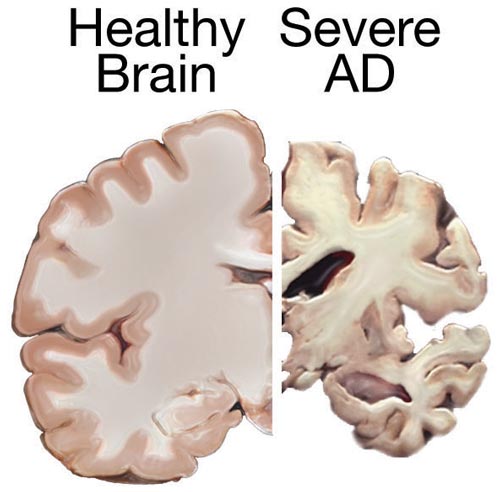
New research in mice has shown for the first time that it's possible to stop the formation of amyloid plaques--one of the key pathological features of Alzheimer's disease--and for the brain to clear them away entirely. This line of research has the potential to lead to medications that can slow, stop, or perhaps even reverse the ravages of this dread, mind-destroying disease.


 Comparison of a healthy brain and a brain with severe Alzheimer's disease
Credit: Wikimedia

As many people know through personal experience with friends or family members, Alzheimer's is an implacably progressive neurodegenerative disease that  robs individuals of their memory, cognitive functions, ability to care for themselves, personalities and, eventually, their lives. It's currently the sixth leading cause of death in the U.S. and, strikingly, ". . . is the only disease in the 10 leading causes of deaths in the United States that cannot be cured, prevented or slowed."

A new study, however, opens up the possibility that Alzheimer's may in fact one day be slowed or prevented, if not cured. Working with mice genetically modified to develop Alzheimer's disease, neuroscientist Riqiang Yan* and his colleagues at the Cleveland Clinic-Lerner Research Institute in Cleveland, Ohio, found that gradually reducing an enzyme called BACE1 blocked the development of amyloid plaques, which are a central part of Alzheimer's pathology.

Although their study was complex and highly technical, the logic behind it is clear. BACE1 is one of two enzymes that snip amyloid precursor protein, or APP, into the shorter pieces that glom together into the plaques that are thought to disrupt and eventually kill neurons. Since BACE1 has important biological functions, removing it early in life or completely creates serious neuro-developmental problems. Still, the researchers reasoned, reducing it gradually in adult mice might slow or stop Alzheimer's without causing unacceptable side effects. That's exactly what they found.

"In our study," says Yan, " we showed that if we delete BACE1 in the adult mice, even after plaque formed, with sequential and increased deletion of BACE1 the plaque was removed. That indicates that if we can get to a patient early enough, it will be beneficial in removing amyloid plaque."

Yan was not surprised to see that lowered levels of BACE1 slowed or stopped the formation of new plaques. He was both surprised and excited to find already existing plaques cleared away--the first time that this has been seen. "To our knowledge," he says, "this is the first observation of such a dramatic reversal of amyloid deposition in any study of Alzheimer’s disease mouse models. We didn't expect the pre-existing plaque would be removed. That was the very interesting part, and warrants additional study to find out why."

While completely blocking BACE1 causes developmental and cognitive problems, a gradual lowering in adult mice appeared appeared safer. Those mice performed better on learning and memory tasks than untreated Alzheimer's prone mice.  However, they still showed some abnormalities in synaptic signalling. Despite this problem, Yan thinks that compounds can be developed that, when applied at the right time and at the right dose, will slow or stop the development of plaques, allow the brain to clear away existing ones, and so keep Alzheimer's at bay.

Prevention is more powerful than treatment

Yan compares this to the enormously successful use of statins to control cholesterol levels enough to block the development of atherosclerosis and heart disease, even though cholesterol has vital functions in the body. "The critical thing is will this lead to some safe drugs?" he asks. "We need to find something very safe like a vitamin that people can take every day without any concerns. Another similarity is to the statins, taking statins to prevent cholesterol from building up. The idea is that prevention is even more powerful that treatment." 

The next step for Yan and colleagues is to track the effects of reduced BACE1 on the mouse brain in more detail and on older mice. "Human patients are typically older than in the mouse model," he explains. "In the mouse model we started to delete [BACE1] at 4 months, which is like 20 years old for people. We now want to delete it in older mice. We need a new mouse model for this later stage."

Robert Vassar is a professor of neurology at Northwestern University, in Illinois, and a pioneer in the study of the role of BACE1 in Alzheimer's disease. He's very supportive of Yan's new findings, and, like Yan, thinks they hold significant promise for Alzheimer's prevention. Vassar too likes the analogy with statins and cardiovascular disease. "You can't turn off the tap of cholesterol, but you can turn it down enough to not accumulate the plaques in the heart that cause heart disease," he says. "It's saved the lives of many people. The BACE1 inhibitors can do the same, if we find the right dose and the right stage of the disease--how much to inhibit and when to treat." 

Vassar and Yan are both aware that years of further research with animals and humans are needed to turn these promising findings into a safe and effective preventative treatment for people. They foresee a long road, but one that urgently needs to be followed. "We have to bold about this disease," says Vassar.  "We're headed for an epidemic of this with the baby boomers, so we've got to do something."

As a baby boomer myself, I couldn't agree more!

-----

You can access Yan and his colleagues' full research paper here.

-----

*Professor Yan is currently Chair of the Department of Neuroscience and William Beecher Scoville Professor in Neuroscience at the University of Connecticut, in Farmington, Connecticut.

-----

If you enjoyed this post, please sign up to follow or receive email alerts from zerospinzone

-----


TK


TK


Sunday, July 23, 2017

PERSISTENT ORGANIC POLLUTANTS ASSOCIATED WITH METABOLIC ABNORMALITIES IN SEEMINGLY HEALTHY PEOPLE

Persistent organic pollutants--POPS--are pervasive in the environment and accumulate in our bodies. Pesticides, pharmaceuticals and many industrial chemicals contribute to this potentially toxic tide.

Some common organic pollutants
Credit CunhaEnviroSci

In an earlier post, I reported on findings by epidemiologist Miquel Porta and his colleagues revealing that ten percent of Americans have 10 or more different POPS in our blood at abnormally high concentrations.

Porta and his team are now studying the impacts of these long-lived organic compounds that many of us unknowingly carry in our bodies and bloodstream.

His most recent findings, reported in the American Journal of Epidemiology, reveal a strong correlation between people's toxic loads and metabolic abnormalities such as high blood pressure, insulin resistance, high blood sugar, unhealthy lipid profiles, and chronic inflammation--factors that increase the risk of metabolic syndrome, diabetes and heart disease.

Porta and his colleagues at the Hospital del Mar Medical Research Institute in Barcelona (IMIM), and the Autonomous University of Barcelona, evaluated 860 people enrolled in the Catalan Health Interview Survey. Participants included obese and normal-weight men and women from the age of 18 to 74. Statistical analyses controlled for the effects of age, sex, BMI, educational level and social-economic status. It's the first study looking at the relationship between POPs and metabolic abnormalities in  normal-weight individuals.

"The take-home message of our study," says Porta, "is that POPs contribute to cause unhealthy metabolic phenotypes as well as the metabolic syndrome."

 Intriguingly, the correlation was stronger for people of normal weight than for obese people. This may help to explain why many people of normal weight turn out to be metabolically unhealthy, and why some obese people remain metabolically normal.

It wasn't  a small effect--people of normal weight carrying high loads of POPs were four times more likely to be metabolically unhealthy than normal-weight peers with low toxic loads. Obese individuals with high toxic loads were 1.4 times as likely to suffer from metabolic abnormalities than those with low levels of toxins in their blood. And regardless of weight, metabolically unhealthy people carried nearly twice the load of toxins than their healthy peers.

A separate research study reports that normal-weight people who are metabolically unhealthy have three times the risk of heart attack, stroke or death compared to their metabolically healthy, normal-weight peers.

Although we are all exposed to organic pollutants from many sources--the air we breathe, the water we drink, furniture, fabrics, food containers and many other sources, the authors point out that fatty animal foods are the biggest source, and one that we can control by what we choose to eat.

They add, however, that individual efforts to eat a healthy diet and maintain a healthy weight are only part of the solution. Government action to minimize the accumulation of POPs and other toxins in the workplace, consumer goods and the environment are also needed, as well as similar efforts by private companies.

"Individual habits play a role, but so do public and private policies," says Porta, "that is, polices of governments and companies that have been shown to decrease 'internal contamination' by POPs."

-----

You can access the abstract of Porta's journal article at this URL.

-----
If you enjoyed this post, please sign up for email alerts from zerospinzone.blogspot.com (right column above).


Friday, June 23, 2017

CYCLING TO WORK CUTS CANCER AND HEART-DISEASE RISK NEARLY IN HALF

A five-year study of 260,000 men and women in the UK found that bicycling to work every day reduced their risk of dying by more than 40 percent compared to commuters who drove or used public transport. In addition, the risk of developing cancer fell by 45 percent, and of being diagnosed with heart disease by 46 percent.

"This is really clear evidence that people who commute in an active way, particularly by cycling, were at lower risk," says Jason Gill, a physician-researcher at the University of Glasgow and corresponding author of the study.

New Yorkers bicycling to work
Credit: Streetfilms
Walking to work had a similar but smaller protective effect, probably because people who used bicycles for their commute exercised longer and more intensely than walkers. 

The powerful protective effect of active rather than passive commuting held up even when the researchers controlled for known risk factors such as smoking, weight and diet.

One benefit of bicycling to work, the researchers point out, is that unlike going to the gym or planned workouts, commuting becomes a no-willpower-needed habit. "You need to get to work every day, so if you build cycling into the day it essentially takes willpower out of the equation," says Gill.

---

You can read the original article, in BMJ, the British Medical Journal, here.


Tuesday, October 18, 2016

IN U.S. EXPOSURE TO HORMONE DISRUPTING CHEMICALS COSTS HUNDREDS OF BILLIONS PER YEAR

Following up on my recent post "Ten Percent of US have high concentrations of ten or more toxins in our blood,", here's a new study that calculates the costs to the U.S. economy from the burden of disease that some of those chemicals cause.


Plastic bottles--one of many sources 
of endocrine-disrupting chemicals
Credit: Velka/Shutterstock (public domain)

Writing in The Lancet Diabetes and Endocrinology, October 17, researchers at the New York University Medical Center say that even a conservative estimate of the diseases and conditions--including birth defects, autism, attention-deficit disorder, intellectual disability, infertility, obesity, diabetes, heart disease and stroke--caused by exposure to these toxins puts their cost to the economy at $340 billion. That's 2.3 percent of the U.S. Gross Domestic Product (GDP).

Flame retardants alone (found in building insulation, fabrics, furniture and electronics) account for more than $200 billion of those health-related costs.

The researchers say this is the first assessment of the overall costs to the U.S. economy from the buildup of endocrine-disrupting substances in the population.

The major sources of these chemicals include plastic bottles, the lining of metal food cans, detergents, flame retardants, toys, pesticides and cosmetics. These pervasive chemicals build up in our bodies over time. They can impair fetal development in the womb, especially the brain and nervous system, and lead to a variety of diseases in adults.

These chemicals are pervasive and extremely difficult to avoid. To address the problem at the policy level, the authors call for more proactive testing and tighter regulation, starting with the Environmental Protection Agency (EPA). They point out that people living in Europe, where these substances are more strongly regulated, have less exposure, lower levels in the bodies and blood, and reduced risk of disability and disease.

At the personal level, they recommend steps such as not microwaving food in plastic containers or covered by plastic wrap, avoiding containers with the number 3, 6 or 7 on the bottom, which contain phthalates and using fragrance free or "all natural" cosmetics.

You can find more ways to minimize your and your family's exposure to endocrine disrupting chemicals here.

This may seem a daunting or even impossible task, given how ubiquitous these chemicals have become. However, new research shows that avoiding common sources of endocrine disrupting chemicals can quickly reduce levels in the body