Showing posts with label CO2. Show all posts

Tuesday, September 13, 2022

New research more than triples the value to society of cutting CO2

 As the world reels from unprecedented   heatwaves, droughts, wildfires, torrential rains and floodingwe're all learning first-hand that loading the atmosphere with carbon dioxide and other greenhouse gasses is costly. Unfortunately, to a large extent, those costs are not accounted for, or as economists say, they are externalized, meaning that polluters profit while society pays.

Unprecedented flooding in Pakistan, 2022

Credit: United Nations

The million of Pakistanis whose lives have been disrupted by unprecedented flooding--even though Pakistan emits less than one percent of the world's greenhouse gasses--can attest to that.

Some countries, including the United States, attempt to mitigate those externalized costs by estimating the social costs of carbon (SCC) and adjusting taxes, surcharges or subsidies accordingly. For example, industries can be taxed for the greenhouse gasses they emit, ideally resulting in lower emissions, while the revenue from those taxes can be used to subsidize green energy programs.

Since official valuations of the SCC underpin climate-related policy-making by governments and industries, it's vitally important that they be as accurate as possible.

A just-released peer-reviewed study published inNature calculates that the current SCC, used by the US government for the past decade, is far too low. The study's updated calculations set the actual cost of CO2 emissions as at least $185 per metric ton (2205 pounds), 3.6 times higher than the current figure of $51 per metric ton.

In other words, policy-makers need to multiply their current estimates of the costs to society of business-as-usual CO2 emissions by a factor of 3.6, and do the same when evaluating the benefits to society of policies to reduce future emissions.

The researchers found that three factors made the biggest contributions to this new benchmark: heat-related deaths, impacts on agriculture and an updated discount rate. As much of the US reels under record-high temperatures and drought, heat-related deaths and the impacts on agriculture of climate change are self-explanatory. The researchers' use of a revised discount rate may require some explanation:

Economists use discount rates to compare current and future consequences of a proposed action, for example a loan or investment, based on the idea that money gained or lost in the future is worth less than the same amount gained or lost today. It's a more precise version of the idea behind the aphorism "a bird in the hand is worth two in the bush."

In dealing with environmental economics, the discount rate can be generalized to reflect "the rate at which society as a whole is willing to trade off present for future benefits" for example keeping fuel prices low today vs reducing temperatures ten years from now.

For the past decade evaluations of the future costs or benefits of climate-related policies have been based on a discount rate of three percent. The current research reduces that rate to two percent, a change that makes the future impacts of today's choices more salient. For example, using a discount rate of 3%, a climate-related investment of $1,000 today would have to produce more than $1,842 in benefits within the next 20 years to be economically justifiable. Using a 2% discount rate means that the same investment would only need to produce $1,497 in benefits over the same time period.

Economist Brian Prest, one of the paper's authors explains that the official discount rate of 3% was based on financial data from the 30-year period from 1973 to 2003. Updating that with data from the most recent 30 years produced the 2% figure that they folded into their calculations.

The researchers note that the actual costs to society of carbon emissions are almost certainly greater than their $185 per metric ton estimate because there are significant impacts that remain un-accounted for. Their calculations included mortality, agriculture, energy costs, and coastal impacts from sea-level rise. They plan to add impacts from biodiversity loss, reduced labor productivity, and increased inequity, conflict and migration to their future calculations.

They add that even accounting for those additional factors may not do justice to the true impacts of carbon emissions. "Other costs of climate change including the loss of cultural heritage, particular ways of life, or valued ecosystems, may never be fully valued in economic terms," they write.

In short, raising the SCC from what their research shows to be an outdated and unrealistically low figure of $51 per metric ton to a more realistic value of $185 per metric ton is just a first step, although an important one.

Wednesday, July 29, 2020

TURNING THE CLIMATE CLOCK BACK 3.3 MILLION YEARS

"BY 2025, CO2 LEVELS WILL BE HIGHER THAN THEY'VE BEEN FOR THE LAST 3.3 MILLION YEARS" [Nature Scientific Reports July 10, 2020]


Let's see. What was going on 3.3 million years ago?

--Humans like us were just a gleam in evolution's eye. The most promising potential ancestor around then was Australopithecus, an apelike creature living in southern Africa who may have been the first to use shaped stones to smash open bones for their marrow. 


--Earth wouldn't enter the current geologic epoch, the Holocene, for another 3,288,000 years. It was then in the middle Pliocene

--North and South America hadn't yet collided and connected. 

--North America sported two elephant-like species, hyenas, small, three-toed ancestors of modern horses, bone-crushing dogs, giant bears and three species of huge, saber-toothed cats


Smilodon populator--one of North America's
Pliocene saber-toothed cats
Credit: Charles Knight/American Museum of Natural History

--Humans wouldn't set foot on the continent for another 3.27 million years.

--Crucially, from our point of view, atmospheric CO2 levels were comparable to today's (somewhere between 381 and 427 parts per million), yet global temperatures were 2 to 3 degrees C (3.6 to 5.4 degrees F) higher than they are now, and sea levels were 25 meters (82 feet) higher. 

Equally crucially, because of those nearly equal CO2 levels, the period tells us what our world may look like all too soon.  "We studied this particular interval in unprecedented detail because it provides great contextual information for our current climate state," says Elwyn de la Vega, researcher at the University of Southampton's School of Ocean and Earth Science, in the UK, and lead author of the Nature Scientific Reports study.

The Southampton research team was able to pin down those ancient CO2 levels by studying the fossilized shells of foraminifera--millimeter-sized sea creatures protected by carbon-rich shells. The ratios of boron isotopes in the shells correlate with atmospheric CO2 levels at the time the shells formed.

Clearly, we're not going to see a return of saber-toothed cats or giant bears. But we, or our children or grandchildren, may well have to deal with a Pliocene climate--much hotter, lacking most of the Northern Hemisphere's ice cover, and with rapidly rising sea levels.

Why aren't we already living in mid-Pliocene conditions? Simply because there hasn't been time for the full impact of the greenhouse gases we've already pumped into the atmosphere to warm the oceans and melt most of Earth's ice. Geochemist Gavin Foster, also at the University of Southampton explains:

... it takes a while for Earth’s climate to fully equilibrate (catch up) to higher CO2 levels and, because of human emissions, CO2 levels are still climbing. Our results give us an idea of what is likely in store once the system has reached equilibrium.

To get a sense of what things will be like when Earth has reached that Pliocene-like equilibrium, picture your favorite coastal city under 80 feet of water. According to recent research, coastal flooding could displace hundreds of millions of people and cost the global economy trillions of dollars by the end of this century if we don't get a grip on climate change now.


Keeling curve--atmospheric CO2 1960-2020
Credit: Scripps Research Insitute

Right now we're at 413 parts per million of atmospheric CO2, and rising, and the curve is getting steeper. We're running as fast as we can towards a very inhospitable past.

--REA


Thursday, March 12, 2020

ANIMATED GRAPH OF ATMOSPHERIC CO2 OVER THE LAST 800000 YEARS AND INTO THE FUTURE

The animated graph linked to below is well worth watching--several times, slowing it down at the end:

https://mobile.twitter.com/OceansClimateCU/status/1237069561364545537?s=20&utm_source=NSDAY&utm_campaign=19fa2fe1ef-NSDAY_110320&utm_medium=email&utm_term=0_1254aaab7a-19fa2fe1ef-373908631

Credit for the above goes to Kris Karnauskas, who leads the Oceans and Climate Lab at the University of Colorado, Boulder.

If we follow the steepest two curves, it really will be the end.

This graph credit: Wikimedia Commons


REA

Wednesday, February 12, 2020

EARTH'S VITAL SIGNS: THREE VERY SCARY GRAPHS

For anyone who is not being paid or propagandized to deny global heating, these three graphs say everything that needs to be said:


 Atmospheric CO2 over the last 800,000 years
Credit: NASA


Atmospheric CO2 over the last 60 years
Note that the rate of increase is speeding up!
Credit: ESRL


 Credit: NASA GISS

By the way, today--2/12/20--the Mauna Loa CO2 observatory clocked the highest ever concentration of carbon dioxide in Earth's atmosphere--416.08 parts per million (ppm). Scientists tell us that the safe level is 350 ppm or less.

And the National Oceanic and Atmospheric Administration announced that Earth just experienced the hottest January on record.

-------

REA

Thursday, November 28, 2019

A BIT OF GOOD NEWS FOR THANKSGIVING

If you've been following the escalating climate crisis, you know that decarbonization of the global economy is a crucial part of achieving a sustainable world. The good news is that the U.S. is moving in the right direction. The latest assessment of how much carbon was injected into the atmosphere from US electricity generation shows that the carbon intensity--pounds of carbon dioxide per MW-hour--dropped 9 percent since this time last year. Total generation fell by 4 percent in the same period. Even better, that's a 40 percent reduction in carbon intensity of power generation in just the last 15 years. 

Carbon emissions per MW-hour in U.S. 2001-2019
Credit: Power Sector Carbon Index, 
Scott Institute for Energy Innovation 

"The U.S. electricity sector is continuing to get cleaner, and both carbon intensity and overall emissions are dropping," said Costa Samaras, assistant professor of Civil and Environmental Engineering at Carnegie Mellon University and co-director of Carnegie Mellon's Power Sector Carbon Index.

The researchers say that this encouraging and continuing trend is due to the decline of coal-powered electricity generation, the increase in power from natural gas, and from renewables such as wind and solar. "We're in the middle of an energy transition right now, and the biggest part of that story in the U.S. is how swiftly coal has been declining over the past decade," said Samaras. "The decline of coal can be attributed to the rise of natural gas, the continued improvement of renewables, and energy efficiency efforts."

There's lots of room for improvement, however. Wind, solar and hydropower still account for less than 20 percent of U.S. electricity, just about equal to nuclear, the other zero-emissions source of power.

The goal, the experts point out, is to continue to produce abundant power while emitting less and less carbon, and also to grow the use of zero- or low-emission electricity in transportation, buildings and industry.

---

REA


Wednesday, May 29, 2019

Quick link to a great piece explaining how what we've done to the Earth is coming back to bite us

Economists call them externalities. Those are all the goods and services that aren't accounted for in a company's or a country's balance sheet--things like the oil and ores we've been extracting from the Earth for centuries and the pollutants, including CO2 and methane, that we've been dumping back into the soil, air and water, supposedly for free. Journalist J. P. Sottile, writing in Truthout, does a great job of clarifying how these "free" goods and services are actually a huge, rapidly growing debt, and how nature is now collecting on our past-due accounts. It's a great piece. Please read it!

https://truthout.org/articles/after-years-of-abuse-the-earth-has-sent-its-bill-collectors/

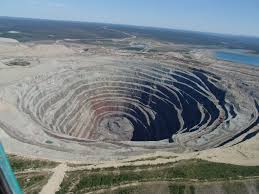
Open pit mine,Udachnaya, Russia--credit Wikimedia


Tuesday, July 31, 2018

CALIFORNIA'S ECONOMY BOOMS WHILE ITS CARBON FOOTPRINT SHRINKS

As reported in Grist earlier this month, California's carbon emissions are down to the levels they were way back in the 1990s, while at the same time its economic productivity has soared. According to the state's Air Resources Board, “California now produces twice as many goods and services for the same amount of greenhouse gas emissions as the rest of the nation."

California windfarm--part of the state's energy success story
Credit: Creative Commons Zero--CC0 

If one believes economists and politicians who, like Donald Trump, are still pushing coal or other greenhouse-gas-spewing energy sources, California, which is leading the nation in the transition to renewable energy, should be failing. For those still interested in facts, nothing could be further from the truth. California's per capita greenhouse gas emissions are roughly one-half the US average, yet it produces twice as many goods and services for every unit of energy use.

Kudos to California for leading the way. However, there's still lots of room for improvement. Transportation still relies far too heavily on fossil fuels, and accounts for 41 percent of California's carbon emissions. To tackle this, the state has plans in place to multiply the number of electric vehicles on California's roads 12 times within the next 12 years.

If the state has the same success with that plan as it has had on its overall carbon emissions, it's likely to beat that deadline and still lead the country in terms of economic productivity, not to mention improved quality of life.

What are the rest of the states waiting for?

REA

------------
If you enjoyed this post, please subscribe to or sign up to receive email alerts from zerospinzone.

-----

Saturday, April 15, 2017

THE BASIC PHYSICS BEHIND GLOBAL WARMING AND CLIMATE CHANGE HAS BEEN KNOWN FOR MORE THAN A CENTURY

Just a quick link to a great piece by engineering professor John Abraham entitled, "150 Years Ago, Scientists Understood the Climate Better than the EPA Head Does Today."

Here's the URL to click on.

It's worth reading the whole article, in which Abraham vividly reminds us that climate-change deniers such as Scott Pruitt, the current head of the EPA, are basically living in the 1800s, at least as far as their acceptance of the basic science of Earth's radiation balance, the greenhouse effect of atmospheric carbon dioxide and water vapor, and the impact of increased greenhouse gases on Earth's climate, all of which were well known before the turn of the century on New Year's Eve, 1899!

The basic science behind climate change was understood before this car hit the road
Credit: National Motor Museum

If you enjoyed this post, please sign up for email alerts and let friends know about zerospinzone.blogspot.com.

Tuesday, April 04, 2017

HOW TO DRILL AND BURN OUR WAY BACK TO THE TRIASSIC

I know that not many of us--and certainly not the President or our representatives in Congress--are thinking past the next vote or at most the next election.

Still, for those who care about the next few generations, here's a heads-up from a trio of earth scientists in the U.S. and the U.K., writing in the prestigious journal Nature Communications.

They warn that if we burn all available fossil fuel reserves within the next few hundred years, the combination of high levels of CO2 in the atmosphere and more intense radiation from the sun will turn up the heat to levels not seen on Earth since the Triassic period, 220 million years ago, or perhaps ever.

In case you don't remember the details, the Triassic featured one giant continent called Pangea. The poles were ice-free. It was hot and steamy near the coasts, baking desert inland, and Earth was dominated by the reptilian ancestors of dinosaurs, birds, mammals, and, way in the distance future, us. An interesting place for a quick visit, but not where most of us would want to live.

Postosuchus, a Triassic archosaur
Credit: Dallas Krentzel, Museum of Texas Tech University

Steamy as it was with atmospheric CO2 around 2000 parts per million, it wasn't as hot as it will be by 2250 AD if we've boosted CO2 to that same level. The reason is that the sun is gradually getting hotter. The increase in solar radiation over the course of the past 220 million years means that the combined impact--a dense greenhouse atmosphere and a hotter sun--would push Earth--and anyone still around then--into an unprecedented and unpredictable climate zone.

"Such a scenario," the authors write, "risks subjecting the Earth to a climate forcing that has no apparent geological precedent, for at least the last 420 Myrs [million years]."

So, if the first line of our business-as-usual mantra continues to be "drill, baby, drill," the next line is even more likely to be "burn, baby, burn."

If you enjoyed this post, please sign up for email alerts and let friends know about zerospinzone.blogspot.com.


Monday, December 05, 2016

WE'VE ALREADY HIT THE 1.5 DEGREE C GLOBAL WARMING CEILING THAT WE'VE AGREED NEVER TO GO BEHOND

Meeting in Paris last year, representatives from 195 nations agreed to work together to limit global warming to 1.5 degrees C (2.7 degrees F) above the temperature that prevailed before the industrial revolution. Scientists and policy members agreed that global warming beyond that level creates unacceptable levels of risk to the environment and civilization--much like revving your car's engine into the red zone. The Paris Agreement (Accord de Paris) went into effect in November of 2016.

Negotiators celebrate Paris Agreement 4/22/16
Credit: UN

In what should serve as a three-alarm wake-up-call, researchers at the European Centre for Medium-Range Weather Forecasts, a prestigious independent intergovernmental organization, reports that Earth hit that 1.5 degree C ceiling for the first time in February of 2016 (see section 10 in the above link).

Global Temperatures 1880 to Present
Credit: NASA GISS

The researchers are quick to note that the early months of 2016 were exceptionally warm, following a strong El Niño, and that Earth has cooled approximately 0.3 degrees C (0.5 degrees F) since then. However, with the levels of carbon dioxide (CO2) and other greenhouse gases in Earth's atmosphere continuing to rise, it's only a matter of time before we don't just bump against the 1.5 degree ceiling, but crash through it.

And not much time. The Berlin-based Mercator Research Institute on Global Commons and Climate Change (MCC) calculates that under the most optimistic assumptions, we have only 4 years before we lock in more than 1.5 degrees C of warming, and under the most pessimistic assumptions, just one year.


Atmosperic CO2 levels over the last 500,000 years/Credit NASA

"It is salutary that the world touched the 1.5 degree C level less that twenty years after touching the 1 degree C level in the record-breaking year of 1998," says Adrian Simmons, the study's lead author. 

"Salutary" is a polite, understated, British way of saying that if we value Earth's health and our own, we'd better pay attention and take action.

(Note 1/10/17: I hate to be pessimistic, but it's clear from Trump's own statements and his appointees that the US government will be leading a climate-change charge, but in exactly the wrong direction--away from wind and other renewable sources of energy, and back towards coal and other greenhouse-gas belching technologies.)


Friday, October 14, 2016

OBIT FOR AUSTRALIA'S GREAT BARRIER REEF

The Great Barrier Reef is considered Earth's largest living structure. It has survived and grown for 25 million years, providing shelter for thousands of species and uncountable billions of organisms. In recent years rising ocean temperatures and ocean acidification--both driven by the CO2 that we are pouring into the atmosphere--have caused repeated bleaching events, in which the coral-building organisms expel the photosynthesizing algae that feed them. The longer the water around them remains too warm, the more likely the reef-building corals are to starve and die.

It now appears that with more heating and acidification locked in due to the CO2 we've already pumped into the atmosphere, and with CO2 emissions still soaring, the 25-million-year-old Great Barrier Reef is doomed.

Environmental (and food) writer Rowan Jacobsen has written the reef's obituary. It's a must read for anyone who cares about the future of life on Earth--including our own.

Bleached coral, Keppel Islands, Great Barrier Reef: Credit Wikipedia


As many of you may know, Jacobsen's obituary for the Great Barrier Reef has gone viral. It has raised the ire of many scientists, who point out that the reef--while suffering the worst bleaching event in history and clearly threatened--is not in fact dead, and potentially can be saved. I think we can safely assume that Jacobsen knows all that, and is thrilled that his premature obit may in fact galvanize people to face up to the life-or-death climatic challenges it, and we, face.

Thursday, October 13, 2016

CO2 RISING--THE SOUNDTRACK

We're currently pumping 2.4 million pounds of the greenhouse gas carbon dioxide (CO2) into the atmosphere per second!

Earth's atmosphere is pretty big, but human activity is measurably changing it.

The longest run of measurements of atmospheric CO2 was started by American scientist Charles Keeling in 1958, from an observatory atop Hawaii's Mauna Loa.


The Keeling Curve--Atmospheric CO2 1958-2015


Credit: By Delorme - Own work. Data from Dr. Pieter Tans, NOAA/ESRL and Dr. Ralph Keeling, Scripps Institution of Oceanography., CC BY-SA 4.0, https://commons.wikimedia.org/w/index.php?curid=40636957

Keeling was the first to document irrefutably that atmospheric CO2 was rising, we now know due to the burning of fossil fuels and other human enterprises such as agriculture and deforestation.

That record of the concentration of CO2 in Earth's atmosphere is known as the Keeling Curve. It shows clear yearly cycles as vegetation absorbs and releases CO2 with the changing seasons.

But it also shows the dramatic rise in CO2 levels from 315 parts per million (ppm) in 1958 to today's levels of more than 400 ppm.

Two University of Washington atmospheric scientists, doctoral student Judy Twedt and Prof. Dargan Frierson, decided to dramatize what we're doing to the atmosphere by transforming the Keeling Curve into music.

You can hear and see the resulting YouTube video here. It speaks for itself.

To view a striking visualization of rising CO2 levels, check out item 3 at this URL.


Tuesday, June 14, 2011

Human activities emit far more carbon dioxide into the atmosphere that volcanoes do


A new study in Eos, published by the American Geophysical Union, shows that human activities currently pump 135 times more CO2 into Earth's atmosphere than volcanoes do in an average year. In fact, our yearly production of CO2 equals that of one or two supereruptions like the one that created Yellowstone two million years ago, every year.You can read the details on Suite101.


Robert Adler
for the institute

Thursday, December 09, 2010

December's Deadly Forest Fire in Israel Confirms Climate Change Predictions in 2000 Report


Smoke from Mt. Carmel fire, from Haifa, Israel


A raging forest fire early this month killed 42 people, destroyed hundreds of homes, and consumed much of the forest that carpeted Mt. Carmel, near Haifa, Israel. The deadly fire was a predictable--and clearly predicted--effect of human caused global warming and climate change, according to the author of an official climate change report that was submitted to the U.N. in the year 2000.

The 2000 report said that rising levels of carbon dioxide (CO2) and other greenhouse gases would create overall hotter and drier conditions around the Mediterranean, with delayed winter rains and a shorter rainy season, but also cause more extreme climate events such as heat waves, heavy downpours and floods. Combined, the predicted changes would significantly increase the risk of severe fires, like the one of December, 2010, threatening the survival of many forests in the Mediterranean region.

More about the 2000 report and the current comments of its co-author, Guy Pe'er at Ben Gurion University, at this Suite101 page.

In my opinion, it's long past time for climate change deniers worldwide to shut up. But even for those of us who have been following the climate change research and "debate" for years, it's time to stop piously saying that we need to act now to protect our children and grandchildren. We need to act now to protect ourselves.

Robert Adler
for the institute


Tuesday, November 02, 2010

Leading geologists warn, "Stop pulling carbon trigger."

The 200 year old Geological Society of London has issued a clear, eminently readable, fact-based statement summarizing what the geological record has to say about climate change. Their understated bottom line is that it would be "unwise" for humanity to continue pouring carbon dioxide into the atmosphere and oceans. Nature ran that experiment 55 million years ago, and the world that resulted would not be suitable for our current civilization. The president of the GSL was a bit more unspoken, writing, "Stop pulling the carbon trigger."

You can read more about this report by clicking here.

Robert Adler
for the institute

Thursday, May 27, 2010

Eyjafjallajokull and climate change--Response to "The futility of man"

Knowing that I’m passionately concerned about climate change, a friend forwarded the following piece to me, something that apparently has been circulating on the internet. He added, “I don’t know if this is true, but it wouldn’t surprise me if it was.”

To respond to my friend, and because the piece contains many of the themes and distortions that seem to energize the anti-climate-change community, I wrote a detailed reply. You can read the commentary and my reply below:

-----------------------------------
The futility of man

Didn't we ALL know this but were just afraid to say something.....

All of you out there across the globe who have fought so hard to tackle the hideous enemy of our planet, namely carbon emissions, you know ....that bogus god you worship of "Climate Change" or "global warming" ....well, I feel it is necessary to inform you of some bad news. It really does pain me to have to bring you this disappointing information.

Are you sitting down?

Okay, here's the bombshell. The current volcanic eruption going on in Iceland, since its first spewing of volcanic ash this past week, has, to this point, NEGATED EVERY SINGLE EFFORT you have made in the past ten years to control CO2 emissions on our planet.


I know, I know.... (group hug)...it's very disheartening to realize that all of the carbon emission savings you have accomplished while suffering the inconvenience and expense of: driving Prius hybrids, buying fabric grocery bags, sitting up till midnight to finish your kid's "The Green Revolution" science project, throwing out all of your non-green cleaning supplies, using only two squares of toilet paper, putting a brick in your toilet tank reservoir, selling your SUV and speedboat, going on vacation to a city park instead of Yosemite, nearly getting hit every day on your bicycle, replacing all of your $1 light bulbs with $10 light bulbs, participating in "earth day" ...well, all of those things you have done have all gone down the tubes in just the past four days.

The volcanic ash emitted into the Earth's atmosphere in the past four days has totally erased every single effort you have made to reduce the evil beast, carbon. And, those hundreds of thousands of jobs you helped move to Asia with expensive emissions demands on businesses... you know, the ones that are creating even more emissions than when they were creating jobs here, well I just know that seems worthwhile now.

I'm so sorry. And I do wish I had a silver lining to this volcanic ash cloud but the fact of the matter is that the brush fire season will start in about two months and those fires will negate your efforts to reduce carbon in our world for the next two years.

But hey, grab a Coke, give the world a hug and have a nice day!

So true, and this has been going on thousands of years. Long, long, long before, combustion engines, or cattle herds were around to expel carbon dioxide. There is nothing new about climate change on Earth. It's been going on since the flood and it will be going on for years to come.

Man is not in control.
Only in arrogance... does he think he is.


---------------------------------------

Response to "The futility of man"

Dear _____,

I don't know who initiated this email, but please send my reply back down the line of email recipients.

Whoever is the author has a point--a lot of CO2 was emitted by this volcano, according to the best scientific estimates about 150,000 metric tons per day. The author does not include this quantitative figure, although knowing the actual amount is important.

The volcano to compare Eyjafjallajokull with is Pinatubo which in 1991 pushed somewhere around 42 million metric tons of CO2 into the air. So scientists refer to Eyjafjallajokull as only a "cough" in comparison.

Averaged over time, volcanoes pump some 200,000 metric tons of CO2 into the atmosphere every year while human activities contribute almost 30 billion metric tons--according to the US Energy Information Agency--almost 700 times as much.

It’s important to note that the author of this post doesn't claim that Eyjafjallajokull dwarfed human emissions, only that it surpassed the very small amount we have been able to cut back those emissions.

The meager success so far of the climate community to cut worldwide greenhouse gas emissions is due in large part to lack of public support which is due in large part to unsubstantiated information such as is presented in this email. One almost has to laugh at such logic. It’s a tragic example of a self-fulfilling prophecy.

A couple of other points need to be made.

The eruption of Eyjafjallajokul will have some warming and some cooling effects, both of which scientists are able to estimate. The estimated amount of CO2 reductions that came from flights being grounded due to the ash is 2.8 million metric tons, and it will take Eyjafjallajokull quite some time to make up for that.

Mt. Pinatubo actually lowered global temperatures by about one degree Celsius for most of two years because of the sulfur it placed up to 20 miles in the atmosphere (sulfer dioxide reflects sunlight and has been proposed as a geoengineering "solution" to global warming--not my choice for a number of reasons). But Eyjafjallajokull did not release as much sulfur as high as Pinatubo, so it will probably not contribute significantly to global cooling, just as it probably will not contribute much to global warming.

Charles Keating started very accurate measurements of CO2 in the atmosphere in 1959 and those measurements have continued to this day. They show a zig-zag pattern that reflects spring and summer decreases in CO2 while plants in the northern hemisphere are breathing it in, and increases in fall and winter when they are producing CO2, mostly through decay.

But Keating's chart shows an inexorable rise in emissions over the past half century. Comparing natural and human emissions, measured atmospheric CO2 did not increase due to Pinatubo in 1991 as much as decreased during times of economic recession--sort of like the aircraft being grounded, but more globally.

So compared with Pinatubo (they call the geoengineering idea of shooting sulfur into the upper atmosphere the "Pinatubo Option") Eyjafjallajokull was very small, and smaller still compared to human emissions.

So if you can get past phrases like “hideous enemy,” "bogus god" and "evil beast" which are designed to play to your emotions, and the “group hug” comment which is meant to categorize everyone concerned about climate change as, I suppose, soft-headed, overly emotional ex-hippies, stop for a while and investigate whether this hyperbole is based in fact, or whether its purpose is to make us all feel better while we—and more importantly the corporations that really profit from it--continue to engage in activities that emit significant amounts of CO2 into our atmosphere.

Because if science (by that I mean all the science academies in countries that have them, and all the meterological associations in the world) are right and we do have a serious problem on our hands, it may just be time to pay attention. It’s worth noting that Insurance companies, investors, and militaries on both sides of the Atlantic are taking climate change very seriously because their business is managing risk and they will take some of the biggest initial hits.

The future scientists forecast, if we do not lower emissions very quickly, will not be a pleasant one for our kids or their kids, or even for us--so let's check the facts.

One argument that this piece uses, and that appears over and over in similar pieces, is that climate change is nothing new. “It’s been going on since the flood and it will be going on for years to come.”

The implication, which is hardly ever spelled out, is that since there has been natural climate change—something that we know about in great detail because of the work of thousands of scientists—there can’t be human-caused climate change. Or, even if there is human-caused climate change, it can’t be important compared to natural changes.

That’s like saying that since lightning causes fires, people don’t. Try convincing youl fire department, police department, or insurance company of that one.

I’ve also noticed that a lot of the anti-climate-change pieces, like this one, say that it is arrogant to think that mere humans can have a significant impact on nature or Mother Earth. “Man is not in control. Only in arrogance . . . does he think he is,” this piece says.

The themes of humility before God and the ultimate futility of human understanding and action run very deep in most religions. The awesome power of God or nature is something that most people—even probably most scientists--would agree on. So tossing it into discussions about climate change can seem pretty convincing.

The trick is that the 6.8 billion people alive today, multiplied by all the mining, agriculture, industry, heating, cooling, transportation, etc. that keep us alive and support our lifestyles obviously are having huge impacts on the Earth, impacts that are easily seen and measured in terms of land use, water use, deforestation, depletion of fisheries, loss of biodiversity, and climate change.

We’re not at all humble about our lifestyles and what it takes to support them. So it seems very self-serving to suddenly be humble about taking responsibility for their impacts on the Earth. It reminds me not at all of humble, God-fearing adults but of spoiled children who feel free to make any kind of mess knowing that Mommy or Daddy will clean up after them.

Unfortunately, there’s nothing about the eruption of Eyjafjallajokull to suggest that we're not making a mess or that God is going to clean it up for us.

If you want more facts regarding climate change, please do not hesitate to let me know. There are lots of excellent books and articles on the subject, and I’ll be happy to refer you to them.

Lou Miller


Friday, October 10, 2008

How much atmospheric CO2 can we live with?

That’s the question James Hansen, director of the NASA-Goddard Institute for Space Studies, addressed on October 7 at the Joint Annual Meeting of the Geological Society of America, in Houston, Texas.

His short answer is less than 350 parts per million—the level Hansen believes will preserve Earth’s ice sheets, mountain glaciers, and head off a devastating sea-level rise.

The fact that we have now surged past 387 parts per million of CO2, with no effective control in sight, is alarming. 

A state of emergency

“I believe we’ve reached a state of emergency,” Hansen said, “although it’s not easy to see. But if you look at the science, it becomes clearer and clearer.”

It’s enough of an emergency to force him to rethink nuclear power, an issue on which he’s previously been “an agnostic.” Renewable energy alone in sufficient quantities, he said, would be too costly.
 
Hansen walked the audience through the science—ice cores that reveal CO2 levels over the past 800,000 years, microscopic shells from under the sea floor that track ocean bottom temperature and salinity for the past 35,000,000 years, reconstructions of past glaciations and sea levels, the current rates at which the Earth is warming and its ice sheets disintegrating, and computer models of the climate system.

The bottom line is that the amount of CO2 in the atmosphere drives Earth’s climate, and that we are driving CO2 off the charts.

“All we have to do is graph the greenhouse gas forcing over the past several hundred thousand years,” says Hansen. “When we choose the right scale, it’s a hand and glove fit. Humans are now completely in charge of the composition of the atmosphere. CO2 and methane are far outside the range they’ve been in for millions of years.”

We’re in charge but out of control

Did you catch that—“Humans are now completely in charge of the composition of the atmosphere.” In charge, but out of control, like airplane without a pilot.

We’re not even close to heading in the right direction. Even countries that signed on to the Kyoto Accord have increased their carbon emissions. There’s more CO2 in the atmosphere than at any time in the last 650,000 years, and the rate at which it’s increasing is itself increasing.

“The actual actions of countries worldwide are inconsistent with stopping the CO2 rise,” Hansen said. “Energy departments around the world are assuming we can burn all the remaining fossil fuel. That will double or triple atmospheric CO2.”

What that means, he said, is that unless global carbon emissions are cut drastically, and soon, we’re headed for “. . . a completely different planet than the one that’s existed in the past. Obviously, it would be an ice-free planet, warmer than it’s been in any of the recent interglacials.” 

Among other impacts Hansen foresees is the disappearance of glaciers in the Himalayas, Rockies, and Andes within the next few decades, threatening the water and food supplies of hundreds of millions of people. 

Hmm. Where would they go, and what kinds of upheavals would that kind of mass migration cause?

Irreversible tipping points

Hansen also warned about climatic and environmental tipping points, “where the dynamics of the system take over and you don’t need any more forcing and there’s the potential to lose control.”

One example is the disintegration of the ice sheets. “It takes thousands of years to build up an ice sheet from snowfall,” he said. “If we cause the West Antarctic ice sheet to disintegrate, that’s essentially irreversible.”

“I think that the metric for what is dangerous should be headed by these irreversible effects, such as the extermination of species,” he said. “We know that when there have been warmings of several degrees in the past, more than half of the species on Earth at that time went extinct.”

Remarkably, Hansen remains optimistic about our ability to push CO2 levels back below 350 parts per million and turn this looming catastrophe around. The keys are technology and public policy.

One necessary ingredient, he says, is to cut back immediately on the burning of coal as well as other fossil fuels. “We could say that we’ll only use coal at power plants where we will capture and sequester it,” he said.

Hansen also wants to see carbon emissions taxed. “The public has to understand that we have to put a price, a tax, on carbon emissions,” he said. “That has to be given back, so the person who reduces his carbon emissions more than average will make money.”

Hansen is now re-examining nuclear power. In principle, he says, fourth generation reactors can burn nuclear fuel far more efficiently than in the past, while generating much less--and less dangerous--waste.

“I think we should be doing the research on nuclear power and having a trial of fourth generation technology, because that may very well be necessary,” he said.

Crimes against humanity and nature

From Hansen’s point of view, business-as-usual versus re-stabilizing the climate is an intergenerational conflict with enormous moral and legal implications.

“It’s an inequity and an injustice for the young and the unborn,” he said. I think it raises ethical and legal questions about liability. There has been intentional misinformation of the public, which makes the companies that engage in that and fund the contrarians to misinform the public ethically and I think legally liable for what I call crimes against humanity and nature.”

Hansen does not believe that the free market alone can or will solve this problem. “The profit motive seems to be so strong that I don’t think we can rely on their conscience to change things,” he said. “We have to rely on public policy.”

Hansen has consistently and courageously advocated on behalf of a stable climate and a viable future for our children. We need to make sure our leaders know he's not alone, and that this may be our last chance to act.