Tuesday, November 13, 2018

FOR BLACK CHILDREN, HAVING EVEN ONE BLACK TEACHER CAN LEAD ON TO COLLEGE

Decades of research have shown that negative stereotypes have a major impact on people's performance and achievement. The theory that best explains these deleterious effects--stereotype threat--argues that the targets of negative stereotypes have to fight against a potentially disabling dose of anxiety and self-doubt when they are in a situation that evokes the stereotype. Typical examples might include a black student taking a scholastic aptitude test, a woman starting a STEM-related job, or an older person faced with a physically or mentally demanding task.

Happily, a growing body of research has shown that seemingly small interventions can reduce or in some cases even eliminate the impacts of stereotype threat. Many of these interventions focus on creating a different mind-set, for example by removing stimuli that evoke the stereotype, writing an essay about one's own family and character at the beginning of a school year, or reinforcing the idea that intelligence is malleable. Some of these positive effects last far beyond a single test or challenge, in some cases improving students' grades for an entire year.

For black children we can now add the potentially lifelong impact of having even one black teacher early in life.

 Graduates--Bennet College, 2008

Researchers at Johns Hopkins University and American University utilized student data derived from Tennessee's STAR class-size reduction program, which started in 1986. They found that black children who had a black teacher in kindergarten were 14 to 18 percent more likely to enter college. Having two black teachers in their first two school years boosted children's chances of enrolling in college by a remarkable 32 percent compared to peers who did not have those black role models.

The researchers believe that having one or more black teachers enhances black children's sense of what is possible and worthwhile for them.

One way in which having a same-race role model may have played out is by inculcating "grit" or determination, traits that are as important to achievement in school and life as knowledge or cognitive skills. The researchers found that black middle-school students who had had a black teacher in their first years of school were 10 percent more likely to receive teacher comments such as "persistent," "made and effort," or "tried to finish difficult work" than peers who had had only white teachers early on.

Having at least one black teacher as an early role model may be particularly important for boys. Using data from North Carolina, the researchers found that for boys, having had a black teacher in elementary school reduced the high school drop out rate by one-third.

"The role model effect seems to show that having one teacher of the same race is enough to give a student the ambition to achieve, for example, to take a college entrance exam," said Nicholas Papageorge, an assistant professor of economics at Johns Hopkins. "But if going to college is the goal, having two teachers of the same race helps even more."

In addition to the impact of having same-race role models, the researchers found that teachers' expectations also influence children's long-term aspirations and success. Black teachers, it turns out, tend to have significantly higher expectations for black students than white teachers do. Those expectations, in turn, can become self-fulfilling prophecies.

Since the vast majority of teachers are white, even if they cannot be same-race roll models to black children, it falls to them not to under-estimate the potential of their black students, but to assume and convey the belief that they have the same potential for learning, achievement and success as white children.

"While we make efforts to find and train new black teachers," says Papageorge, "we also need to educate white teachers about implicit bias, teach them to be culturally competent, and show them how not to exacerbate these existing achievement gaps."

-----

You can access the original research article here.

-----Here's the same story in Spanish:

Décadas de investigación han demostrado que los prejuicios y estereotipos negativos tienen un gran impacto en el rendimiento y los logros de las personas. La teoría que mejor explica estos efectos nocivos—las amenaza del estereotipo—propone que los impactados por estereotipos negativos tienen que batallar contra una dosis potencialmente incapacitante de ansiedad y dudas de si mismo cuando estén en una situación que evoca el estereotipo. Ejemplares típicos pueden incluir un estudiante negro tomando una prueba de aptitud académica; una mujer empezando un trabajo en las ciencias, la tecnología, la ingeniería o las matemáticas; o una persona mayor frente a una tarea físicamente o mentalmente exigente.

Felizmente, un creciente cuerpo de investigación ha mostrado que aparentemente pequeñas intervenciones pueden reducir o, a veces, incluso eliminar los impactos de la amenaza del estereotipo. Muchas de estas intervenciones funcionan por crear un contexto cognitivo y emocional diferente, por ejempolo por eliminar estímulos que evocan el estereotipo; por escribir un ensayo sobre su propia familia, valores y carácter cuando empieza un año de escuela; o por reforzar la idea que la inteligencia es maleable, o que la edad no tiene que disminuir las capacidades de uno. Algunos de estos efectos positivos pueden durar mucho más allá que una sola prueba o desafío, a veces pueden mejorar las calificaciones de un estudiante por todo un año.

Para niños negros ahora podemos agregar el impacto positivo potencialmente por toda la vida de tener a lo menos un maestro negro temprano en la vida.

Investigadores en la Universidad de Johns Hopkins y la Universidad Americana usaban datos derividos del programa STAR Reducción del Tamaño de Classes, lo que empezó en 1986. Ellos descubrieron que niños negros quienes hayan tenido un maestro negro en el jardín de niños fue 14 hasta 18 por ciento más probable que hubiera entrado la universidad. Tener dos maestros negros en los dos primeros años subió la probabilidad de empezar en la universidad por un notable 32 por ciento en comparasión con compañeros a quienes les faltaron estos modelos negros a seguir.
Los investigadores creen que tener uno o mas maestros negros realza el sentido de niños negros de lo que sea posible y valioso para ellos.

Una manera en la que tener un modelo a seguir de la misma raza podía haber tenido un impacto es por inculcar valentía o determinación, rasgos que son tan importantes en la preparación y en la vida como conocimiento o habilidades cognitivas. Los investigadores descubrieron que entre los estudiantes negros de la escuela intermedia, los que han tenido un maestro negro durante sus primeros años de escuela fueron 10 por ciento más probable que recibiesen comentarios como “persistente,” “hizo un esfuerzo,” o “trató de terminar trabajo difícil” en comparasión con compañeros quienes han tenido nada más maestros blancos en sus primeros años.

Tener a lo menos un maestro negro como un modelo a seguir temprano en la vida puede ser especialmente importante para niños. Usando datos de Carolina del Norte, los investigadores descubrieron que para niños, haber tenido un maestro negro en la primaria redújo la tasa de deserción

“Este efecto de modelo a seguir parece mostrar que tener un maestro de la misma raza es suficiente para darle a un estudiante la ambición de lograr, por ejemplo, tomar un examen para entrar la universidád,” dice Nicholas Papageorge, un profesor asistente de la economía en Johns Hopkins. “Pero, si ir a la universidad es la meta, tener dos maestros de la misma raza ayuda aún más.”

Aparte del impacto de tener modelos a seguir de la misma raza, los investigadores desubrienron que las expectativas de los maestros también influyen en las aspiraciónes y en el éxito a largo plazo de los jóvenes. Maestros/profesores negros, resulta, tienden a tener expectativas significativamente mas altas para estudiantes negros que maestros blancos. Estas expectativas, en turno, pueden convertirse en profecías autocumplidas.

Ya que la gran mayoría de maestros son blancos, aún que no pueden ser modelos de seguir de la misma raza para estudiantes negros, les toca a ellos no subestimar el potencial de sus estudiantes negros, al contrario, asumir y transmitir la creencia que ellos tienen el mismo potencial para aprender, lograr y tener exito como jóvenes blancos.

“Mientras echamos esfuerzos para encontrar y entrenar nuevos maestros negros,” dice Papageorge, “también necesitamos educar maestros blancos sobre sesgo implícito, enseñarlos a estar competente culturalmente, y mostrarles como no exacerbar/hacer aún peor estas brechas de logros existentes.”

-----

If you enjoyed this post, please sign up to follow or receive email alerts from zerospinzone.blogspot.com


Tuesday, November 06, 2018

DID AN ALIEN SPACE SAIL ZOOM THROUGH THE SOLAR SYSTEM A YEAR AGO?

Just a quick note linking to an intriguing story on spaceweather.com about the possibility that the interstellar object 'Oumuamua that zipped through the solar system last fall--the first such interstellar interloper ever detected--may have been a light sail built by an extraterrestrial civilization.

This isn't wide-eyed speculation from a tabloid, but a serious analysis by two respected researchers at the Harvard Smithsonian Center for Astrophysics, Shmuel Biali and Abraham Loeb. What caught their attention was the fact that 'Oumuamua didn't follow a purely gravitationally-driven trajectory as it careened through the solar system. Instead, it accelerated away from the sun with a force proportional to the inverse square of its distance from the sun.

 'Oumuamua's trajectory through the solar system

That would have been understandable if the object had been a comet, accelerated by jets of gas and dust triggered by the sun's heat. However, astronomers were unable to detect traces of any comet-like activity from 'Oumuamua, which left the anomalous acceleration unexplained. To Loeb, who chairs the advisory board of the Breakthrough Starshot solar sail project, 'Oumuamua's one-over-r-squared acceleration exactly matched the way a lightweight solar sail would have acted.

 Artist's representation of 'Oumuamua as an elongated asteroid
(Observers estimated that it was 10 times longer than its width)

Loeb and Biali went on to analyze in detail the properties of a solar sail following 'Oumuamua's trajectory. They found that it would have to be constructed of very thin material, less than a millimeter in thickness, weighing no more than a tenth of a gram per square centimeter. They also calculated the wear and tear on a sail of this description speeding through interstellar space, colliding with gas and dust as well as being stressed by its own rotation. They conclude that it could have survived a trip of at least 16,000 light years, about one-sixth of the way across our home galaxy.

(Note that there's nothing mysterious or hypothetical about a solar sail with these specifications. We humans have made, tested and deployed a variety of solar sails.)

'Oumuamua sailed out of the solar system before astronomers could perform more definitive studies, and it's not going to return. So it's nature will remain a mystery. Critics point out that that makes the hypothesis that it was an alien craft untestable, and so not scientific. However, Loeb and Biali point out, even the possibility that it was the product of an alien technological civilization warrants an active search for more such visitors.

It's a bit technical, but you can read their article here.

-----

If you enjoyed this post, please sign up to follow or receive email alerts from zerospinzone.blogspot.com.


Monday, November 05, 2018

GUNS AND KIDS IN THE US

We all know that guns are a hot-button issue here in the United States. The Constitution grants and the Supreme Court affirms Americans' right to bear arms, and we do that to a fault. According to the Independent, US citizens own 40 percent of all the privately owned arms in the world, more than the next 25 most heavily armed countries combined. That's a remarkable 12 guns for every 10 of us, men, woman and children.

Many of those 393 million guns don't just sit unloaded, securely stored and unavailable to children. While millions of responsible gun owners do keep their weapons safely away from children, millions do not. Here's one sad result whose magnitude shocked me: According to Stephanie Chao, a pediatric surgeon and professor of surgery at Stanford University, children aged 15-19 in the US are 82 times more likely to die from gun homicide than in any other developed country.

Nearly 3000 US children die from firearm injuries every year
Photo credit: Mediapart

Please excuse my emphasis here: American teenagers are not twice as likely to die from a deliberate gunshot, not 10 times more likely, not 50 times more likely, but 82 times more likely. Than in any other developed country.

The statistics for younger children, and for suicide and accidental deaths from guns are not quite so horrendous, but the US is a consistent and clear outlier on every measure relating to gun deaths.

As a pediatric surgeon dealing with trauma every day, Chao would very much like to find ways to reduce or prevent these tragic deaths. Here's a clue that she found. State by state, laws make a difference.

"Firearm-related injuries are the second leading cause of death among children in the United States," she says, "but we found a clear discrepancy in where those deaths happen that corresponds with the strength of states' firearm legislation. In states with lenient laws, children die at alarmingly greater rates."

How much difference can gun laws make? Chao and her colleagues found that in states with the most relaxed gun laws 5 children out of every 100,000 die from gun-related injuries every year. States with the strictest gun-control laws cut that death rate nearly in half, down to 2.6 children out of every 100,000.

Saving half of children at risk from gun-related death would be a very good thing. Saving all of them would be even better. "Each and every one of these deaths is preventable," says Chao. "Our study demonstrates that state-level legislation prevents children from dying from guns."

When it comes to our children, perhaps we can get away from slogans and fiery rhetoric, and work towards sensible gun-safety laws in more states. Three thousand US children don't need to die from gunshots next year.

-----

As I write this, the 2018 midterm elections are just a day away. If you would like to find out about gun-control legislation and pro-gun-control candidates in your state, here's an excellent resource. Your vote could save young lives.

-----

There's a strong relationship between gun ownership and youth suicide. You can read a zerospinzone post about that here.


SOMETHING NEW TO WORRY ABOUT--QUASI-RESONANT AMPLIFICATION

Picture a river flowing down from the mountains to the plains. In the high country, where the river's descent is steep and hedged in by canyon walls, it's likely to follow a relatively straight path, basically tracing the shortest route down. Once it gets to the plains, however, there's no big difference between one path and another, and the river will begin to meander.


 Meandering river
Credit: Alana Whitman

Something similar is true for the jet streams, vast rivers of air that circle the globe from west to east, sometimes reaching speeds of 250 miles per hour. Like rivers, jet streams typically meander north and south. The size of those meanders and the speed with which they gradually drift eastward have major impacts on the weather. The UK, for example, was deluged by record floods in 2007 and again in 2012 when the jet stream looped far to the south and then stalled, unleashing extended periods of heavy rains.

Meandering polar jet stream

That, in turn, gets us to climate change and quasi-resonant amplification (QRA). 

One of the most dramatic impacts of global warming and climate change is that the far north and south are warming much faster than the mid-latitudes and the tropics, a phenomenon known as polar amplification. What this means is that the temperature difference between the poles and the tropics-- which is what creates and drives the jet streams--is reduced. And like a river crossing a plain, this reduced gradient lets the jet stream meander farther north and south, and also tends to make the individual loops, known as Rossby waves, drift more slowly from west to east.

At the extreme, the meanders in the jet stream can form a stable sequence of exaggerated loops around the planet that can stay in place for weeks or months. This is known as quasi-resonant amplification  (QRA) and its results can be devastating. Warm, sunny days can extend into deadly heat waves, droughts and wildfires; while cool, rainy weather can linger, drenching an unlucky region with unprecedented rains and floods.

Michael Mann, a distinguished professor of atmospheric science and Pennsylvania State University, says that as of 2018 this phenomenon has now passed from the theoretical to the all-too-real and threatening. "It played out in real time on our television screens and newspaper headlines in the form of an unprecedented hemisphere-wide pattern of extreme floods, droughts, heatwaves and wildfires," he says.

Unfortunately, Mann adds, climate models indicate that such QRA-caused weather extremes will grow more frequent and more severe unless we get a handle on global warming. Recent research reinforces the link between reduced Arctic sea ice and the meandering jet stream, along with equally dire predictions. We can hope that humanity (and the politicians and corporations who hold the reins) will get their act together. In the meantime, however, we can all expect more QRAs and the devastating weather extremes they bring coming to a region near us.

-----

You can read an earlier post on this subject here.

For more detail on arctic warming and its impacts on our weather click here.

And for a new study that shows that these destructive "blocking events" will cover greater areas as the world heats up, navigate to this URL.

(As-yet unpublished research shows that these stalled atmospheric waves have the potential to cut crop production across much of the northern hemisphere.)

-----
If you liked this post, please consider signing up to follow or receive email alerts from zerospinzone.blogspot.com.

-----


Saturday, November 03, 2018

HOW VALUABLE IS A SCHOOLYARD TREE?

A few schoolyard trees might make the difference between a child's future success or failure.

That's the remarkable implication of new research carried out by Ming Kuo, an environmental scientist at the University of Illinois and her colleagues. Using advanced imaging technology and innovative statistical analysis, Professor Kuo and her colleagues found that the amount of tree cover in and around schools in disadvantaged neighborhoods predicted the academic achievement of students, especially in mathematics. She cautions that the current study only shows a statistically robust correlation, not proof of cause and effect. Still, she  would like to see these findings widely applied as a relatively inexpensive intervention that could potentially benefit millions of disadvantaged children in the US.

"Early math skills are one of the best predictors of later success, not just in math, but in school in general," says Kuo. "So what we have here is a very exciting clue that maybe simply greening -- planting trees in school yards -- could potentially have a significant impact in math achievement and school success down the line for these kids. And you don't have to plaster the schoolyard with trees -- just bringing schools up to average looks like it could have a substantial effect."

 Treeless schoolyard, Washington, DC
Credit: chesbayprogram


Kuo and her colleagues found that tree cover in and around schools had a beneficial effect on children's academic success independently of the levels of disadvantage in their student bodies, the percentage of bilingual students, the number of students, the percentage of female students, and the pupil/teacher ratio. And the impact of trees was localized and specific--more tree cover in the catchment neighborhood did not have the same effect, nor did the amount of grass or shrubbery in the schoolyard.

Schoolyard with trees, Greenbelt, Maryland
Credit: Marjorie Collins/Library of Congress 

As most of us have learned, complicated problems usually require complicated solutions. Wouldn't it be great if Professor Kuo has alerted us to a simple intervention that could at least help solve the complex and extremely important problem of so-called "underachieving schools"?

-------
-------
If you enjoyed this post, please sign up to follow or receive email notices from zerospinzone. 
----- 


Monday, October 29, 2018

THE TWO MINUTES HATE--ORWELL GETS IT RIGHT AGAIN

In George Orwell's dystopian novel, Nineteen Eighty-Four, a mandatory part of daily life for all citizens is the Two Minutes Hate. Everyone must gather before one of the ubiquitous telescreens to watch a propaganda film designed to stir up their fear and focus their hate on the odious figure of Emmanuel Goldstein, the supposed arch-enemy of the state, and on whatever nation Oceania currently happens to be at war against.

Orwell describes the finely honed propaganda and the intoxication of the crowd as so overpowering that joining in was inescapable:

 Two Minutes Hate--Scene from 1984
Credit: Devin Foley

He writes:

"A hideous ecstasy of fear and vindictiveness, a desire to kill, to torture, to smash faces in with a sledge hammer, seemed to flow through the whole group of people like an electric current, turning one even against one's will into a grimacing, screaming lunatic."

You can view a dramatization of the Two Minutes Hate from the British movie 1984 at this URL. "Shout out his name," the narrator commands, and the enraged crowd roars, "Goldstein! Goldstein! Goldstein!"

Of course, supporters of President Trump will deny any similarity. But watch Trump work the crowd into a frenzy about Hillary Clinton at his rallies here, or against Dianne Feinstein at this URL. Trump ever so smugly denigrates these supposed "enemies," and the excited and enraged crowd roars, "Lock her up! Lock her up. Lock her up." It's fascinating--and frightening--to watch Trump then step away from the microphone and turn his back on the chanting crowd, as if to say, "This hatred isn't my doing."

Credit Washington Examiner

I'll give Trump credit--he's a master of this dark art of stoking fears and focusing hatred wherever he wants. Orwell described the rage stirred up by the daily Two Minutes Hate as an emotion that could be switched from one object to another like the flame of a blowtorch. So it seems with Trump and his tribe.

And it works; stoking the desire to kill in at least some of his followers, not yet with a sledge hammer to the face, but with mail bombs and an AR-15. The intense hatred Orwell described is eerily similar to the feelings expressed by one of Trump's rally-goers who, as reported in the Guardian, told his liberal sister, whom he claims to love, "If there is a civil war in this country and you were on the wrong side, I would have no problem shooting you in the face."

"She has to know," he went on, "how passionate I am about our president."

-----

10/29/18: For an extremely clear and thoughtful assessment of Trump's role in inciting violent acts such as the bombs recently mailed to leading Democrats and progressives and the synagogue attack in Pittsburgh, please click through to this Washington Post perspective.

Saturday, October 06, 2018

BREASTFED BABIES END UP RICHER

W know that breastfeeding provides multiple health benefits for babies and their mothers, but until now nobody had looked into the long-term economic benefits of breastfeeding. It turns out they're pretty significant--50 years down the line, the family income of adults who were breastfed is 10 percent higher than their non-breastfed peers.

Based on his research, Mark McGovern, an economist at Queen's University in Belfast, Northern Ireland, concludes, " . . . breastfeeding may also have a significant economic impact throughout the life course."

Breastfeeding has multiple benefits to babies and mothers
Credit: Pixabay

McGovern and his colleagues drew their data from a massive long-term study that followed more than 17,000 children born in England, Scotland and Wales during one week in 1958.  As detailed in a report published by Queen's University, 50 years later the average household income of adults who had been breastfed was 10 percent higher than adults born at the same time who had not been breastfed. This result was significant even when other factors, such as parents' education or income were taken into account.

McGovern mentions three factors that he thinks may account for this difference--breast milk has substances in it that boost brain development, breastfed infants develop higher intelligence, and breastfed babies are healthier across the board. "Breastfeeding is associated with improvements in health, and health is in turn associated with earning capacity."

As an economist, McGovern is struck by the global economic benefits that would come from increased encouragement of and support for breastfeeding. But individual mothers deciding whether to breastfeed or not can add the possibility of life-long economic benefits to the physical and psychological benefits of nursing.


DON'T JUST REMEMBER TO EXERCISE--EXERCISE TO REMEMBER!

We all know that exercise boosts physical fitness, but more and more research is showing that it also boosts mental fitness. The latest evidence appears in an article in MIT's Journal of Cognitive Neuroscience, showing that six weeks of aerobic exercise boosted performance on a challenging memory task. Although the subjects in this study were 95 healthy young adults, the researchers expect to see similar results as they research the benefits of exercise for older adults. They hope to show that exercise can ward off age-related memory loss and even the ravages of dementia.

“At the other end of our lifespan, as we reach our senior years," says researcher Jennifer Heisz, at McMaster University, in Ontario, Canada, "we might expect to see even greater benefits in individuals with memory impairment brought on by conditions such as dementia.”

 Aerobic exercise--credit Wikipedia

The kind of exercise that produced these results is called interval training--short bouts of intense exercise followed by a short rest period, repeated over 20 minutes. The physical results were impressive--improved cardiovascular fitness, and an increase in brain-derived neurotrophic factor (BDNF) a protein that helps brain cells to survive and thrive. But the mental benefits were equally important--a significant boost to high-interference memory, which lets us recall the correct word, name or event when there are many similar possibilities.

A growing body of research with mice and other animals also homes in on BDNF as a key player in translating physical exercise into better brain functioning. Remarkably, there are hints that this effect changes the expression of DNA in reproductive cells and can pass on cognitive benefits to offspring. You can read an excellent summary in TheScientist by clicking here.

So, if you remember to exercise, exercise will help you remember!

-------

If you enjoyed this post, please subscribe or sign up to receive email alerts from zerospinzone.


Sunday, September 30, 2018

US AT ESPECIALLY HIGH RISK FROM UNCHECKED CARBON EMISSIONS

How much economic damage does a ton of carbon pumped into the atmosphere really do? That's the question an international team of climate scientists and economists set out to answer on a country-by-country basis. While previous studies have suggested that poor countries are more vulnerable to climate change, these new results reveal the opposite--a large and complex economy like that of the US magnifies the impacts of a destabilized climate. It turns out that the US is especially vulnerable.

Some of the most obvious impacts to the US of a changing climate 
Credit: Union of Concerned Scientists/NOAA

"It makes a lot of sense because the larger your economy is, the more you have to lose," says Kate Ricke, the study's lead author of the recent Nature Climate Change article. "Still, it's surprising just how consistently the U.S. is one of the biggest losers, even when compared to other large economies." 

Other countries who will take major hits due to climate change include India, China and Saudi Arabia.

Ricke and her colleagues estimate that current levels of carbon emissions are already costing the US economy around $250 billion per year. That's nearly $2000 per US household. Even more worrisome, they point out, climate change doesn't just hit us on a year-by-year basis, it's likely to take an increasing  chunk out of America's economic rate of growth. Like a ballooning interest rate on a mortgage, the costs don't just add up, they multiply.

When the researchers take this cumulative economic erosion into account, their estimates of the long-term impact of unchecked global warming and resulting climate change are up to ten times greater than current mainstream estimates, for example those of the US government.

The authors emphasize that these higher estimates of the economic costs of "business as usual" make it clear that it's in the selfish best interest of countries like the US with highly developed economies to take steps--such as a carbon tax--that would actually match the real-world costs and help rein in global warming and climate destabilization.

In an invited commentary,  Frances Moore, an environmental economist at the University of California, Davis, writes: 

"In other words, based on just their own self-interest, these countries should be acting unilaterally to dramatically cut GHG emissions. The fact that we do not see this yet suggests that damages are overestimated or costs are underestimated, that countries have not yet recognized the risk posed by climate change, or that sub-national political constituencies have been able to effectively block ambitious mitigation policies that would otherwise be in their national interest."

To those obstructionist political constituencies including, it appears, the entire Republican Party and our current president, this should be a clarion call to do what Kevin Conrad, representing Papua New Guinea, told the United States delegation to the Bali climate conference in 2008--"lead, follow, or get out of the way."


Saturday, September 29, 2018

WHO NEEDS SCIENCE? CERTAINLY NOT TRUMP'S EPA.

The Environmental Protection Agency (EPA) was created in 1970 with the mandate to enforce national environmental protection standards, and to conduct research on pollution in order to strengthen environmental protection and guide policy-making.


 Andrew Wheeler
the smiling face of the new EPA

To coordinate these efforts, the EPA created the Office of Science Advisor. Here's how the EPA's website describes the Science Advisor's role as of 9/28/18:

The Science Advisor works across the Agency to ensure that the highest quality science is better integrated into the Agency's policies and decisions. In this capacity, the Science Advisor leads the OSA and chairs the Agency's Science and Technology Policy Council which reviews selected science issues that have implications across program and regional offices. The mission of the OSA is to provide leadership and serve as an honest broker for cross-Agency science, science policy, and technology issues.

But not for long. The EPA is planning to delete the Office of Science Advisor, ostensibly to "eliminate redundancies" and "combine offices with similar functions." The scientist who has filled the post since 1981, Dr. Jennifer Orme-Zavaleta, is an expert on the effects of chemicals and other risk factors on human and environmental health. Apparently, her expertise is no longer needed at the EPA.

Neither is that of Dr. Ruth Etzel, the head of the Office of Chilren's Health. Dr. Etzel, a specialist in children's diseases and a strong advocate for protecting children from pollutants, was placed on administrative leave, stripped of her ID, email and access to the building, and sent packing.

It's more evidence, if needed, that Trump's EPA, currently headed by Andrew Wheeler, a lawyer and former coal lobbyist, is not all that interested in the kind of inconvenient facts once provided by Drs. Etzel and Orme-Zavaleta. Protecting people and the environment has been pushed to the rear, while deregulating polluting industries has been ushered to the front. The new EPA can now freely focus on Trump's promise to advance the cause of "beautiful, clean coal."*

-----

* That beautiful clean coal produces lots of toxic waste, including neurotoxic mercury. Now the EPA is going to make it easier for polluters to put that into the air you and your children breathe, and the water you drink.

Not to mention radiation. If you believe that a little ionizing radiation is good for you, then today's EPA is the place for you, as they also work to justify reducing radiation protection rules.

And you can now include particulates and ozone; the advisory boards dealing with both of these pollutants are being gutted or disbanded.

You can read more about these anti-science and anti-citizen steps here.

This just in (11/4/18): The EPA's website will no longer discuss climate change. I guess that for Trump's EPA, climate has nothing to do with protecting the environment.

-----

If you enjoyed this post, please sign up to follow or receive email alerts from zerospinzone.

Saturday, September 15, 2018

ARE ENVIRONMENTAL TOXINS DAMAGING BABIES' BRAINS?

According to the Centers for Disease Control, the incidence of neurodevelopmental disorders--any of a number of brain-related problems such as attention deficit, hyperactivity or autism--increased by 17 percent between 1997 and 2008. Attention deficit hyperactivity disorder (ADHD) rose by 33 percent, while autism exploded by an astonishing 289 percent during that period.

Most strikingly, autism has continued to rise. In 2008, about one US child out of 125 was diagnosed on the autistic spectrum, while by 2018, it was one out of 59, including one out of every 42 boys.

There's still debate about whether these dramatic increases are real, or are caused by increased awareness, more access to care or changing diagnostic criteria. Those may all be factors, but it seems unlikely that they can explain a tripling in the documented incidence of autism in such as short time.

A small but growing body of research suggests that the risk of autism or other neuro-developmental disorders is increased by exposure to pesticides or other persistent organic pollutants (POPs), which may disrupt crucial steps in brain development. We all carry numerous POPS in our bodies, and they have been shown to cause a wide range of metabolic abnormalities. Given the complexity and delicacy of fetal development, and especially the development of the brain, it would not be surprising to find that these ubiquitous pollutants are at least part of the story.

Some recent research with tadpoles may shed light on this question. Although humans and frogs may seem very distantly related, both are vertebrates (animals with backbones) and share many developmental steps and basic brain features. 

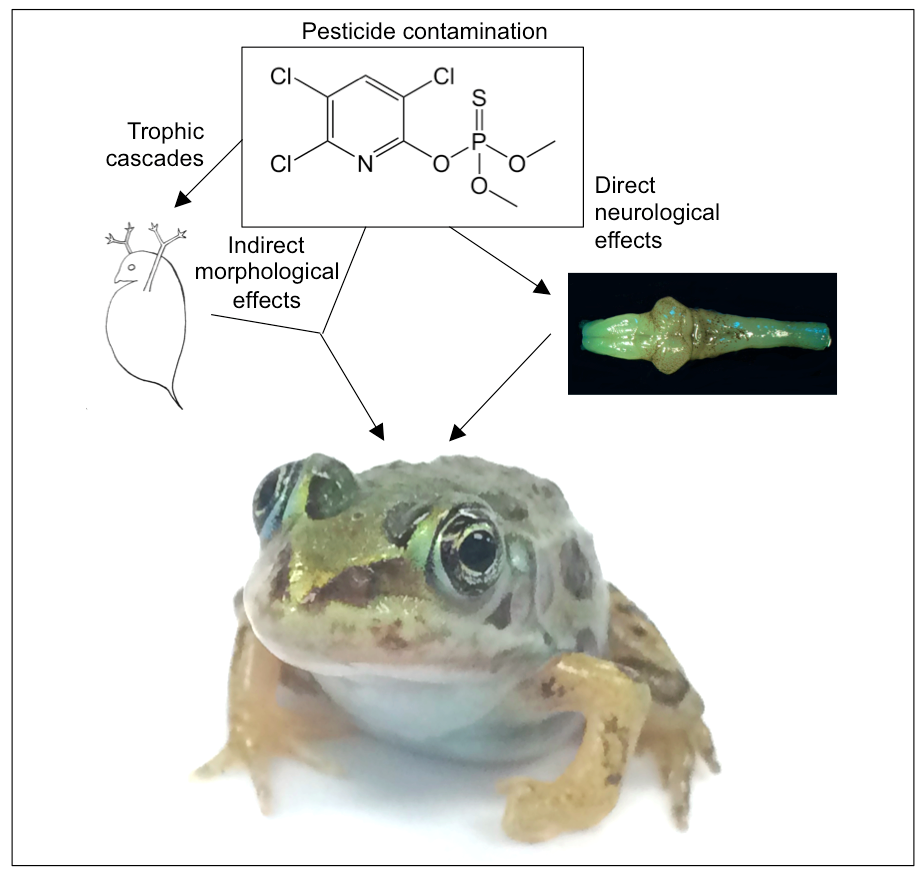
Sara McClelland, a biologist at Duquesne University in Pittsburgh, Pennsylvania, and her colleagues studied the impact of very low doses--1 millionth of a gram per liter of water--of the commonly-used pesticide chlorpyrifos on the brains and bodies of the tadpoles of northern leopard frogs. 

As they reported in the journal Environmental Toxicology and Chemistry, exposure to chlorpyrifos caused significant changes to the tadpoles' brains. Three brain areas were impacted, areas important to vision, hearing, breathing and motor control. Those changes turned out to be independent of the pesticide's effect on the tiny animals the tadpole's feed on.

 "Innocuous" pesticide dose directly impacts vertebrate brain development
Credit: McClelland et al., Environmental Toxicology and Chemistry

"This study demonstrates that exposure to very low, presumably innocuous levels of organophosphorous pesticides can alter neurodevelopment in amphibians," says McClellnd. "Due to developmental similarities in vertebrates, this work may have implications for how exposure to low doses of organophosphorous pesticides could affect human neurodevelopment."

Given that chlorpyrifos is just one of dozens or hundreds of toxins that we are exposed to, more research on their human impacts is urgently needed. As epidemiologist Miguel Porta points out, "Whatever we know, whatever we think we know about the adverse health effects of a given chemical compound, and about the adverse health effects of several different compounds, simply think that it will not be uncommon for them to be--each and all--present at high concentrations in a significant minority of your patients, constituency, citizens, family or friends. And then think about the plausible negative health effects of the combination or 'cocktail' at high and low concentrations."

-----

You can find a link to the Environmental Toxicology and Chemistry study here.

And a recent study linking a "cocktail" of pollutants to impaired fetal growth at this URL.

And click here for another recent study on the impact of toxic cocktails on brain development.

-----

If you enjoyed this post, please subscribe to follow or receive email alerts from zerospinzone.blogspot.com.


Thursday, August 30, 2018

CALIFORNIA POWERS AHEAD IN THE FIGHT AGAINST CLIMATE CHANGE

We need all the good news we can find these days, and California has just handed us a climate-change bouquet.

On August 28, 2018, the legislature passed a bill that requires 100 percent carbon-free electricity in the state by 2045. This massive change in the way power is produced in or imported to California will keep 70 million metric tons of greenhouse gases from being spewed into the atmosphere every year, equivalent to taking 12 million cars off the road.


California Wind Farm
a rapidly growing source of clean power
Credit: Creative Commons Zero; Max Pixel


If Governor Brown signs the bill into law, as expected, California will become the largest economy in the world to commit to 100% carbon neutral electricity before mid-century. (Yes! Governor Brown signed the bill into law on September 10, 2018).

Of course, much more than this is needed for the world to meet the goals of the Paris Climate Agreement and keep global temperatures no more than 1.5 or at most 2.0 degrees C (2.7/3.6 degrees F) above pre-industrial levels. Still, it's a giant step in the right direction, and one that we hope many more states, cities, countries, companies and industries will follow--and the sooner the better.

----------

You can find the text of California Senate Bill 100 here.

Friday, August 24, 2018

SCIENTISTS CAN NOW LINK WEATHER EXTREMES TO CLIMATE CHANGE

Climatologists have traditionally been leery of linking a specific event--an extended drought, an exceptional run of hurricanes, massive flooding--to climate change. The most they could be coaxed to say was something along the lines that climate change might have increased the odds of the extreme event, often with a comparison to rolling loaded dice or to an athlete on steroids.

Recently, however, some researchers have started to be more specific. For example, Frederika Otto, a climate scientist at Oxford University, and her colleagues recently reported that South Africa's three-year mega-drought, during which Cape Town came nerve-wrackingly close to running out of water, was demonstrably three times as likely as it would have been without human-caused climate change.

This new capability goes beyond just pinning down the increased odds of an extreme event. In three cases recently, researchers have felt confident enough to say that certain events simply could not have happened without human climate forcing. These included devastating heatwaves in Asia in 2016, the global heat record set the same year, and shockingly high sea temperatures in the Gulf of Alaska and the Bering Sea between 2014 and 2016. 

A review of 170 similar attribution studies between 2004 and 2018 found that two-thirds of the extreme weather events studied were more likely or more intense because of human caused climate forcing.

 South Africa's Theewaterskloof Reservoir, nearly empty on March 11, 2018
Credit: Zaian

So the question is, what's changed? Why are climate scientists now able to make such specific attributions of the impacts of human-caused climate change?

In principle, the answer is remarkably simple. Researchers use multiple state-of-the-art computerized climate models to run thousands of simulations with slightly different initial conditions. Some of the simulations run with current levels of greenhouse gas levels while others use pre-industrial levels. The researchers can then see how many times a comparable event shows up in each scenario. A drought as long and intense as the one that drained Cape Town's reservoirs to the brink of catastrophe happened three times more often under current atmospheric greenhouse gas levels than in models using pre-industrial levels.

In practice, it's a bit more challenging. The multiple computer simulations that are needed are costly and need a lot of time even on the fastest supercomputers. Otto and her colleagues got around this by tapping into weather@home, a network of thousands of volunteers who offer up time on their computer to help perform these massive calculations. In addition, current climate models are not fine-grained enough to model smaller events, such as a crop-destroying hailstorm or an outburst of tornadoes.

Still, scientists now have what it takes to specify to what extent many extreme events, such as a drought, massive flooding or a killer heat wave, can reliably be attributed to human-caused climate change. We can expect much more frequent, accurate and meaningful reports of this kind in the near future.

These attribution studies are not likely to convince dyed-in-the-wool climate change deniers, but they are already proving helpful to planners at all levels. For example, Helen Davies, with the Western Cape's Department of Economic Development and Tourism, now knows that the devastating drought was not a once-in-a-lifetime event. "This is an incredibly strong message which we cannot afford to ignore. We may need to work on a radically new approach to water management."

Otto hopes that this approach will soon be fast and accurate enough to be linked to extreme weather events in real time. Germany may become one of the first countries to do this on a regular basis. 'It’s part of our mission to illuminate the links between climate and weather,” says Paul Becker, Vice President of the German Weather Agency. “There is demand for that information, there is science to provide it, and we are happy to spread it.”

One example of real-time attribution is the assessment by scientists at the Lawrence Berkeley National Laboratory that Hurricane Florence is 50 miles wider and will inundate the Atlantic Coast with 50 percent more rain than a comparable hurricane before human-caused climate change.

And a new study using the supercomputers at the Lawrence Berkeley National Laboratory was able to detail the additional rainfall provoked by global warming in 15 hurricanes that took place in the last ten years, and predict even more rainfall and more intense winds if warming continues.

Let's hope that the entrenched climate change denial on the part of the current US president and congress does not keep this important emerging science from being used here at home.

---------------

The Nature article from which most of this information comes can be found here.

The article summarizing 170 different studies, including a useful interactive map, can be found at this URL.

------------

If you enjoyed this post, please sign up to follow or to receive email alerts from zerospinzone.


Friday, August 17, 2018

LINK BETWEEN AUTISM AND LONG-BANNED INSECTICIDE DDT

Remember DDT? It's an insecticide that was banned worldwide for most uses more than 30 years ago, but which lingers in the environment and in our bodies to this day. In its heyday, DDT was sprayed massively over farms, forests and cities to control mosquitoes and other insects. I remember as a child swimming in an outdoor pool as a plane flew overhead spraying DDT over the entire city. People accepted it as normal.

We're just now finding out that there's a possible link between DDT and autism, a severe, often disabling developmental disorder estimated to impact more than 25 million people worldwide, and 15 children out of ever thousand in the US (one out of every 42 boys!). Autistic children have difficulties with communication and relating to people, and often repeat certain movements or behaviors such as rocking over and over again.

 Autistic child and his mother
Credit: istock

A long-term study involving over one million mothers and children in Finland found that high levels of DDE--a breakdown product of DDT that ends up in the fatty tissues of animals and humans--in the blood of pregnant women doubled the risk of a child developing autism with intellectual disability. This link remained strong even after controlling for factors such as the mother's age and psychiatric history.

DDT is one of many Persistent Organic Pollutants (POPs), potentially toxic man-made chemical compounds that accumulate in soil, water and air, in the foodchain and in our bodies. Other research has shown that 10 percent of us have high concentrations of 10 or more POPs in our blood, and that high concentrations of POPs in the body are associated with a variety of metabolic abnormalities, including those leading to metabolic syndrome, diabetes and heart disease.

The current research is the first to reveal a link to autism. The authors suspect that DDT and its metabolite DDE may trigger autism because they lead to lower birthweight infants, and by interfering with the proper functioning of androgens, hormones necessary for the development of male characteristics.

"Unfortunately," says Alan Brown, an epidemiologist at Columbia University Medical Center,  "[these chemicals] are still present in the environment and are in our blood and tissues. In pregnant women, they are passed along to the developing fetus. Along with genetic and other environmental factors, our findings suggest that prenatal exposure to the DDT toxin may be a trigger for autism."

Clearly, homing in on the environmental causes of autism can help us find ways to reduce the high and still increasing incidence of this extremely disruptive condition.

-----
If you liked this post, please sign up to follow or receive email notifications from zerospinzone.


Wednesday, August 01, 2018

WILL CLIMATE-CHANGE DENIERS LEARN FROM PERSONAL EXPERIENCE?

Having followed and written about climate change and the science behind it for decades, I've also had to think a lot about climate-change denial. I've come to realize, ruefully, that science, starting with the most basic physics and including the most powerful supercomputer based climate models, has failed to convince many people who, for one reason or another, are wedded to climate-change denial. Neither have appeals to the health and safety of future generations, nor to the plight of the increasing millions of people whose lives are currently being disrupted by climate change (many of whom become the refugees and migrants whom many climate-change deniers fear).

Credit: INICIWEB

Through all that I've clung to the idea that when climate change comes home, as it inevitably will, when residents of Florida find their homes flooded because of rising sea levels, when Midwest corn farmers lose ten percent of their crop to extreme heat, when Texas see-saws between drought and floods, or when, as happened to my home town of Santa Rosa, California last year, wildfire sweeps through like a blowtorch, it can no longer be denied. Surely, I've thought, first-hand, life-changing personal experience will break through those layers of denial.

But I'm starting to realize that my faith in personal experience to slap people awake, like my earlier faith in the persuasive effect of science and empathy, is simply naive.

What brought this home to me was an article in the Guardian based on interviews with people who have been impacted by the deadly Northern California Carr fire, which happened to hit a staunchly conservative, Republican, Trump-supporting and climate-change-denying area. The Guardian reporter had no trouble finding people, from politicians to men and women on the street, whose ideas were unchanged even in the midst of the smoke and embers of this deadly fire. "It's bull," said one respondent. And even the one respondent who accepted that climate change was real clung to the meme that we humans are too puny to deal with it, leaving how to fix the problem in the hands of "the good Lord."

There's more evidence in a Guardian story speaking to residents of North Carolina in the aftermath of Hurricane Florence, which climate scientists tell us was 50 miles wider and dropped 50 percent more rain than it would have under pre-industrial conditions. Once again, the reporter found plenty of people still in full climate-change-denial mode.

Scholars who study the history of science often point out that for a new paradigm such as plate tectonics or quantum dynamics to replace an older set of ideas, the old guard simply have to be replaced by a new generation. If scientists, who after all are committed to experiment, hard data and putting every idea to the test, are unwilling or unable to let go of outmoded ways of thinking, I suppose I shouldn't be surprised if everyday people also refuse to learn, even if the lesson is right in front of their eyes.

 Perhaps young people will see more clearly than their elders
Credit: TAKVER

There's still room for hope, if younger generations realize that climate change is real, dangerous, and, can only be dealt with through concerted action. Perhaps Greta Thunberg can be the role model. She's a 15-year-old Swedish girl who is staying out of school and sitting in front of the Swedish Parliament to bring the urgency of the climate crisis home to her elders. Given the feeble steps we've managed to take to date, young people like her may be our last, best hope.

REA
-------------

Here's a related story involving people who have become committed to the idea that vaccination is some kind of dangerous, evil-minded plot. This couple almost lost their six-year-old son to tetanus, a terrible and potentially deadly disease to which most of us are immune because we've been inoculated against it. Doctors were able to save the boy's life, but only through radical interventions and weeks of intensive care, which racked up a bill of over $800,000. Despite this horrifying experience, the parents refused further vaccinations. It used to be said that there's no force on Earth more powerful than an idea whose time has come. Maybe we need to modify that to reflect that, for many people, there's no force on Earth more powerful than an idea that perfectly matches their preconceived view of the world.

-----

If you enjoyed this post, please sign up to follow or receive email alerts from zerospinzone.

-----