Monday, April 22, 2019

EVEN LIGHT PHYSICAL ACTIVITY KEEPS YOUR BRAIN YOUNG

Here's the bad news: unless you're under 25, your brain is shrinking. The rate of brain loss is slow at first but speeds up gradually over the years. The brain volume of a typical 75 year old is about 15 percent less than it was at its peak. That gradual loss of brain volume goes hand in hand with the decline in memory and other cognitive functions commonly seen as people age.


 All you need is . . . to take a walk
Image source: Creative Commons

The good news is that even light physical activity--getting up, moving around, doing chores, taking a stroll, working standing rather than sitting--slows down brain shrinkage and ageing. A three-year study of more than 2300 men and women found that for every extra hour per day of light physical activity, people's brains measured more than a year younger, and the brains of people who clocked 10,000 or more steps a day were nearly two years younger than those of people who managed fewer than 5,000 steps a day.

The participants in this study were from the second and third generation of the famous Framingham Heart Study, a long term study centered in Framingham, Massachusetts, that has contributed greatly to our understanding of cardiovascular health and disease, diet and exercise. Activity was measured using accelerometers, and brain volume was tracked via MRIs.

These findings are encouraging to the millions of us--75 percent of Americans--who don't manage to meet the official physical activity guidelines of 150 to 300 minutes per week of moderate exercise or 75 minutes per week of vigorous, aerobic exercise. We can protect our brains with less intense activities.

"Every additional hour of light intensity physical activity was associated with higher brain volumes, even among individuals not meeting current Physical Activity-Guidelines," says Nicole Spartano, a researcher at Boston University School of Medicine and lead author of the study. "These data are consistent with the notion that potential benefits of physical activity on brain aging may accrue at a lower, more achievable level of intensity or volume."

The bottom line is that almost any kind or amount of daily exercise, even just an our or so of light physical activity, can give your brain the boost it needs to stay young and fit.

-----

If you enjoyed this post, please sign up to follow or receive email alerts from zerospinzone.


Tuesday, April 16, 2019

AN ARTIFICIAL INTELLIGENCE CAN NOW WRITE BOOKS

A computer just wrote a book. It's not a particularly catchy title--Lithium-Ion Batteries--and the author, a system called Beta Writer, isn't going to win a Pulitzer. However, it is a full-fledged, meaningful and readable book entirely written by a machine--the first but certainly not the last.

Authors watch out--one more "human only" skill bites the dust

If your reaction to this news is along the lines of "what's the big deal," that's understandable. Hardly a day goes by without news that AI has equaled or surpassed us plodding humans at yet another activity once thought to require uniquely human intelligence.

Artificial intelligence systems--let's just call them AIs for short--are now as good as humans at a large and rapidly growing number of tasks, and far superior in some others, including games like chess and Go, mastery of which was once seen as one of the pinnacles of human intelligence, and highly esteemed (and highly paid) skills including sinking basketball three-pointers. This is happening so rapidly and so frequently that most of us don't even notice the next advance.

However, some heavy-duty thinkers including Elon Musk, Bill Gates and Stephen Hawking have been warning us for some time about the potentially existential risks of AI.

Gates, Musk and Hawking are not so much worried about AIs that are better than humans at one particular task or another, but about the emergence of an AI that is smarter and more capable than humans in every area. This kind of entity, they point out, could rapidly design and create an even smarter AI, which in turn could quickly improve on itself, leading to an intelligence explosion that could leave the human race, quite literally, in the dust.

Beta Writer, the system that created Lithium-Ion Batteries is pretty smart. It read thousands of scientific articles, extracted their most important findings, melded together related items, and them summarized them in readable, if technical prose. It produced the kind of comprehensive,  well organized, up-to-the-minute review of a scientific or technical field that until now would have been produced by an expert or a team of experts in a field. As such, it joins the ranks of expert systems that are matching or surpassing humans at increasingly high-level tasks. As an author myself, I can't help but be impressed. However, it's far more limited than the kind of AIs Hawking worried about.

Most researchers working on AI argue that these system, even if increasingly savvy and capable, are on the whole benign, for example helping doctors make accurate diagnoses, providing even amateur investors with high-quality guidance, and making all kinds of complex systems such as air traffic, shipping and product delivery run more smoothly. AIs are now integrated, mostly invisibly, into almost every aspect of our lives, and we rely on them whether we choose to or not. And although they occasionally do destructive things, for example the financial "Flash Crash" of 2010, or the deadly real crashes of  Boeing's 737 Max 8 aircraft, it wasn't because they were too smart or being malicious.

It's extremely difficult to predict when, if ever, an AI will emerge that surpasses humans in all of the areas that we consider important, including a deep understanding of itself and the world, emotional as well as analytic intelligence, creativity and imagination as well as problem solving. However, those who have thought most deeply about this, point out that such an entity may well have values and goals that are very different than ours.

These critics, or prophets, warn that we should be working as hard on "the control problem"--making sure that any emerging super-smart AI has the safety and security of us humans embedded so deeply into its design that it can't decide to act against us--as we are working to make AIs smarter, more capable and more ubiquitous.

All I know is that hundreds or thousands of times more money and talent is being poured into developing smarter, more capable AIs than are being devoted at that boring, but potentially vital control problem.

-----

Earlier posts on AI and its risks:

Google's Alphazero is now scary smart

Advanced artificial intelligence--friend or foe?

-----

If you enjoyed this post, please sign up to follow or receive email alerts from zerospinzone

Wednesday, April 03, 2019

GALAXIES LIKE GRAINS OF SAND--GREAT GRAPHICS GIVE US A BIT OF PERSPECTIVE

Every so often I come across a presentation that makes something I had a vague idea about crystal clear. I invite you to dive into this great piece by Brian Resnick and Javier Xarracina on Vox. It's partly about dark matter, but it uses a series of beautifully done graphics to give us a sense of where the Earth fits into the big picture of the sun, the Milky Way and the hundreds of billions of galaxies in the known universe, all of which are dwarfed in turn by dark matter and dark energy.

 Looking up at the Milky Way--our home galaxy
Credit: Free photos from Pixabay

Please give it a click! You won't be sorry.

And to get a totally different view of the history and immensity of the cosmos, check out this new video zoom out of the depths of the Hubble Legacy Field.

-----

Thanks to British author Brian Aldiss for the striking phrase "galaxies like grains of sand." That was the title of the American edition of a collection of some of his short stories, published in the UK under the title The Canopy of Time

-----

If you liked this post, please sign on to follow or receive email alerts from zerospinzone.

Thursday, March 28, 2019

VIOLENT PEOPLE WITH GUNS KILL / UNIVERSAL BACKGROUND CHECKS SAVE LIVES

Imagine you hold a dial in your hand. Turn it to the left and you reduce the number of people killed in your state every year by 15 percent. Turn it to the right and it will increase the number of people killed by 9 percent. For example, if you live in California, you could save 279 lives with a flick of your wrist (or, if you're of a sociopathic bent, you could add 167 deaths per year). In Texas, you could save 197 people or see an extra 118 killed. In New York, you could prevent 92 homicides or provoke 55 more.

Now, new research by public health specialists at the Boston University School of Public Health and Boston Children's Hospital shows that the 50 state legislatures hold exactly that power.

Community health researcher Michael Siegel and his colleagues performed the first simultaneous controlled statistical study of the relationship between different gun laws and homicides in all 50 states, covering the years 1991 through 2016. Out of many different kinds of gun-related laws they studied, they found that three had powerful positive or negative impacts. Universal background checks preventing convicted violent felons from owning guns produced a 15 percent reduction in overall homicides. Laws blocking people convicted of violent misdemeanors cut the homicide rate by 18 percent. In contrast, "shall issue" laws that prevent authorities from using any discretion in granting concealed-carry permits resulted in a 9 percent higher homicide rate.

The researchers found that states with positive forms of all three laws--universal background checks preventing both felons and people with violent misdemeanors from buying or owning guns, and laws giving authorities the right to deny concealed-carry requests from people deemed risks to themselves or other--benefited from 33 percent lower homicide rates.

 Firearms confiscated from felons, California, 2011

For this study, the researchers excluded deaths from legal interventions (e.g. deaths at the hands of police), accidental firearm deaths and firearm deaths whose intent wasn't determined--in total 4.5 percent of firearm-related deaths. They also controlled statistically for many variables known to impact firearm fatalities, including the racial mix of each state, the percentage of young men between the ages of 15 to 29, and the rate of violent crimes other than homicide, divorce, unemployment and poverty.

They found that limiting dangerous people's access to guns is the most effective legal intervention, saving more lives than, for example, trying to limit the kinds of firearms that are available. Asked to summarize the implications of the study for policy makers, Siegel writes:

"Our research suggests that focusing on the “WHO” (i.e., who has access to firearms) is more impactful than focusing on the WHAT (i.e. what types of firearms are allowed). Based on these findings, the priorities for state policy makers should be: (1) universal background checks; (2) laws that prohibit gun purchase or possession by people with a history of violence (a conviction); and (3) extreme risk protection order laws that provide a mechanism for removing guns from people at high risk of violence to themselves or others."

In 2016, 17,250 people were the victims of homicide in the US. In the 26 years covered by this study, 859,871 people were killed. If I had a dial that could prevent even one death, I'd turn it. Wouldn't you? How about saving 2200 lives in a year? Or 130,000 lives over the next 26 years?

------

You can access the research paper, published in the Journal of General Internal Medicine, at this URL.

You can view earlier zerospinzone posts on gun-related issues at the following links:

stand-your-ground laws 

facts about guns in the US

guns and kids in the US

guns, young people and suicide in the US

New Zealand responds to gun violence

------

A slightly different version of this post appeared on OpEdNews at this URL.

If you enjoyed this post, please sign up to follow or receive email alerts from zerospinzone.


Monday, March 25, 2019

PUTTING THE NUT INTO NUTRITION--ESPECIALLY FOR YOUR BRAIN

This is certainly not the most serious thing I could be writing about, what with the Mueller report finally coming to a fizzling end, Venezuela falling into chaos, the Middle East arguably growing even more explosive, decades of relative restraint on the development and potential use of nuclear weapons being tossed aside by the US and Russia, and, lest we forget, climate change.

Still, a little bit of actually useful information is probably worthy of at least a few moments of your attention.

Here's the snippet of news: If you're over 55 and you eat more than 10 grams (.35 oz or 2 teaspoons) of nuts every day, you're 40 percent more likely to enjoy good thinking and memory than your non-nut-consuming peers.


Can a few peanuts a day keep senility away?
Credit: Aney/Wikimedia

This was the main finding in a study of almost 5000 Chinese seniors. Eating more than 10 grams of nuts every day--mostly peanuts for this study group--boosted cognition by about two-thirds of a point as measured on a 40 point scale. That's equivalent to shaving off two to three years of age.

With a greying population putting millions of people at risk of dementia, any intervention that can slow brain ageing can be of great value to individuals and to society as a whole.

Some people will pay thousands of dollars for surgery to make them look a few years younger. How much is it worth to you to have your brain actually work like it did when you were a few years younger? If the "cost" is munching a few teaspoons of nuts every day, it would seem to be extremely well worth it.

-----

You can reference the research report in the Journal of Nutrition, Health & Ageing here.

-----

If you enjoyed this post, please sign up to follow or receive email alerts from zerospinzone.

Thursday, March 21, 2019

WHAT'S RIGHT WITH THIS PICTURE? NEW ZEALAND RESPONDS TO GUN VIOLENCE

Here in the US, whenever there's a mass shooting we re-enter a futile, paralytic cycle. Gun-control advocates use the tragedy to argue once again for stricter laws. Second-Amendment advocates launch a counter attack, saying "now is not the time." Their supporters in Congress offer "thoughts and prayers." Their critics point out their hypocrisy. Gun-lovers rush to buy more guns. Nothing changes. And, within a few days we endure yet another massacre.

 "This is not New Zealand"
Credit: AP/Vincent Yu

As we know, a week ago New Zealand was shocked when a white racist gunman murdered 50 people at their prayers. The nation united in revulsion. Prime Minister Jacinda Ardern spoke movingly about the victims, vowed never to mention the shooter's name in order to deprive him of the notoriety he sought, and promised to enact stricter gun-control laws and ban semi-automatic weapons entirely as soon as April 11.

Most remarkably, at least some New Zealanders are voluntarily turning their weapons over to the police to be destroyed.

There's a problem. The government responds. People respond. It sounds so sensible. It must feel very good to be part of a functional society and government.

Why not here?

-----

Click here for a more in-depth commentary on this subject.

-----

If you liked this post, please sign up to follow or receive email alerts from zerospinzone.


Thursday, March 14, 2019

CAN ALZHEIMER'S BE ERASED?

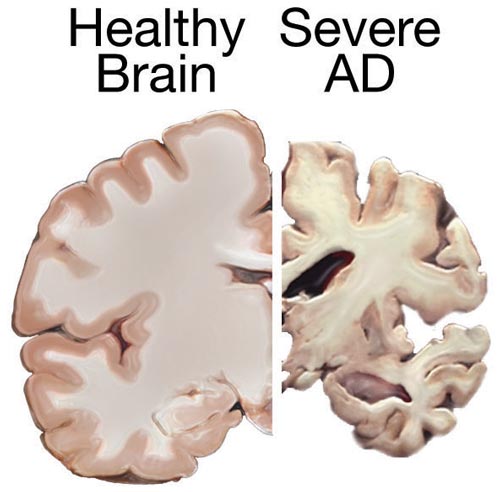
New research in mice has shown for the first time that it's possible to stop the formation of amyloid plaques--one of the key pathological features of Alzheimer's disease--and for the brain to clear them away entirely. This line of research has the potential to lead to medications that can slow, stop, or perhaps even reverse the ravages of this dread, mind-destroying disease.


 Comparison of a healthy brain and a brain with severe Alzheimer's disease
Credit: Wikimedia

As many people know through personal experience with friends or family members, Alzheimer's is an implacably progressive neurodegenerative disease that  robs individuals of their memory, cognitive functions, ability to care for themselves, personalities and, eventually, their lives. It's currently the sixth leading cause of death in the U.S. and, strikingly, ". . . is the only disease in the 10 leading causes of deaths in the United States that cannot be cured, prevented or slowed."

A new study, however, opens up the possibility that Alzheimer's may in fact one day be slowed or prevented, if not cured. Working with mice genetically modified to develop Alzheimer's disease, neuroscientist Riqiang Yan* and his colleagues at the Cleveland Clinic-Lerner Research Institute in Cleveland, Ohio, found that gradually reducing an enzyme called BACE1 blocked the development of amyloid plaques, which are a central part of Alzheimer's pathology.

Although their study was complex and highly technical, the logic behind it is clear. BACE1 is one of two enzymes that snip amyloid precursor protein, or APP, into the shorter pieces that glom together into the plaques that are thought to disrupt and eventually kill neurons. Since BACE1 has important biological functions, removing it early in life or completely creates serious neuro-developmental problems. Still, the researchers reasoned, reducing it gradually in adult mice might slow or stop Alzheimer's without causing unacceptable side effects. That's exactly what they found.

"In our study," says Yan, " we showed that if we delete BACE1 in the adult mice, even after plaque formed, with sequential and increased deletion of BACE1 the plaque was removed. That indicates that if we can get to a patient early enough, it will be beneficial in removing amyloid plaque."

Yan was not surprised to see that lowered levels of BACE1 slowed or stopped the formation of new plaques. He was both surprised and excited to find already existing plaques cleared away--the first time that this has been seen. "To our knowledge," he says, "this is the first observation of such a dramatic reversal of amyloid deposition in any study of Alzheimer’s disease mouse models. We didn't expect the pre-existing plaque would be removed. That was the very interesting part, and warrants additional study to find out why."

While completely blocking BACE1 causes developmental and cognitive problems, a gradual lowering in adult mice appeared appeared safer. Those mice performed better on learning and memory tasks than untreated Alzheimer's prone mice.  However, they still showed some abnormalities in synaptic signalling. Despite this problem, Yan thinks that compounds can be developed that, when applied at the right time and at the right dose, will slow or stop the development of plaques, allow the brain to clear away existing ones, and so keep Alzheimer's at bay.

Prevention is more powerful than treatment

Yan compares this to the enormously successful use of statins to control cholesterol levels enough to block the development of atherosclerosis and heart disease, even though cholesterol has vital functions in the body. "The critical thing is will this lead to some safe drugs?" he asks. "We need to find something very safe like a vitamin that people can take every day without any concerns. Another similarity is to the statins, taking statins to prevent cholesterol from building up. The idea is that prevention is even more powerful that treatment." 

The next step for Yan and colleagues is to track the effects of reduced BACE1 on the mouse brain in more detail and on older mice. "Human patients are typically older than in the mouse model," he explains. "In the mouse model we started to delete [BACE1] at 4 months, which is like 20 years old for people. We now want to delete it in older mice. We need a new mouse model for this later stage."

Robert Vassar is a professor of neurology at Northwestern University, in Illinois, and a pioneer in the study of the role of BACE1 in Alzheimer's disease. He's very supportive of Yan's new findings, and, like Yan, thinks they hold significant promise for Alzheimer's prevention. Vassar too likes the analogy with statins and cardiovascular disease. "You can't turn off the tap of cholesterol, but you can turn it down enough to not accumulate the plaques in the heart that cause heart disease," he says. "It's saved the lives of many people. The BACE1 inhibitors can do the same, if we find the right dose and the right stage of the disease--how much to inhibit and when to treat." 

Vassar and Yan are both aware that years of further research with animals and humans are needed to turn these promising findings into a safe and effective preventative treatment for people. They foresee a long road, but one that urgently needs to be followed. "We have to bold about this disease," says Vassar.  "We're headed for an epidemic of this with the baby boomers, so we've got to do something."

As a baby boomer myself, I couldn't agree more!

-----

You can access Yan and his colleagues' full research paper here.

-----

*Professor Yan is currently Chair of the Department of Neuroscience and William Beecher Scoville Professor in Neuroscience at the University of Connecticut, in Farmington, Connecticut.

-----

If you enjoyed this post, please sign up to follow or receive email alerts from zerospinzone

-----


TK


TK


Sunday, March 03, 2019

DONALD TRUMP CHANNELS JOSEPH MCCARTHY

Joseph McCarthy, February 9, 1950:

"I have here in my hand a list of 205 that were made known to the Secretary of State as being members of the Communist Party and who nevertheless are still working and shaping policy in the State Department.

Credit: Getty Images

Donald Trump, March 2, 2019:

"We have people in Congress right now that hate our country. And you know that. And we can name every one of them if they want."

 Trump at CPAC 2019
Credit: Rolling Stone


-----

If you liked the post, please sign up to follow or receive email alerts from zerospinzone.


Thursday, February 28, 2019

LONG-SUFFERING LAKE ERIE GAINS PERSONHOOD RIGHTS

Just a quick link to a lovely piece of news from Toledo, Ohio. After decades of watching the waters of Lake Erie become more polluted, and after a series of devastating toxic algae blooms, the citizens of Toledo overwhelmingly voted for the Lake Erie Bill of Rights. The new law grants Lake Erie many of the legal rights of a person or corporation, and allows citizens or the city to act as the lake's legal guardians, and sue or take other legal actions to protect it.

Lake Erie toxic algae bloom
Credit: NASA/Landsat
The city of Toledo joins a small but growing growing number of governments that have granted personhood rights to natural features such as lakes and rivers. You can read a previous blog post about similar actions in New Zealand, India and Columbia here.

And you can read about an effort by a group of philosophers and scientists to draft a declaration on the rights of water. You read that correctly; not only the right of people to have access to water, but the rights of water itself.

-----

For other local legal action against unchecked pollution, check out this news from Exeter, NH.

And for an entire nation--Sweden--getting ready to give nature constitutional rights, click here.

If you enjoyed this post, please sign up to follow or receive email alerts from zerospinzone.

Sunday, February 10, 2019

GUNS, YOUNG PEOPLE AND SUICIDE

Last year, nearly 40,000 people died in the U.S. from the use of firearms. Among those deaths, roughly 60 percent were suicides. And among those were more than 1000 young people between the ages of 10 and 19; nearly three children or teenagers every day.

As a quick internet search will show you, there's a lot of information available to parents, teachers and other concerned people about how to reduce the risk that a child will commit suicide. Unfortunately, many of these well-meaning and supposedly authoritative sources gloss over or fail even to mention the single biggest step to take to reduce the number of suicides by young people.

That step is--get guns out of their homes.

Young people and guns--a lethal combination
Credit: publicdomainpictures.net

New research from the Boston School of Public Health (BUSPH) shows that on a state-by-state basis, every ten percent increase in gun ownership increases the youth suicide rate by 27 percent. That means that young people in states like Alaska, with the highest rate of gun ownership, were five times more likely to kill themselves than young people in states like New Jersey with the lowest percentage of guns in homes.

The rate of gun ownership varies greatly from state to state. The 10 states with the highest rates averaged more than one gun for every two households (52.5%), while the 10 states with the lowest gun ownership averaged just one gun per every five households.

Remarkably, gun ownership outweighed every other factor--poverty, race, educational levels, family structure, mental illness, drug and alcohol use, you name it--contributing to youth suicide. "This study demonstrates that the strongest single predictor of a state's youth suicide rate is the prevalence of household gun ownership in that state," says Michael Siegel, a community health researcher at BUSPH and the study's co-author.

The bottom line is clear. If you want to reduce the number of children and teenagers who kill themselves, the first and most significant thing to do is to get guns out of their homes.

-----

You can find the full study here.

-----

Young people in the U.S. are far more at risk from gun-related violence of all kinds than youth in other countries. You can read a zerospinzone post about that here.

-----

If you enjoyed this post, please sign up to follow or receive email notifications of new posts from zerospinzone.


Friday, February 01, 2019

SELF AWARE ARTIFICIAL INTELLIGENCE? COMING SOON TO A ROBOT NEAR YOU

"Open the pod bay doors, HAL."
"I'm sorry, Dave. I'm afraid I can't do that."

This classic exchange from Stanley Kubrick's masterpiece, 2001: A Space Odyssey, epitomizes the risks of a self-aware artificial intelligence.

 Looking through the eye of HAL 9000
a scene from 2001: A Space Odyssey
Credit: Wikimedia

 People who tell us not to worry about the existential threat of super-smart artificial intelligence or Artificial General Intelligence (AGI) often argue that however brilliant AI agents--such as deep learning programs or autonomous robots--become at specific tasks, they'll inevitably lack the general, all-purpose kind of intelligence  humans have. Without that high-level understanding of oneself, the world, and one's place in it, those soothing voices say, AI is and will remain a safe and helpful technology; just another tool like a laptop or a smartphone.

I'd like to believe in the lovely AI-enhanced future AI enthusiasts envision, but I keep coming across flaws in their shiny picture. One, that just came to my attention today, is that robots are becoming self aware. That brings them one step closer to becoming truly autonomous agents, not just eager-to-please tools with a Swiss-Army-knife-full of potentially superhuman skills, but entities with minds and goals of their own, like HAL.

 Robot arm with developing self image overlay
Credit: Robert Kwiatkowski/Columbia Engineering

The latest research along this line comes from Hod Lipson, director of the Creative Machines Lab at Columbia University and graduate student Robert Kwiatkowski. They built an articulated robot arm with four degrees of freedom, allowing it to rotate, bend and grasp in a huge number of different ways. The arm was controlled by a deep-learning computer network. Deep learning networks mimic the human brain in being able to learn from experience, and are the basis of many of today's most powerful AI applications, such as Google's AlphaZero, which in the course of just one day of "play" became the world champion in chess, Shogi and Go.

Initially the arm's deep learning network--in effect its brain--had no idea of the size, shape or structure of the arm, nor of the ways it could move. However, much like a baby babbling as it learns to speak, the system made thousands of random motions from which it gradually created an accurate internal model of itself. What looks like a distorted shadow in the picture above is an overlay of the arm's model of itself early in its learning process. After 35 hours of practice, the system developed a very accurate self model. In the picture below, you can see how closely the shadowy overlay tracks the actual arm.


Robot arm with nearly perfect self image
Credit Kwiatkowski et al.

 You can watch a video of the robot "babbling" in order to create its self image at: https://www.youtube.com/watch?v=FHisJi3ZBeo.

Once the robot arm's brain had an accurate self image, it could very quickly learn how to perform any number of specific tasks. In the video above, you can watch the arm pick up balls and place them in a container, and also print words.

And, much like a person learning to perform a familiar task under unusual circumstances, for example eating with one arm in a cast, the robot rapidly modified its self image when the experimenters substituted a longer, bent piece for one segment of the arm.

Until now, the authors explain, human programmers had to spell out a robot's size, shape, and potential movements in order for it to function. “But if we want robots to become independent, to adapt quickly to scenarios unforeseen by their creators," says Lipson, "then it’s essential that they learn to simulate themselves."

The researchers also suspect that having a self image able to plan and execute a multiplicity of tasks may represent a crucial step in human development. "We believe that this separation of self and task may also have been the origin of self awareness in humans," they write.

It may seem like a long way from a robot arm generating an accurate self image to a high-functioning, seemingly self aware AI like HAL. However, the pace of development in AI is dazzlingly fast and only getting faster. It may not take many iterations before Siri or your Google Assistant isn't just a chatty interface with an amazing collection of knowledge and skills, but a self aware entity, potentially with a mind of its own.

-----

You can read the paper by Lipson and Kwiatkowsky  here.

For a more in-depth assessment of the risks of AI, here's a recent report.

And for an earlier zerospinzone commentary on the subject, click here.

-----

If you enjoyed this post, please sign up for email alerts of new zerospinzone postings.


ZERO POLIO CASES SO FAR THIS YEAR!

Followers of Zerospinzone know that I've been following the worldwide effort to eradicate polio, a disease that killed or paralyzed 350,000 children per year not long ago. Since the Global Polio Eradication Initiative (GPEI) was launched in 1988, polio has been wiped out in country after country and continent after continent. The wild polio virus now hangs on in only a few countries such as Pakistan, Afghanistan and Nigeria.

The good news is that in the first month of 2019 exactly zero cases of polio were reported. Not a single child fell ill with this once terrifying and deadly scourge. What a great achievement!

Polio virus--it may soon exist only in a few super-secure laboratories


This doesn't yet mean that the virus has been completely eradicated. It may still lurk undetected in a few countries, and there's a very small but real risk that the attenuated virus used for oral inoculations can mutate in some individuals and cause cases of the disease. This complicates the polio end-game, during which at-risk populations may need to receive injections of a vaccine that uses killed virus particles, a costlier and more difficult undertaking.

However, this month with no polio cases tells us that the decades-long worldwide campaign to eradicate polio is closing in on its goal.

The apparently growing number of parents who are choosing not to have their children vaccinated might give a moment's thought to the 1950s, when polio paralyzed 15,000 children per year in the U.S. alone, and smallpox disfigured or killed an estimated 50 million people every year. A massive, worldwide effort similar to the current battle to eradicate polio succeeded brilliantly; the last case of smallpox occurred in 1979. Had anti-vaccination sentiment and propaganda been as strong then as now, millions of people would have been disfigured, paralyzed, or would have died needlessly.

-----

Seventy people, most of them children, have died from measles in the Philippines just in the past month. Every one of those deaths was preventable.

-----

If you enjoyed this post, please sign up for email alerts or to follow zerospinzone.

Friday, January 04, 2019

A NEW YEAR'S GOAL--TRYING TO FIND THE TRUTH IN A FOG OF LIES

One of the central challenges at this moment in history is homing in on the truth in the midst of a tumult of half truths, false news, spin-doctoring, propaganda, weaponized disinformation and outright lies.

Two recent events brought this home to me.

The first is the subject of my previous blog, "The big picture--the history, size, shape and shape of Russian disinformation." The New York Times video that I summarized in that post demonstrates that "Russiagate," Russia's use of stolen and leaked documents, troll farms and social media to stir up discord and influence the 2016 presidential election, is just the very sharp tip of a huge iceberg of "active measures" or disinformation dating back to the Soviet Union during the depths of the Cold War and continuing today. In addition to tilting the electoral balance and  likely handing the presidency to Trump, in personal and practical terms, this ongoing, multi-decade campaign means that almost any piece of news or information one comes across may truly be "fake news"--a targeted distortion or flat-out lie perhaps cunningly wrapped around a bit of truth to make it more palatable.

If you haven't seen the video, please click here and take the time to view it.

The second eye-opener came from the rapidly advancing field of artificial intelligence (AI). The high-tech company NVIDIA, which specializes in graphic processing, has perfected a neural network that generates convincing portraits of people who've never existed.* Here's an example:


Add to this Google Assistant's natural voice and speech and so-called "deep fake" videos like the one that seamlessly melded Scarlett Johansson's face to a porn star's body and you realize that in the immediate future we may be watching or reading about absolutely convincing videos of events that didn't take place, seeing politicians saying things they would never say, and witnessing public figures (or our next-door neighbors, friends or family members) saying and doing things they never did.

In other words, as hard is it is today to try to figure out if a news story is factual or an analytic or opinion piece is at least fact-based, telling truth from lies is going to get a lot, lot harder, and soon.

There's a famous quote of uncertain origin--"A lie can travel halfway around the world before the truth can get its boots on." I think many of us would agree that recent history provides convincing vindication of the idea. The quote, however, needs to be updated in this age of the internet, 24-7 news cycles, social media and individually-tailored feeds of news, ads and come-ons. Perhaps a more up-to-the-minute version would read, "A swarm of lies can go viral and encircle the globe in minutes or hours, drowning out the truth completely."

I think it's vital to realize that it's not just other people who are the targets and victims of manipulation, disinformation and increasingly sophisticated fake news; it's all of us. Whether you're on the right receiving the latest reason to "lock her up" or on the left hearing about ICE's latest outrage at the border, an evangelical hearing that God has hand-picked Trump to save the US or a non-believer being provoked by the same story, we all need to realize that, like geese being fattened to make foie gras, we're being force-fed a diet that suits someone else's agenda, but is almost certainly not in our own best interest.

As FACEBOOK is discovering now that it belatedly tries to cut down on hate speech and disinformation, highly charged, sensational posts are the ones that generate clicks (and revenue). "As content gets closer to the line of what is prohibited by our community standards," says CEO Mark Zuckerberg, "we see people tend to engage with it more." And as their army of 20,000 fact checkers and content reviewers is finding out, making this kind of call is extremely hard. To get a sense of the size of this problem, Facebook says that it deleted 1.5 billion accounts between June and November of last year, and WhatsApp says it's deleting 2 million accounts every month to try to stop the flow of fake news.

I don't pretend to have a formula, an algorithm, or even much of a clue how to determine if what I'm reading or viewing online is truth or lies, meaningful argument or weaponized propaganda, especially as the purveyors of disinformation get more and more sophisticated and have more and more powerful tools at their disposal.

My alarm bells go off if a story seems too good to be true, or too bad--meaning that it too neatly confirms my preconceived views. In that case it probably is the information equivalent of junk food.  And I'm determined to tune out pretty much anything that tries to bypass my brain and push emotional buttons--communications using terms such as "urgent," "crisis," "demand," "decimate," or  "eviscerate" (button-pushers I found in just one page of emails). 

No doubt these steps are just a start, but given how toxic a diet of lies can be, I'm determined to up my game. What about you?

------------

*As with all things digital, the rate of progress in this area is astonishing. As of 9/20/19, a company is now offering a collection of 100,000 convincing computer-generated faces online, for free, for any use.


xx

Saturday, December 29, 2018

THE BIG PICTURE-THE HISTORY, SIZE, SHAPE AND IMPACT OF RUSSIAN DISINFORMATION

If you're like me, every so often you come across something--an idea, a talk, an event--that ties all kinds of things together and makes them perfectly clear. This 47-minute video from the New York Times entitled Operation InfeKtion did that for me, putting the drip-by-drip revelations about Russian intervention to divide the US and help elect Trump into the context of Russia's, and before that the Soviet Union's multi-decade practice and perfection of the art of disinformation.


Remember Pizzagate?
Just one of many disruptive interventions. 
Photo credit: Blink O'fanay
 

I don't usually take the time to watch videos, but this very clear, well researched and well made piece from the Times was worth every minute. If you want to understand the origin, goals, scope and sophistication of Russia's disinformation apparatus, and how that all came together to stir up confusion and division among Amerians, denigrate Hillary Clinton and boost Trump, click here and watch the video. As I post this piece, the video has been watched by just 145,000 people. It needs to be seen by 145,000,000.

As many commentators have pointed out, the US is far from innocent when it comes to intervening in other nation's elections and internal affairs. Just note the 800 military bases that the US maintains in some 70 countries. However, that fact doesn't relieve us of the responsibility to understand what has been and is still being done to us by a very skillful, practiced and determined adversary, or to at least start to learn how to counter it.

The report reverse-engineers seven key ingredients to a successful disinformation campaign. Once you've seen the list, you'll start to see them everywhere, contributing to the miasma of misinformation and disinformation that we are immersed in. Here they are:

1. Find the cracks in the targeted society.
2. Create a big, dramatic, emotionally charged lie.
3. Wrap that lie around a kernel of truth.
4. Conceal your hand.
5. Find some "useful idiots" to back it up or propagate it.
6. If you're exposed, deny, deny, deny.
7. Play the long game.

To which I would add, in this era of social media, "Repeat, repeat, repeat on as many platforms as possible."

Russia's "meddling" in our 2016 elections may have been their most successful disinformation program, but this documentary shows that it was far from their first, and will not be the last.

-----
If you liked this comment, please sign up to follow or receive email alerts from zerospinzone.blogspot.com.


Monday, December 17, 2018

REMARKABLE 15-YEAR-OLD GRETA THUNBERG SPEAKS TRUTH ABOUT CLIMATE

You may have heard about Greta Thunberg, the 15-year-old Swedish student who made headlines worldwide by skipping school for a month to demand action on climate change by camping out on the steps of the Swedish parliament.

Greta Thunberg and friends
on strike for climate action
Credit: Marc Fermenia

If you haven't heard her remarkable speech at the plenary session of the UN Climate Summit at Katowice, Poland, you need to. Every word rings true, and should make anyone who is not already acting to save the planet get moving now. What an amazing young person--she's like an old-testament prophet in the body of a 15-year-old girl.

You can see her speech here.  Please watch it. Every sentence hits home.

And here's a brief video she made to be played at the Davos meeting of the rich and powerful.

If you need more convincing, you can read more about the importance of her speech at Grist.

And to learn a bit more about this amazing young person, please view her TED talk here

And her talk to the British Houses of Parliament: You Did Not Act in Time.

-------

3/14/19: Just before tomorrow's global youth manifestation for climate action, Ms. Thunberg has been nominated for the Nobel Peace Prize. What an amazing young person!


Saturday, November 24, 2018

BREAK POINT


The swift rise and rapid collapse of McCarthyism more than sixty years ago offers evidence and a relatively recent example of the capacity of American society and democratic institutions to recover from the paralyzing sway the politics of fear, xenophobia, ethnic division and subversion can temporarily hold over the body politic.

Donald Trump and Joseph McCarthy
Credit: NYMag.com

Surfacing during eras of extreme cultural stress, and highly dependent on the symbolic appeal of simplistic purifying or redemptive solutions targeting infectious ‘alien’ agents—the Red Menace in the ‘50s or terrorist Muslims and Central American caravans today-- such movements rely on two basic ingredients. First, a heightened fear that ‘enemies’ have penetrated the nation’s porous borders, taking advantage of our over-tolerant institutions; and second the powerful appeal of a self-appointed charismatic leader willing to transcending normal institutional limits in order to protect the vulnerable homeland and root out by any means necessary subversive elements within and without.

There have been previous outbreaks of what historian Richard Hofstadter first described as the “Paranoid Style” in American politics. But the infectious America First nationalism and anti immigrant fear-mongering of Donald Trump today has only one major parallel: the fierce anti-communist witch-hunt fanned to a fever pitch by the Junior Senator from Wisconsin, Joseph McCarthy, in the early 1950’s. Though different in scope and scale, both McCarthyism and Trumpism share a common script, and, if history is any guide, contain similar seeds leading to their own ultimate devolution and destruction.

McCarthy was late to recognize but quick to exploit the enormous potential and power that extreme and undocumented charges against ‘elite’ government officials could bring at a critically unsettling moment in the early Cold War. Aided and enabled by ambitious politicians, credulous reporters and officials like FBI Director J. Edgar Hoover willing to use the Senator for their own purposes, McCarthy was suddenly elevated to a position where even the threat of his investigations could silence or destroy powerful individuals and institutions at every level of government and society. Even without Trump’s enormous degree of institutional authority, McCarthy’s assumed power, for a time, seemed unlimited.

Though initially challenged by a few members of his own party who recognized the danger he posed to constitutional freedoms, and later, publicly, by media figures such as the respected broadcaster, Edward R. Murrow, it was, importantly, McCarthy himself whose continuing excesses brought him down.

Legal decisions ultimately prevented some of his most extreme actions, though not before thousands of individuals had their careers and lives destroyed by mere threats or charges. Exposed to a national audience during the televised Army-McCarthy hearings, McCarthy and his counsel Roy Cohn’s bullying misuse of power, prompting the famous line uttered by Attorney Joseph Welch: “Senator, have you at last no decency left?” exposed him for the demagogue he was.

Once the spell was broken, the air went rapidly out of the balloon. Public approval diminished; previous supporters backed away from the spectacle. McCarthy’s political power in congress soon evaporated, and though in some cases it took decades, individuals and institutions McCarthy had attacked could begin to respond and rebuild.

We don’t know yet how many insulted American heroes, generals or admirals it will take, or how many humiliated or berated intelligence agents, or agencies. Nor how many ignorant and un-empathetic comments about the Puerto Rican hurricane, synagogue shooting or Californian fire victims.
How many juvenile or vile name-calling tweets belittling basketball players, commentators or political critics it will take to break the spell. But the spell will break. Indecency has its limits!

On the political side, the scale of the country’s growing repudiation of Trumpism is becoming increasingly evident as final vote counts in various regions confirm the strength of an actual ‘blue wave’ in national and state elections. Where Trump’s acolytes and enablers did win, their victories were hard-fought and far narrower than expected, often dependent on deliberate techniques of voter suppression and political gerrymandering. Denied or not, rising blue tides do indicate gradually melting poles of support.

True to form, and much like that of the earlier demagogue, the President’s immediate response was to attack: first by deriding losing candidates who had not sought his blessing; then by firing the Attorney General whom he had long blamed and demeaned for not sufficiently protecting him from the Mueller investigation, and then by appointing a strong supporter who would do so. Attempting to reassure his base, Mr. Trump then reignited his war with the fake news media, berating African American reporters at his first full news conference and then banning an assertive CNN reporter who insisted on asking difficult questions.

As vote counts tightened, he was quick to charge election officials with fraud, whipping up resentment and public passion against nameless ‘enemies’ as well as against the legitimate mechanisms of democratic governance. Most recently, in attacking a Federal Appeals Court ruling against his asylum policies, he incurred an unheard of rebuke by the Chief Justice of the Supreme Court who defined the independence of the Judicial System as a critical feature of American democracy countering the President’s attack by saying “there are no Obama judges, or Bush or Clinton judges…..”

Continual exposure to a Chief Executive whose authoritarian tendencies, willingness to incite violent passions, compulsion to lie, lack of empathy towards minorities, asylum-seekers, victims of natural disasters—and even homeless children-- and vindictiveness toward those in the press or public who dare to question his policies and behavior, appears to have begun to awaken a significant portion of the public, among them former supporters.

We may not know yet whether the “spell” has fully been broken, or where the  break point actually is, but it is clear politically that his self-inflated balloon has sprung leaks. Attacks on old ‘enemies’ (Hillary, ‘fake news’ media, congressional opponents, proponents of climate change, NATO allies) will go on, as well, but have passed their sell-by date. Those, and even newer threats like the ‘invasion’ of legitimate asylum-seekers from Central America may no longer serve to patch the increasingly visible holes. Failed tax policies, disruptive tariff wars and unexpected foreign events emanating from the Middle East—as well as the fallout from the Mueller investigation—may well complete the process.

Just as McCarthy’s rampage weakened democratic institutions at home while endangering America’s standing abroad, Trump’s embrace of authoritarian leaders and murderous tyrants can only undermine any remaining sense of America’s moral capacity to guide international affairs in a positive direction.

Yet, cultural and institutional limits to coarse, brutal and amoral practices in the name of public welfare do exist, and if modern American history is any guide, there is a point when ‘fevers’ (political or otherwise) do break. The question then is how basically healthy bodies can slowly recover and rebuild, and how much lasting damage has been done.

Les Adler

-----

You can also view this post on OpEdNews

-----

If you liked this commentary, please subscribe to or sign up for email alerts from zerospinzone.blogspot.com.


Sunday, November 18, 2018

A MUST-READ ARTICLE ABOUT CLIMATE AND OUR FUTURE

A friend alerted me to a superb and extremely sobering article by Bill McKibben in the November 26, 2018 edition of the New Yorker. Entitled "How Extreme Weather is Shrinking the Planet," the piece lays out in detail the depth of the climate crisis we're in, and how we got here with the help of Exxon, the Koch brothers, Rex Tillerson and decades of dithering or deluded politicians. 

McKibben offers a ray of hope, if we the people, worldwide, can come together and fight against disinformation and special interests for our own survival and the survival of the biosphere that supports us.

The future is here--Southern California wildfire
Credit: FEMA